
What Happens During Water Softener Installation in Garner, NC?
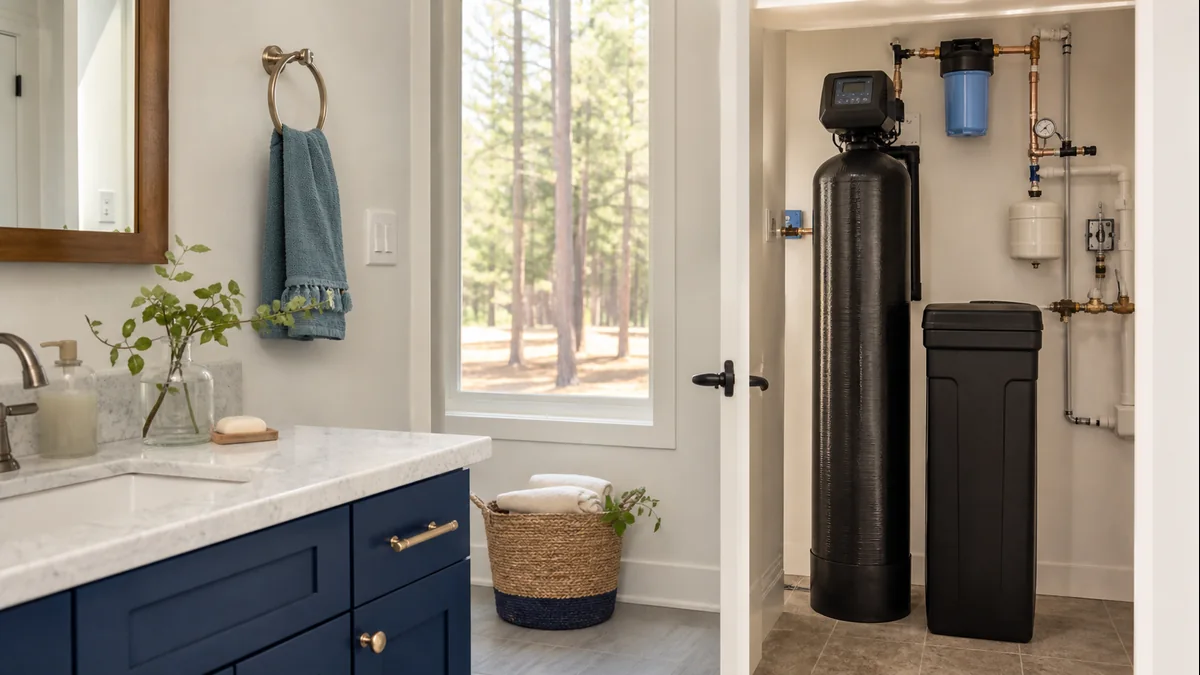
Direct answer: Installation day in Garner starts with a site walk and a water test, then the all-in-one system — softening resin and carbon filtration in one unit — ties into the main line near where it enters your house, with a bypass so the household can still run water during service. Garner administers its own plumbing permit for the work, and a licensed installer pulls it and schedules the inspection as part of the job, not something you have to sort out yourself.
What Does Water Softener Installation Actually Involve in Garner?
It's a plumbing tie-in where your main water line enters the house, done by a licensed installer, covered by a local plumbing permit. A whole-home system isn't a plug-in appliance — it sits in the path of every gallon of water your house uses, which is why the work is treated as plumbing contracting under North Carolina law. The general sequence is the same across the service area: a site walk and water test, placement of the all-in-one unit near the main line's entry point, a bypass connection so the system can be serviced without shutting off the whole house, a drain line for regeneration discharge, the permit and inspection, and a startup walkthrough. The exact layout — garage, crawlspace, basement, or utility closet — depends on your house, and that's confirmed at the site walk, not guessed at over the phone.
Does Garner Require a Permit for a Whole-Home Water System?
Yes. Garner administers its own plumbing permits rather than routing through Wake County Permits & Inspections, but the underlying requirement is the same one that applies regionwide: a whole-home installation ties into the main water supply, which makes it plumbing work, and plumbing work needs a permit. Wake County's own permitting office — which covers unincorporated Wake County plus Rolesville, Wendell, Knightdale, and Zebulon, not Garner — puts the general principle plainly: "A plumbing permit is required for the installation, extension, relocation, replacement or general repair of any plumbing system." Garner's own office applies that same reasoning inside town limits, so a whole-home system still gets permitted and inspected — just through Garner rather than the county.
Who Actually Pulls the Permit — Me or the Installer?
Your installer does. Under N.C. Gen. Stat. § 87-21, installing a whole-house water treatment system is defined as plumbing contracting work, which is why the job goes to a licensed plumbing contractor rather than being treated as a DIY appliance swap. Filing with Garner's permitting office and scheduling the inspection is a normal step in the job — you're not expected to track down which office covers your address or file the paperwork yourself.
What Happens on Installation Day, Step by Step?
| Step | What it involves |
|---|---|
| Site walk and water test | The installer looks at your plumbing layout and where the main line enters the house, and tests your water to see where your address falls |
| Placement | The all-in-one unit is positioned on the incoming main, near the entry point — garage, crawlspace, basement, or utility closet, depending on your home |
| Bypass tie-in | A bypass connection lets the household run water around the system if it ever needs service, without shutting off the whole house |
| Drain connection | A drain line is run for the softening side's regeneration discharge |
| Permit and inspection | The installer files with Garner's permitting office and schedules the inspection as part of the job |
| Startup and walkthrough | The system is brought online, checked for leaks and normal pressure, and you're walked through the basics |
That order holds for most Garner homes on city water. What varies is the specifics inside each step — where the main line enters, how much room there is to work with, whether the drain connection needs extra routing — and that's what the site walk exists to catch before install day, not on it.
How Long Will My House Be Without Water During Installation?
It depends on your home's plumbing layout, and that's confirmed at the site walk rather than quoted as a fixed number up front. How accessible the main line is, whether the entry point is easy to reach, and what else is tied into that section of plumbing all change how long water is off. Your installer will tell you what to expect once they've actually seen your house, and a good one flags anything unusual — an older system, a tight crawlspace, an odd point of entry — before install day rather than as a surprise partway through it.
Is Garner's Water Actually Hard Enough to Need This?
Enough to matter, even though it isn't in the "hard" band on the industry scale. Garner is served by Raleigh Water — the same utility that supplies Raleigh, Knightdale, Rolesville, Wake Forest, Wendell, and Zebulon — sourced from Falls Lake, which comes in at roughly 1.6 gpg. On the Water Quality Association scale the Hach Total Hardness Test Kit, Model 5-B, uses, that's classified "slightly hard," not "hard" (that band starts at 7 gpg) and not soft either. Triangle Waterworks' own testing across the service area measures 1.6 to 3.7 gpg by ZIP code — slightly hard at the low end, moderately hard at the top — which is why a system gets sized from a test at your specific address rather than pulled off a catalogue.
Garner's housing stock is a mix of older established neighborhoods and newer subdivisions, and that age spread is a fair, practical thing to factor in: an older home has simply logged more years of the same calcium and magnesium passing through its pipes, water heater, and fixtures than a house built more recently. That's not a reason to worry — it's a reason to test rather than guess where your address actually falls in that range.
What About Chlorine Taste and Disinfection Byproducts?
That's a separate issue from hardness, handled by a different half of the same system. Raleigh Water — Garner's supply — normally disinfects with chloramine, which the City describes as having no taste or odor associated with it. Once a year, on the N.C. Department of Environmental Quality's recommendation, it converts to free chlorine only and flushes the distribution system; chlorine residual runs higher system-wide, and the flush can cause temporary discoloration. Timing shifts year to year, so check the City's own announcement rather than a fixed date.
Raleigh Water also carries documented disinfection byproducts: HAA9 at 19.9 ppb and TTHM at 21.7 ppb, both compliant with EPA limits. EWG's guidelines are a separate, stricter, non-regulatory health benchmark, not a violation — the two shouldn't be conflated. Softening resin does nothing about any of this; it's ion exchange for calcium and magnesium only. That's why the system installed in Garner pairs softening with a carbon stage in one unit, addressing the mineral side and the taste/byproduct side at once.
Because both stages live in one unit, the permit, the tie-in, and the install-day sequence are the same whether the system is handling calcium and magnesium, chlorine taste, or both — there's no separate second installation to schedule for the carbon side.
What Happens After the System Is Installed?
Once the system is tied in, the installer brings it online, checks for leaks, confirms pressure is normal throughout the house, and walks you through the basics — how regeneration works and where your paperwork lives. The Garner permitting office's inspection is scheduled as part of the same process your installer already manages. From there, the system runs automatically in the background; you notice it in the water itself, not in ongoing maintenance calls.
Pricing depends on your home's plumbing and where your address falls in the 1.6–3.7 gpg range, which is why it isn't published here — a system gets sized and quoted after a free water analysis. For comparison, national big-brand installers commonly quote $6,000 to $12,000 for whole-home coverage.
For more on what Garner's water carries and how it's treated, see water treatment in Garner, NC. For the source numbers behind Raleigh Water's hardness reading, see Raleigh water hardness, and for how to read your own water utility's report, see how to read your water quality report in Garner. For what softened water changes day to day, see soft water and laundry in Garner. If you're comparing how permitting works just outside town limits, does Wake County require a permit for water softener installation covers the county-run process.
Frequently Asked Questions
I just moved to a newer subdivision in Garner and figured newer plumbing meant I didn't need to worry about this yet — is that right? Newer plumbing doesn't change what's in the water, only how long it's been exposed. Garner runs on Raleigh Water at roughly 1.6 to 3.7 gpg by ZIP, so a newer home still has calcium, magnesium, chlorine taste, and disinfection byproducts to deal with — it just hasn't accumulated as many years of buildup as an older house nearby.
My house is older and I'm worried the plumbing is too outdated for a modern system to tie in cleanly — is that something I should bring up before scheduling? Yes, and it's exactly what the site walk is for. A licensed installer looks at your specific plumbing layout, entry point, and any older piping before install day and plans the tie-in around what your house actually has, rather than assuming a standard setup and running into it partway through the job.
Does Garner really handle its own permits, or does that go through Wake County like some nearby towns? Garner administers its own plumbing permits. Wake County Permits & Inspections covers unincorporated Wake County plus Rolesville, Wendell, Knightdale, and Zebulon — Garner isn't one of those four, so your installer files with Garner's own permitting office instead of the county's.
Do I need to be home for the whole installation? Most installers ask that someone be available to grant access to the water line and be walked through the system once installation is finished. Confirm the arrival window and access needed directly with your installer when you schedule.
Can I add carbon filtration later if I already have a stand-alone softener, or does it have to go in as one combined system? That depends on your existing setup and plumbing layout, which varies enough house to house that it's worth a direct look rather than a general answer. A free water analysis is the way to find out what's realistic for your system.
Will the inspection hold up my move-in date or any other plumbing work at the house? The permit and inspection are built into how a licensed installer schedules the job, not tacked on as a separate wait afterward. Your installer handles filing and inspection coordination directly with Garner's permitting office, so it's managed alongside the rest of the installation.
See What Installation Looks Like for Your Garner Home
Take the 60-second water quiz to see how an all-in-one softening-and-carbon system fits your household, or book a free water analysis to find out exactly where your Garner address falls in the 1.6–3.7 gpg range and what installation day will actually look like at your house.
Answer nine practical questions, then request a written quote or well-water analysis.
Start My Water Analysis