
What to Expect From Water Softener Installation in Raleigh, NC
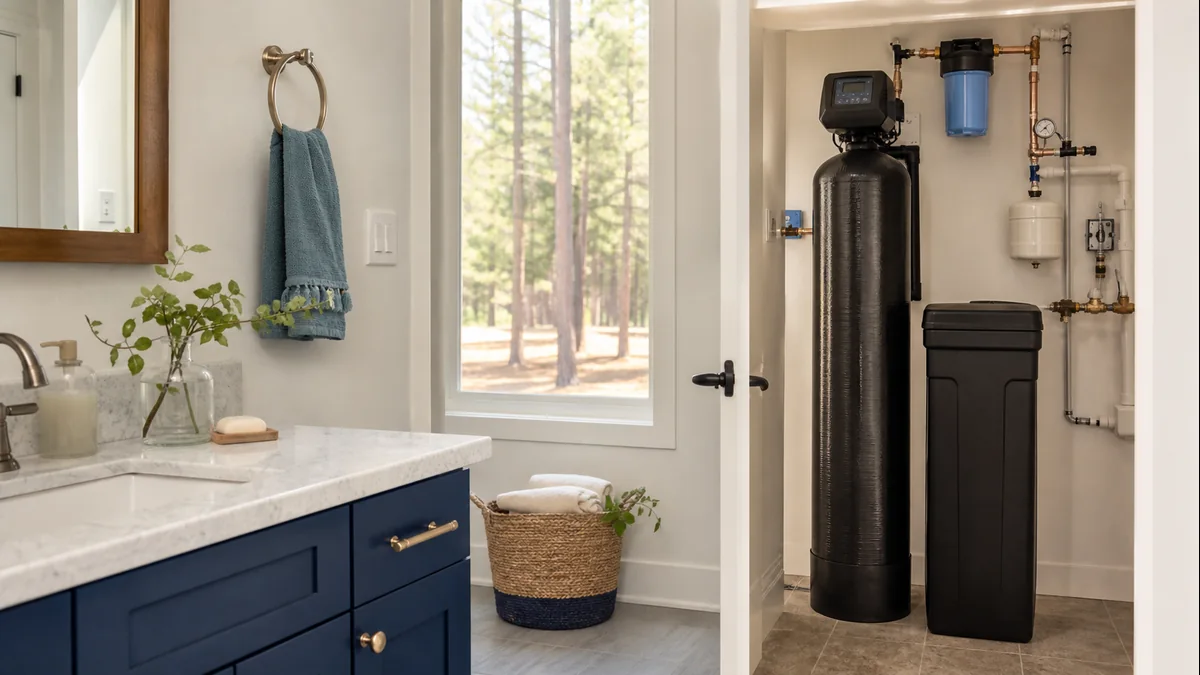
Direct answer: A whole-home water softener installation in Raleigh is typically a single visit, 2–4 hours, performed by an NC-licensed plumber under NCGS §87-21. Triangle Waterworks installs it as part of an all-in-one system — softening resin plus carbon filtration — priced after a free water analysis, with an under-sink reverse osmosis system and a lifetime warranty with terms in writing included at every tier.
Who is allowed to install a water softener in Raleigh?
Under North Carolina General Statute §87-21, installing a whole-home water treatment system — including a softener — is classified as licensed plumbing work, not a handyman task. That's because the install ties directly into your home's main water line, ahead of every fixture in the house. A company cutting into that line without a licensed plumber on the job is taking a risk with your plumbing that shows up later as a leak, a pressure problem, or a code issue when you go to sell the house.
Before you hire anyone, ask for their NC plumbing license number and confirm it yourself through the NC State Board's public license lookup. It takes two minutes and is the single most useful thing you can check before letting a crew into your house.
What actually happens on install day?
For most city-water homes, install day is one visit, and the crew is usually in and out in 2–4 hours. Here's the general shape of it:
- The plumber shuts off the main water supply and identifies the best point of entry for the system, usually near where the line enters the house (garage, basement, or utility closet).
- The all-in-one unit — softening resin and carbon filtration together — gets tied into the main line, along with a drain line connection for the system's regeneration cycle.
- The under-sink reverse osmosis unit gets installed at the kitchen sink (or wherever you'd like your primary drinking water tap).
- The plumber turns water back on, checks for leaks, and confirms pressure and flow are normal throughout the house.
- You get walked through the basics — how regeneration works, when to add salt, and where your warranty paperwork lives.
Most homeowners don't need to clear their schedule for more than a morning or afternoon. If your home's plumbing setup is unusual — an older system, an odd point of entry, tight crawlspace access — a good installer flags that ahead of time rather than surprising you on install day.
What's included with a Triangle Waterworks installation?
Every tier of a city-water install includes the same core package — you're not paying more at a higher tier for a stripped-down version of the same thing:
| Home size | What drives the price | Included |
|---|---|---|
| 1–2 bathrooms | Lower flow capacity needed | All-in-one system + under-sink RO + lifetime warranty (written) |
| 3–4 bathrooms | Mid-range flow capacity | All-in-one system + under-sink RO + lifetime warranty (written) |
| 5+ bathrooms | Higher flow capacity needed | All-in-one system + under-sink RO + lifetime warranty (written) |
Pricing scales with bathroom count because it's a reasonable stand-in for how much water the household actually moves through the system day to day — more fixtures means more flow capacity needed. The RO unit and the written lifetime warranty are standard at every tier, not add-ons you have to negotiate for.
For comparison, national franchise brands commonly quote $6,000–$12,000 for similar whole-home systems. One documented case involved a Leaf Home Water Solutions quote that dropped from $12,241 to $4,825 after pushback — the same system, less than half the original number. An itemized local quote, sized to your home rather than a franchise script, avoids that negotiation entirely. For a deeper breakdown of what drives softener pricing specifically, see water softener cost in Raleigh.
Why install an all-in-one system instead of a stand-alone softener?
A softener by itself only does one job: ion exchange that pulls calcium and magnesium out of your water. That protects your water heater, dishwasher, washing machine, and plumbing from scale buildup, and it makes soap lather better and dishes come out cleaner. It's a real, useful piece of equipment.
But a stand-alone softener does nothing about chlorine or chloramine taste and smell, and nothing about disinfection byproducts like haloacetic acids and trihalomethanes — both of which are documented in Triangle city water. That's a carbon filtration job, not a softening job. Installing the two together, in one all-in-one unit, means you're covering both sides of what's actually in the water instead of solving half the problem and leaving the other half untouched.
There's also a mechanical reason to pair them: resin bed life varies with water quality, and chlorine is commonly cited in the trade as one of the things that shortens resin life over time. Running water through a carbon stage before it hits the softening resin protects the investment you just made in the resin itself — the reason the all-in-one setup is framed as "best of both worlds" rather than two separate purchases.
If you want a closer look at how a stand-alone softener compares to filtration-only setups, whole house filter vs. water softener walks through the difference in more detail. And if you're weighing a salt-based system against a salt-free conditioner, salt-free conditioner vs. water softener covers what each approach actually does — and doesn't do — to hardness minerals.
What should I ask before signing a contract?
- "Can I verify your NC plumbing license number myself?" A company confident in its standing will hand this over immediately.
- "Is the under-sink RO system actually free, or is that added back into the price somewhere?" It should be included at every published tier, not billed separately.
- "Is the warranty in writing, and can I read the terms before I sign?" A verbal "lifetime warranty" isn't the same as one with terms on paper.
- "Is this an all-in-one system — softening resin and carbon together — or just a softener?" If it's softening only, ask what handles chlorine, PFAS, and disinfection byproducts.
- "Is the regeneration valve metered (demand-initiated) or on a fixed time clock?" Under the NSF/ANSI 44 efficiency standard, only metered systems that regenerate based on actual water use qualify — a fixed schedule wastes salt and water regenerating whether or not it's needed.
- "Is the quoted price final, or does it change after you see my house?" A quote given after a free water analysis shouldn't move much once someone actually looks at your setup.
A company that answers all six without hedging is one worth hiring. For a broader rundown of how to vet any local installer, see how to choose a water filtration company in Raleigh.
Does installation look different on well water?
Yes. Well water installs aren't priced off a bathroom-count chart the way city installs are, because wells vary too much from one property to the next — iron, sulfur, pH, and hardness levels are specific to your well. Pricing should always follow a free water analysis, never precede it. The typical setup is iron removal paired with carbon and/or softening resin, sized to what your test actually shows. If you're not sure whether your softener needs (or already has) that kind of pairing, water softener sizing by grains explains how sizing works once you know your water's hardness and iron levels.
Frequently Asked Questions
I'm scheduling installation for a 3-bathroom house in Raleigh — how long will the crew actually be there? Most 3–4 bathroom city-water installs are completed in a single visit, typically 2–4 hours. You'll get a walkthrough of the system and your warranty paperwork before the crew leaves.
Is the person installing my system really a licensed plumber, or just a technician who does this specific job? Under NCGS §87-21, whole-home water treatment installation is licensed plumbing work in North Carolina, so the person doing your tie-in should hold an actual NC plumbing license. Ask for the number and check it yourself at the NC State Board's public lookup before the appointment.
I just moved to Cary and my glasses still come out a little spotty — I thought the water here was supposed to be soft? Cary, Apex, and Morrisville run around 1.6–3.7 gpg, which is soft at the low end but reaches moderately hard at the top of that range — and even water on the softer end still carries some calcium and magnesium that accumulates on fixtures and glassware over time. An all-in-one system handles that mineral buildup on the softening side while the carbon side deals with taste, odor, and disinfection byproducts.
Do I need to be home for the whole installation? Most installers ask that someone be available to grant access to the water line and be walked through the system settings once the install is finished. Confirm the specifics — arrival window and what access is needed — directly with your installer when you schedule.
What if my install takes longer than the quoted 2–4 hours? Straightforward city-water installs are typically finished in that window. If your home's plumbing setup adds complexity — an unusual point of entry or older piping — a good installer flags that before install day, not partway through it, so there are no surprises on price or timing.
Can I add carbon filtration to a softener I already have, or does it have to be one combined unit? That depends on your existing setup and plumbing layout, which varies enough from house to house that it's worth a direct look rather than a general answer. Take the water quiz or request a free analysis and an installer can tell you what's realistic for your specific system.
On city water in Raleigh, Cary, Apex, Morrisville, or anywhere else Triangle Waterworks serves, the fastest way to see your exact price and system is the 60-second water quiz — no sales visit required. On a well, start with a free water analysis so your iron and carbon/resin system gets sized to what your water actually needs, not a guess.
Answer nine practical questions, then request a written quote or well-water analysis.
Start My Water Analysis