
Water Softener Installation in Wake Forest, NC — What Installation Day Looks Like
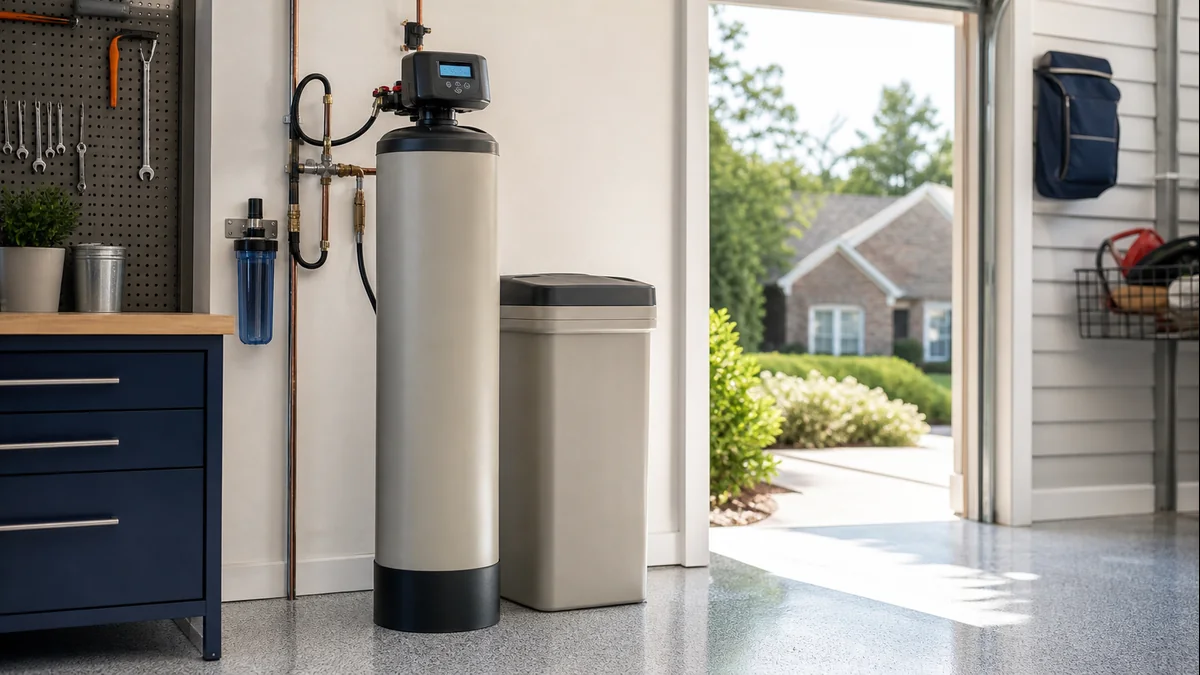
Direct answer: Installation in Wake Forest starts with a free in-home water analysis and sizing, then agreeing on where the all-in-one system goes — garage, crawl space, basement, or near where the main line enters the house. NC-licensed plumbers handle the tie-in, pull the local permit, and commission the system before walking you through how it runs. One unit combines softening resin and carbon filtration, sized to your specific home.
What Does Water Softener Installation Actually Involve in Wake Forest?
It's a plumbing tie-in at the main water line, done by an NC-licensed plumber, covered by a local permit. A whole-home system isn't a plug-in appliance — every gallon your house uses runs through it, which is why North Carolina treats the work as plumbing contracting.
The sequence is consistent: a free water analysis and sizing, agreeing on the equipment's location, the install visit itself, and commissioning with a homeowner walkthrough. The exact spot — garage, crawl space, basement, or a utility area near the main line — depends on your house, and that's confirmed before the crew arrives, not guessed at over the phone.
What Happens at the Free In-Home Water Analysis?
A specialist tests your water at your own address and looks at your plumbing layout — where the main line enters, how much room there is to work with, and what's already tied into that section of the house. This is also where the system gets sized, since Wake Forest addresses vary across the 1.6 to 3.7 gpg range Triangle Waterworks measures across the service area.
Nothing gets ordered or scheduled for install until this step confirms what your specific home actually needs.
Where Does the System Actually Go in a Wake Forest Home?
Most Wake Forest homes fall into one of four setups: a garage corner near the water heater, a crawl space where the main line runs, a basement mechanical area, or a utility closet close to where the line enters the house. Whichever applies to your home, the location gets agreed on during the water analysis, not decided on the spot during the install visit.
The unit needs three things wherever it lands: access to the main line, a nearby drain for regeneration discharge, and a standard electrical outlet.
Does Wake Forest Require a Permit, and Who Pulls It?
Yes, and your installer handles it. Wake Forest administers its own plumbing permits rather than routing through Wake County Permits & Inspections — worth confirming with the Town for your own address, and exactly the kind of detail a licensed installer working in the area already has sorted out. Under N.C. Gen. Stat. § 87-21, installing a whole-house water treatment system is plumbing contracting work, which is why it goes to a licensed plumbing contractor rather than being treated as a DIY appliance swap.
Filing with Wake Forest's permitting office and scheduling the inspection is a normal part of the job — not something you're expected to track down or file yourself.
What Happens on Installation Day, Step by Step?
| Step | What it involves |
|---|---|
| Free water analysis and sizing | Already completed before install day — this is where the system spec was set |
| Location confirmed | Garage, crawl space, basement, or main-line entry point, agreed on in advance |
| Main line tie-in | The all-in-one unit connects at the point where water enters the house |
| Bypass connection | Lets the household run water around the system if it ever needs service |
| Drain line | Run for the softening side's regeneration discharge |
| Permit and inspection | Filed and scheduled by your installer with Wake Forest's permitting office |
| Commissioning | System brought online, checked for leaks and normal pressure |
| Homeowner walkthrough | You're shown how regeneration works and where your paperwork lives |
That order holds for most Wake Forest homes on city water. What varies house to house is the specifics inside each step — how accessible the main line is, how much crawl space clearance there is to work with — and that's exactly what the water analysis exists to catch ahead of time.
Is Wake Forest's Water Actually Hard Enough to Need This?
Enough to matter, even though it isn't in the "hard" band on the industry scale. Wake Forest doesn't run its own treatment plant — it's supplied by Raleigh Water, the same utility serving Raleigh, Garner, Knightdale, Rolesville, Wendell, and Zebulon. Raleigh Water's 2025 Consumer Confidence Report shows average hardness of 25.2 ppm, ranging 21.9 to 35.3 ppm — roughly 1.3 to 2.1 grains per gallon (gpg).
On the Water Quality Association (WQA) scale the Hach Total Hardness Test Kit, Model 5-B, uses, that range falls in the slightly hard band — never "hard," which starts at 7 gpg on that scale. Triangle Waterworks' own in-home testing across the service area reads higher, 1.6 to 3.7 gpg by ZIP code, spanning slightly hard to moderately hard. Neither figure contradicts the other; one is a plant-wide average, the other is measured address by address.
Wake Forest also has an older historic district alongside newer construction — a mix that means minerals have had different amounts of time to accumulate depending on the home. See how that historic housing stock factors into plumbing decisions.
What About Chlorine Taste and Disinfection Byproducts?
That's a separate issue from hardness, handled by the carbon half of the same system. Raleigh Water — Wake Forest's supply — normally disinfects with chloramine, which the City describes as carrying no taste or odor. Once a year, on the North Carolina Department of Environmental Quality's recommendation, it converts to free chlorine only and flushes the distribution system, and the chlorine residual runs higher system-wide during that window.
Dates shift year to year — the 2026 period ran February 26 through April 2 — so check Raleigh Water's own current-year announcement rather than assuming a fixed calendar.
Raleigh Water's 2025 report also documents real disinfection byproducts: total trihalomethanes (TTHM) averaging 34.2 ppb, ranging up to 42.8, against an 80 ppb legal limit, and haloacetic acids (HAA5) averaging 22.0 ppb, ranging up to 33.6, against a 60 ppb limit. Both are fully compliant.
EPA's National Primary Drinking Water Regulations table lists TTHM's potential long-term health effect above the legal limit as "Liver, kidney or central nervous system problems; increased risk of cancer," and HAA5's as "Increased risk of cancer." Compliance is real, but it's a ceiling EPA set at the edge of its own acceptable risk, not proof that everything under it deserves no attention.
Softening resin does nothing about any of this — it's ion exchange for calcium and magnesium only — which is exactly why the system installed in Wake Forest pairs softening with a carbon stage in one unit.
What Happens After the System Is Installed?
Once the tie-in is complete, the crew brings the system online, checks for leaks, confirms normal pressure throughout the house, and walks you through the basics — how regeneration works and where your documentation lives. Wake Forest's permitting inspection is scheduled as part of the same process your installer already manages, not a separate wait tacked on afterward. From there, the system runs in the background; you notice it in the water itself, not in ongoing service calls.
Because softening and carbon filtration live in one unit, there's no second installation to schedule for the chlorine or disinfection-byproduct side — the same tie-in, permit, and install-day sequence covers both.
FAQ
I just scheduled my install and I'm not sure my crawl space has enough clearance — does that get sorted out before the crew shows up? Yes. Location and access get confirmed during the free water analysis, before anything is ordered or scheduled, so a tight crawl space is exactly the kind of detail your installer plans around ahead of time rather than discovering on install day.
My house is in Wake Forest's historic district — does older plumbing change how the system gets installed? It can affect the specifics of the tie-in, which is why the water analysis includes a look at your plumbing layout before install day. See how the historic district's older homes factor into plumbing work for more on what to expect.
Do I need to be home for the whole installation? Most installers ask that someone be available to grant access to the main line and be walked through the system once it's commissioned. Confirm the arrival window and access needed directly with your installer when you schedule.
Does Wake Forest handle its own permits, or does that route through Wake County like some nearby towns? Wake Forest administers its own plumbing permits. Wake County Permits & Inspections covers unincorporated Wake County plus Rolesville, Wendell, Knightdale, and Zebulon — Wake Forest isn't one of those four, so your installer files with Wake Forest's own permitting office instead.
How long will my house be without water during the install? That depends on your home's plumbing layout — how accessible the main line is and what else is tied into that section — which is confirmed during the water analysis rather than quoted as a fixed number up front. Your installer tells you what to expect once they've seen your specific house.
Can I get a straight timeline from booking to a working system? The water analysis comes first and sets the actual timeline for your address, since it depends on scheduling, permitting, and your home's specific layout. Booking the analysis is the step that turns a general question into a specific answer for your house.
See What Installation Looks Like for Your Wake Forest Home
Take the 60-second water quiz to see how an all-in-one softening-and-carbon system fits your household, or book a free water analysis to find out exactly where your Wake Forest address falls in the measured range and what installation day will look like at your house.
Sources
- City of Raleigh — Raleigh Water 2025 Consumer Confidence Report
- EPA — National Primary Drinking Water Regulations
Related reading: Water Treatment in Wake Forest, NC | Who Installs Water Treatment in Wake Forest, NC | What Does a Water Softener Cost in Wake Forest, NC? | Is Wake Forest, NC Water Hard? | Wake Forest Historic District Old Home Plumbing
Answer nine practical questions, then request a written quote or well-water analysis.
Start My Water Analysis