
Water Softener Installer Company in Fuquay-Varina, NC — What They Actually Do
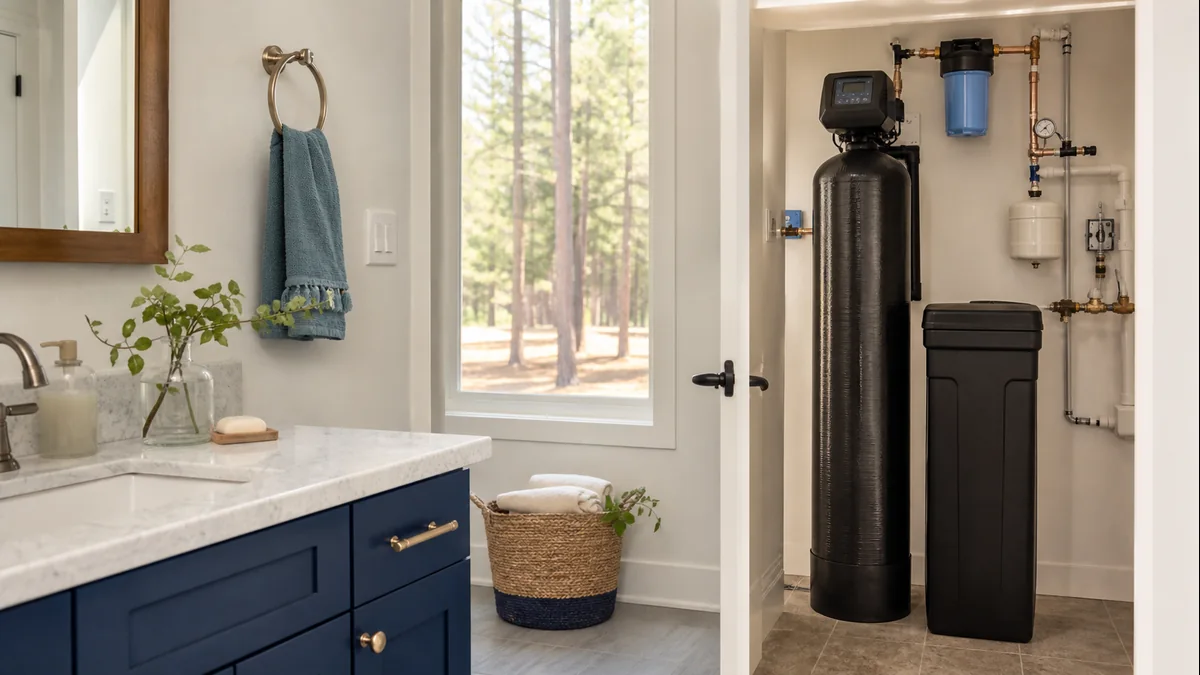
Direct answer: A water softener installer company in Fuquay-Varina runs a free water analysis first — essential here since the town blends water from three source utilities — sizes an all-in-one softening-and-carbon system to what that finds, then has a licensed plumber complete the main-line tie-in under N.C. Gen. Stat. § 87-21 before programming the system to your household's use. Book the free analysis to start.
Already decided you want a system and just choosing who installs it? This page walks the process from first call to finished install, what to have ready beforehand, what install day looks like, and why the all-in-one configuration gets specified for Fuquay-Varina homes.
What Does a Water Softener Installer Company Actually Do, Start to Finish?
There's a fixed order to a real install, and jumping ahead is the first warning sign. Call in, get tested at home, get sized off the reading, get the main line tied in by a licensed plumber, get the valve programmed, then get service afterward if anything needs attention.
Skip any one of these and the whole chain weakens: a size picked before testing is a guess dressed up as a recommendation, and a tie-in done outside licensed plumbing is the kind of shortcut that only surfaces later — at inspection, or at resale. Two visits, six confirmations, in this order.
| Visit | What actually gets confirmed | Why Fuquay-Varina makes this one non-negotiable |
|---|---|---|
| Intake call | Symptoms at the tap, plus your exact address | Address matters more here than in a single-source town — it hints at which of the three source utilities dominates |
| Water analysis | Hardness measured on-site, plumbing walked for access | A townwide figure can't stand in for a blended supply that shifts block to block |
| Sizing | All-in-one spec built from the reading, not a catalog tier | Guessing a size off a district average is guessing twice in a blended town |
| Licensed tie-in | Main-line connection under N.C. Gen. Stat. § 87-21 | The town issues its own permit, separate from Wake County's process |
| Startup | Valve programmed to your household's actual use | Regeneration timing follows your numbers, not a factory default |
| Follow-up | Salt checks, warranty response, service calls | Confirms the company that tested and sized your system will still answer the phone later |
How Does the free Water Analysis Work in a Blended-Supply Town Like Fuquay-Varina?
A technician tests your water at your own tap rather than quoting off any single utility's number — that matters more here than almost anywhere else in the Triangle. Fuquay-Varina doesn't run one treatment plant; it buys finished water wholesale from three separate systems (Raleigh, Harnett Regional, Johnston County) and blends it across the distribution network, so which supply dominates a given address can genuinely differ block to block.
Raleigh Water, one of the three utilities feeding that blend, tests its own finished water at roughly 1.6 grains per gallon (gpg) — slightly hard on the WQA scale, the same scale the Hach Total Hardness Test Kit, Model 5-B uses. That's Raleigh's number, not a Fuquay-Varina number, and only one ingredient in what reaches your tap.
Our own testing across the wider service area measures 1.6 to 3.7 gpg by ZIP code, spanning slightly hard to moderately hard — which is why the visit exists. In a single-source town, a company can start from a townwide average; in a blended one that average barely applies, so the technician's job is finding where your specific address falls. They also walk your plumbing — crawl space, garage, utility room — to see where a system fits.
How Does the Company Decide What Size System I Need?
Sizing comes from two numbers taken at the same visit: measured hardness and household daily water use, not a catalog default. Undersized for either, a system regenerates too often and wastes salt; oversized for a smaller household, it costs more without adding usable capacity.
Because the blend can shift which utility dominates a given address, sizing off anything but your own tested reading is sizing blind here. A company that quotes a size over the phone before testing is skipping the step that determines the number — worth asking about before you book.
Who Handles the Licensed Plumbing Tie-In, and Who Pulls the Permit?
A licensed plumber, not a sales-certified installer alone. North Carolina law is specific on this point: § 87-21 of the state's General Statutes places a "whole-house water purification or treatment system" squarely inside the definition of plumbing contracting, precisely because the unit connects to your main supply line instead of an outlet.
Fuquay-Varina runs its own plumbing permitting rather than routing through Wake County Permits & Inspections, which covers unincorporated Wake County plus Rolesville, Wendell, Knightdale, and Zebulon. A legitimate installer company already knows this and pulls the permit from the town directly. For the wider permitting picture, our breakdown of Wake County's permit rules covers why the requirement isn't optional.
What Happens During Startup and Programming?
With the tie-in finished, the technician dials in the control valve — regeneration frequency, salt draw per cycle, and a run time that won't land mid-shower. That link between sizing and programming is the whole point of using one company for both. If a quote treats them as separate, unrelated services, ask why before you book.
What Should I Have Ready Before I Book the Water Analysis?
A few minutes of prep makes the visit faster and the quote more accurate:
- Household size and routine — people, plus rough weekly laundry/dishwasher loads — since usage is half of what sizing is built from.
- Access to your main line and water heater — crawl space, garage, or utility closet — for the same-visit install assessment.
- Recent complaints noted — spotty glasses, chlorine smell, a change after a repair — to help separate hardness from a disinfection byproduct.
- Your exact address, since the blend varies within town and that context helps interpret the reading.
What Does Install Day Actually Look Like?
Install day usually follows the sizing visit as a single appointment. A licensed plumber handles the main-line tie-in — brief shutoff, bypass valve connection, leak check — while the crew levels the unit, connects the drain, and loads the initial salt charge. Programming happens the same visit, and the technician walks you through the salt level and who to call if anything seems off. Expect a few hours, most of it without any water interruption beyond that brief shutoff.
Why Does the All-in-One System Get Installed in Fuquay-Varina, Not a Softener Alone?
Because a softener alone leaves everything that isn't hardness untouched — and Fuquay-Varina's blend draws from three surface-water sources, all disinfected to stay safe from intake to tap. That process can leave behind chlorine or chloramine taste, plus disinfection byproducts like HAA9 and TTHM formed when disinfectant reacts with organic material. Softening resin is strictly ion exchange for calcium and magnesium; it does nothing about any of that.
Meeting a federal limit isn't the same as posing zero risk — the two get conflated constantly. EPA's own National Primary Drinking Water Regulations table spells out what long-term exposure above that limit is associated with: for TTHM, "liver, kidney or central nervous system problems; increased risk of cancer," and for HAA5, "increased risk of cancer." All three utilities supplying the blend report numbers under the ceiling, and the ceiling is a regulatory line, not a promise about what's safest. Carbon filtration sidesteps the question by pulling the compounds out rather than arguing over where the line sits.
That's the case for pairing carbon with resin instead of buying either alone: one tank strips the calcium and magnesium causing your scale, the other strips what disinfection leaves behind, and neither substitutes for the other regardless of which source utility feeds your street that month. A quote mentioning only softening is quoting half the problem. Still sorting which local company to trust? Our vetting checklist for Fuquay-Varina covers licensing, insurance, and references.
Ready to Book the Water Analysis That Starts the Process?
Everything above only moves once your water is tested at your own address — sizing, the tie-in, and programming all follow from that reading, and in a blended town there's no shortcut around it. Take the 60-second water quiz or book a free water analysis to get started.
FAQ
I'm already sold on getting a system — can we just skip the analysis and go straight to scheduling install day? Skipping it doesn't save you a step, it just moves the guessing into the install itself. In most single-source towns that guess might land close; in a blend fed by three utilities, the technician genuinely doesn't know your number until they measure it at your tap. The visit is free and it's normally the same appointment that locks in your install date, so there's little upside to bypassing it.
My neighbor two streets over said their water tests differently than mine — is that actually possible in Fuquay-Varina? Yes, and it's a documented feature of how the town sources water, not a fluke. Fuquay-Varina blends finished water from Raleigh, Harnett Regional, and Johnston County, and which supply dominates a given address can shift within town.
How do I confirm the plumber doing my tie-in is actually licensed? Ask for the license number before work starts. N.C. Gen. Stat. § 87-21 makes the main-line tie-in licensed plumbing contracting work, so any legitimate company provides that number without hesitation — it's public information either way.
Both my spouse and I work from home — does one of us actually have to stop and be there for these visits? One of you does, for both appointments. The technician can't measure your hardness or reach the tie-in point without someone opening up the water source and the install area, and having a person there to hear the sizing numbers explained beats getting them secondhand after the fact.
Once the crew leaves after install, am I on my own if something goes wrong six months later? You shouldn't be — confirm it before you sign. Ask who answers if the system alarms or salt runs low, and whether warranty work goes through the office that sized your unit or gets routed to a third party. The company that measured your water has the most context to fix it.
Can I just buy a softener online and have any plumber install it? You can, but a generic model number was sized for a national average, not for the specific gpg reading at your address in a town where that number moves depending on which utility is upstream. A plumber can still connect it correctly — they just can't tell you if it's the right size, because that call belongs to whoever ran the water test.
Sources
- EWG Tap Water Database — City of Raleigh (PWS NC0392010)
- EPA — National Primary Drinking Water Regulations
- North Carolina General Assembly — G.S. § 87-21, Definitions; contractors licensed by Board
Related reading: Water Treatment in Fuquay-Varina, NC | How to Choose a Water Treatment Company in Fuquay-Varina, NC | Water Softener vs. All-in-One System | How to Choose a Water Softener
Answer nine practical questions, then request a written quote or well-water analysis.
Start My Water Analysis