
What Does a Water Softener Installer Company Do in Holly Springs, NC?
Direct answer: A water softener installer company in Holly Springs runs a free in-home water analysis, then sizes an all-in-one softening-and-carbon system to what that finds and ties it into your existing plumbing. The Town's own Drinking Water page puts hardness at 30-50 mg/L, or 1.75-2.92 grains per gallon — slightly hard on the WQA scale — sourced from the Cape Fear River. Book the analysis for your address's own reading.
What Does a Water Softener Installer Company in Holly Springs Actually Do?
Triangle Waterworks runs a free in-home water analysis first, then sizes an all-in-one softening-and-carbon system to what that test measures and installs it directly into your existing plumbing. Every step happens in that order so the sizing is always based on what the test actually measured. For the fuller picture of what's available in town, see water treatment in Holly Springs, NC.
The installer who tests your water is also the one who sizes and installs the system, so the recommendation reflects what was actually measured at your address.
Where Does Holly Springs' Water Come From, and Why Does That Matter for Installation?
Holly Springs draws its water from the Cape Fear River, processed at the Harnett County water treatment plant and delivered through Harnett Regional Water. That's a different supply chain from the Jordan Lake system serving Cary, Apex, and Morrisville — a genuinely different source, treated at a different plant, by a different utility. See how Holly Springs fits into the broader Triangle water picture for how the region's supply chains compare.
A river source requires an active disinfection process to keep organic material and pathogens in check as water moves from the plant to your tap, and that process is the second half of what an installer plans around beyond hardness alone.
What Does Holly Springs' Own Hardness Number Actually Say?
The Town of Holly Springs states its hardness figure directly on its Drinking Water page: "The water is considered moderately soft and usually averages between 30-50 mg/L hardness as calcium carbonate or 1.75-2.92 grains of hardness per gallon." That's the Town's own published range, not an outside estimate.
On the Water Quality Association scale the Hach Total Hardness Test Kit, Model 5-B uses, that entire range — 1.75 to 2.92 gpg — sits inside the slightly hard band. Both labels describe the same measured water; they come from different classification scales, not a disagreement about the numbers.
| Measurement | mg/L | gpg | WQA classification | Town's own label |
|---|---|---|---|---|
| Low end of range | 30 | 1.75 | Slightly hard | Moderately soft |
| High end of range | 50 | 2.92 | Slightly hard | Moderately soft |
Slightly hard is still a genuine, measurable hardness case — calcium and magnesium accumulating on fixtures, glassware, and inside a water heater over years is cumulative, regardless of which end of that range your address falls on.
What Happens During the Free Water Analysis?
A technician tests your water directly at your address instead of applying the Town's published range to every home. See how to test tap water hardness yourself in Holly Springs if you want a preview of what that measurement looks like. The Town's figure is a system-wide average; what an individual address reads can sit anywhere inside — or slightly outside — that published range depending on where it falls in the distribution network.
The same visit also covers your plumbing: where the system will go, how the main line runs, and what the install will involve once sizing is confirmed.
How Does the Installer Match a System to Holly Springs' Water?
Sizing comes from your address's own hardness reading combined with your household's water use — not the Town's published average applied uniformly. What a full system costs in Holly Springs covers what to expect once sizing is confirmed. A system matched to your specific numbers runs efficiently at either end of Holly Springs' published range, since 1.75 to 2.92 gpg is a comparatively narrow band to begin with.
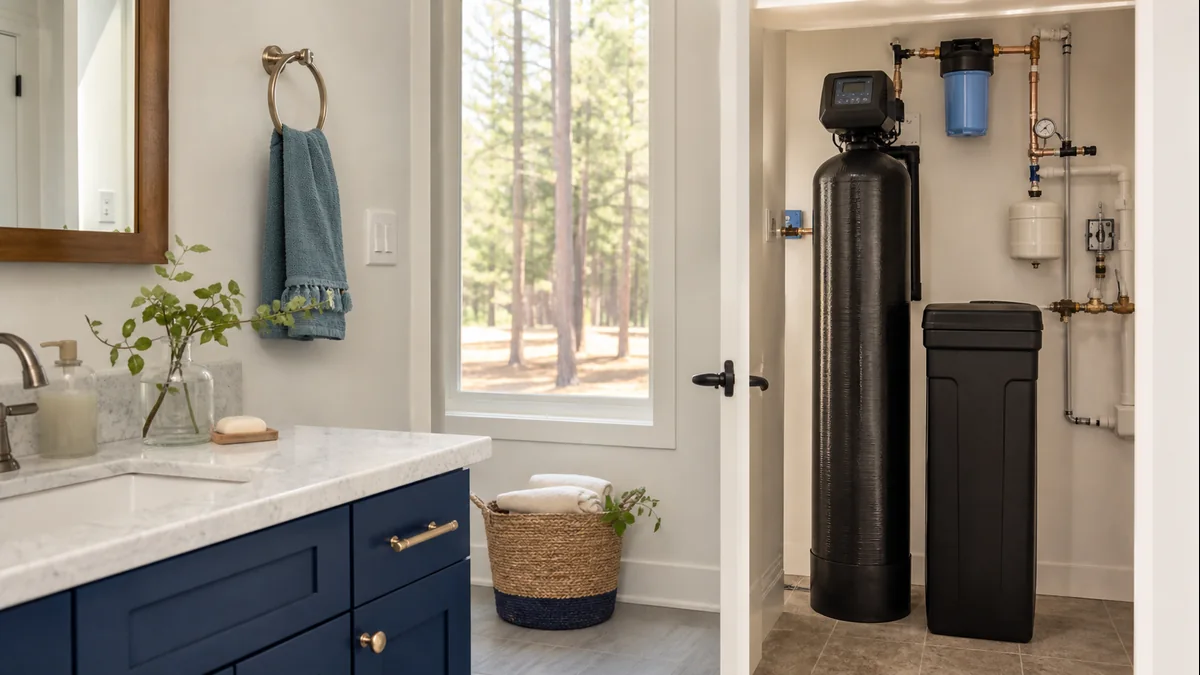
Once sizing is confirmed, installation ties the system into your existing plumbing at the main line, ahead of the water heater, so every fixture in the house receives treated water. Here's how to prep your home for that install visit if you're getting ready to schedule.
Why Does the Installer Pair Softening With a Carbon Stage Here?
Because hardness is only half of what Holly Springs' water carries. The Cape Fear River source requires disinfection to keep the water safe between the Harnett County plant and your tap, and that process can produce disinfection byproducts as it reacts with organic material in the source water — compounds a softener's resin bed does nothing to address.
EPA's National Primary Drinking Water Regulations table lists TTHM's potential health effect from long-term exposure above the legal limit as "Liver, kidney or central nervous system problems; increased risk of cancer," and HAA5's as "Increased risk of cancer." A system that's legally compliant is operating under a ceiling EPA itself set — not a promise of zero exposure — and a carbon stage removes those compounds directly rather than relying on staying under that line.
- Softening resin handles calcium and magnesium — the minerals behind scale on fixtures and inside the water heater.
- A carbon stage handles chlorine or chloramine taste and disinfection byproducts — what the resin bed was never built to touch.
- Both get installed together, sized from the same water analysis, in a single visit.
FAQ
I read that Holly Springs calls its water "moderately soft" — is a softener still worth installing? Yes — "moderately soft" and "slightly hard" describe the same measured range, just on different scales, and 1.75 to 2.92 gpg is still a real, measurable hardness case. Calcium and magnesium build up on fixtures and inside a water heater over years regardless of which label the water carries.
Our house is near the edge of town — how does the installer confirm we're actually on Harnett Regional Water before sizing anything? That's part of the same visit as the water analysis. The technician tests your water directly at your address, so the system gets sized to what's actually measured there rather than assumed from where your address sits on a map.
How long does the process take from the first call to a working system? The water analysis and plumbing assessment typically happen in one visit, with installation following once sizing is confirmed. Timing depends on your home's plumbing layout and access, which the first visit covers.
Do I need to be home for the water analysis and the install? Yes for both. The technician needs access to your water source and your plumbing to test accurately and to connect the system correctly, and being there lets you see what the test finds before the install begins.
Does the installer test every fixture, or just one tap? The analysis measures your incoming water supply at your home, which is what the system treats before it reaches any fixture. The system itself is installed at the main line, not fixture by fixture.
What's actually different about installing in Holly Springs versus a town that publishes no hardness figure at all? Not much in terms of process — the free water analysis happens either way, since a townwide figure never substitutes for an address-level reading. What differs is that Holly Springs' own page gives a published range to compare your result against, where some other towns in the area publish nothing at all.
Get Your Holly Springs Home's Own Water Analysis
Holly Springs publishes a hardness range on its own Drinking Water page, but the number that actually sizes your system is the one measured at your address. Take the 60-second water quiz or book a free in-home water analysis to get your Holly Springs home into the process.
Sources
- Town of Holly Springs — Drinking Water
- Town of Holly Springs — Infrastructure
- EPA — National Primary Drinking Water Regulations
Answer nine practical questions, then request a written quote or well-water analysis.
Start My Water Analysis