
What Drives Water Softener Maintenance Cost in Raleigh, NC?
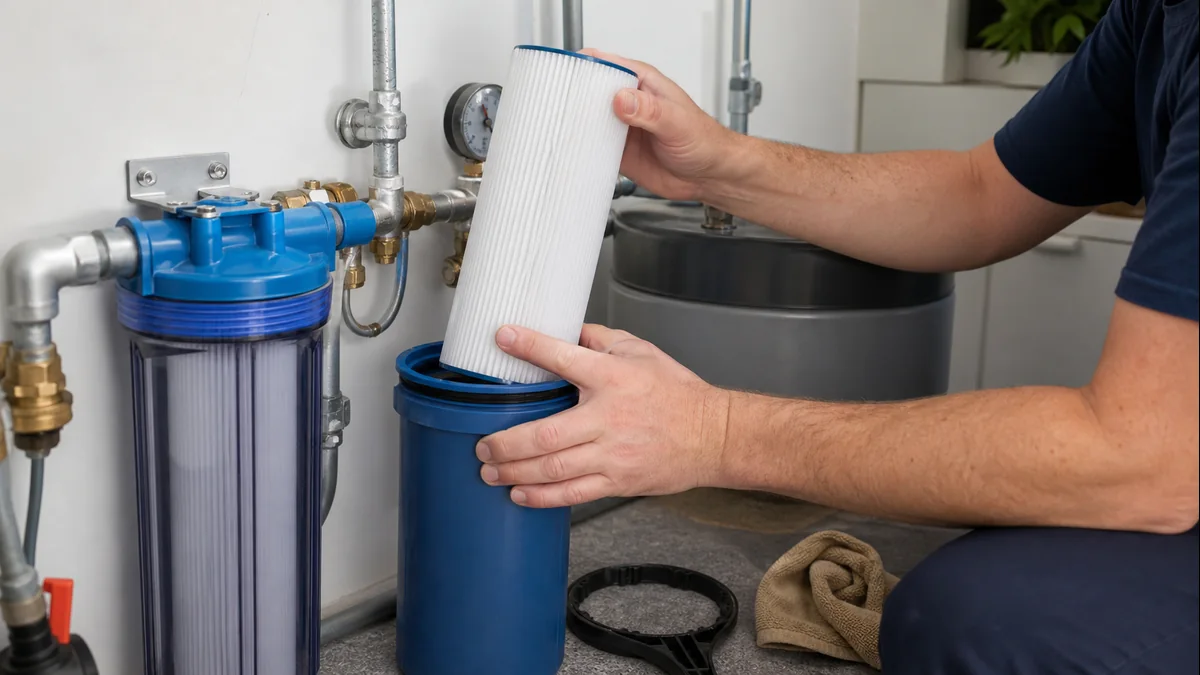
Direct answer: What drives water softener running cost in Raleigh isn't the equipment — it's four factors: your address's hardness (more grains, more frequent regeneration), household size and water use, how the system is sized, and how often the carbon stage needs service. Raleigh's slightly hard 1.3–2.1 gpg water keeps grain load low, so an all-in-one system here runs cheaply and regenerates rarely.
What actually drives the cost of keeping a water softener running in Raleigh?
Four things, and none of them is the sticker price of the equipment itself: how hard the water is at your specific address, how much water your household actually runs through the system, whether the system is sized correctly for that use, and how often the carbon stage needs attention.
Every one of those scales up or down independently — a home with low hardness but heavy water use can cost more to run than a harder-water home with a smaller household.
That's the useful reframe for a "maintenance cost" question. It isn't one number that applies to every Raleigh house. It's a set of inputs, and Raleigh's water happens to be favorable on the biggest one.
Does Raleigh's hardness level make my softener expensive to run?
No — Raleigh's hardness works in your favor here. Raleigh Water's 2025 Consumer Confidence Report puts average hardness at 25.2 ppm, ranging 21.9–35.3 ppm across the system, which works out to roughly 1.3–2.1 grains per gallon (gpg). On the WQA/Hach scale the Hach Total Hardness Test Kit uses, that's slightly hard — nowhere near the "hard" or "very hard" bands that push a softener into frequent, salt-hungry regeneration cycles.
Softener running cost tracks hardness directly: more grains per gallon means the resin bed reaches its capacity faster, which means more regeneration cycles, which means more salt used over a year. Raleigh sitting at the low end of that scale is a genuine cost advantage, not a reason to skip softening — the minerals are still present, they're just present at a lower load.
How does household size affect ongoing softener cost?
Directly, and independently of hardness. EPA's WaterSense program notes that the average American family uses more than 300 gallons of water a day at home, with roughly 70% of that used indoors — and every gallon that runs through a softener is a gallon working the resin bed. A larger household, more bathrooms in daily use, or habits like frequent laundry loads all push more water through the system between regenerations.
Two identical houses on the same Raleigh street, at the same measured hardness, can have meaningfully different running costs if one holds a family of five and the other a household of two. That's why a real cost estimate starts with a water analysis at your address, not a citywide average applied to every home the same way.
Does system sizing change how much a softener costs to maintain?
Yes, in both directions. A system sized too small for a household's actual water use regenerates more often than it should, since it hits capacity faster — that means more salt and more wear over the same period. A system sized larger than a household actually needs isn't necessarily a cost win either, since it's paying for capacity that goes unused.
The goal is a system matched to the household doing the sizing: your grains-per-gallon reading multiplied by your household's realistic daily water use. Getting that match right is what a free water analysis and a proper installation are for — see how water softener sizing by grains works for the mechanics behind that calculation.
What drives the cost of servicing the carbon stage?
The same two forces as the softening side: how much water passes through it, and how much the carbon is actually adsorbing out of that water.
Raleigh Water's 2025 CCR shows total trihalomethanes (TTHM) averaging 34.2 ppb (up to 42.8) and haloacetic acids (HAA5) averaging 22.0 ppb (up to 33.6), both under the EPA's regulatory limits.
EPA's National Primary Drinking Water Regulations table lists TTHM's potential long-term health effect above the legal limit as "liver, kidney or central nervous system problems; increased risk of cancer," and HAA5's as "increased risk of cancer."
Legally compliant is a ceiling EPA set based on its own risk tolerance, not proof of zero risk — carbon removes those compounds rather than relying on staying under a number.
There's no invented number for how long a carbon stage lasts before it needs attention — that depends on your household's water volume and what's actually in your water, which is exactly why your installer sets that interval to your system rather than a generic calendar figure.
How do national big-brand quotes compare on ongoing cost?
National big-brand whole-home quotes commonly run $6,000–$12,000. What matters for your running cost is not that headline number but whether the system behind it was sized to your household at all.
So ask directly what any quote's maintenance assumptions are based on: your measured hardness, your household size, and your actual water use — or a generic install. A system matched to your address is the one whose upkeep costs behave predictably.
A locally sized system starts from the opposite direction: a free water analysis first, so the sizing — and everything that follows from it, including how often the system regenerates and how the carbon stage gets serviced — is built from your actual numbers rather than a one-size-fits-most package.
Can I lower my softener's running cost without changing anything else?
The biggest lever most homeowners already control is correct sizing and a demand-initiated (metered) regeneration setup rather than a fixed-schedule one — a metered system only regenerates when the resin has actually reached capacity, instead of running cycles on a calendar regardless of use. See how water softener regeneration actually works for the mechanics behind why that distinction matters for cost.
Beyond that, the honest answer is that running cost mostly follows the four drivers above rather than a habit you can adjust day to day. Getting the sizing right at installation does more for long-term cost than anything a homeowner changes afterward.
Does living in a harder-water Triangle town cost more to maintain than Raleigh?
At the top end, yes, somewhat. Cary, Apex, and Morrisville run 1.6–3.7 gpg by ZIP on our own testing, crossing into moderately hard at the high end of that range — a system there can regenerate somewhat more often than one on Raleigh's 1.3–2.1 gpg water. It's still a modest difference in absolute terms; none of the Triangle's city-water towns approach the "hard" or "very hard" bands where running cost climbs sharply.
Cost drivers and why each one moves the number
| Cost driver | Why it moves the number |
|---|---|
| Hardness at your address | More grains per gallon means the resin reaches capacity faster, so it regenerates more often |
| Household size / water use | More water through the system between regenerations, independent of hardness |
| System sizing | Undersized regenerates too often; oversized pays for capacity that goes unused |
| Carbon stage service interval | Set by your installer based on your water volume and what's in your water, not a fixed number |
| Regeneration type | Metered (demand-initiated) regenerates only when needed; fixed-schedule runs cycles regardless of actual use |
Get your actual numbers, not a citywide estimate
Every driver above is address-specific — hardness, household water use, sizing, and carbon load all vary house to house even within the same Raleigh ZIP code. The only way to know your real running-cost picture is a free water analysis rather than an estimate built from a city average. Take the 60-second water quiz to see what an all-in-one system looks like sized to your Raleigh home.
FAQ
I have a family of five in Raleigh — will my softener cost more to run than my neighbor's smaller household? Likely somewhat, since household water use is one of the independent drivers of running cost — more water through the system between regenerations means more cycles over a year, regardless of hardness. A free water analysis sized to your actual household is the only way to get a real answer instead of guessing from a neighbor's setup.
Does Raleigh's water being called 'slightly hard' mean running cost is basically nothing? It means running cost is low relative to harder markets, not zero. Raleigh Water's 2025 CCR puts hardness at roughly 1.3–2.1 gpg system-wide, which keeps regeneration frequency down — but household size, sizing, and carbon service still factor in, so the honest number still depends on your specific home.
I'm comparing a national big-brand quote to a locally sized system — why do the numbers look so different? National big-brand whole-home quotes commonly run $6,000–$12,000. Rather than compare headline numbers, ask each installer what their sizing and upkeep assumptions are based on. A locally sized system starts with a free water analysis, so the sizing behind it reflects your real hardness and water use — which is what actually determines running cost.
How do I know if my system is sized correctly for my house? The correct size is calculated from your measured hardness in grains per gallon multiplied by your household's realistic daily water use — not a generic per-bathroom estimate. A free water analysis is where that calculation happens; see water softener sizing by grains for how the math works.
Does the carbon stage cost more to maintain than the softening side? It depends on your water volume and what the carbon is actually adsorbing — chlorine, chloramine, and disinfection byproducts in Raleigh's case — rather than a fixed comparison that holds for every home. Your installer sets the carbon stage's service interval to your system rather than applying a generic number to both stages equally.
If I move from Raleigh to Cary or Apex, will my running cost go up? Somewhat, at the higher end of Cary/Apex's measured range, since our own testing there runs 1.6–3.7 gpg compared to Raleigh's 1.3–2.1 gpg — more grains per gallon means somewhat more frequent regeneration. It's a modest shift, not a dramatic one; neither market approaches the hardness levels where running cost climbs sharply.
Sources
- Raleigh Water — 2025 Consumer Confidence Report
- EPA — National Primary Drinking Water Regulations
- EPA WaterSense — How We Use Water
Related reading: Water Treatment Company Near Me in Raleigh, NC | All-in-One Water System Cost in NC | Water Softener Sizing by Grains | How Does Water Softener Regeneration Work? | Raleigh Water Hardness Explained
Answer nine practical questions, then request a written quote or well-water analysis.
Start My Water Analysis