
What Maintenance Does a Water Softener Need in Cary, NC?
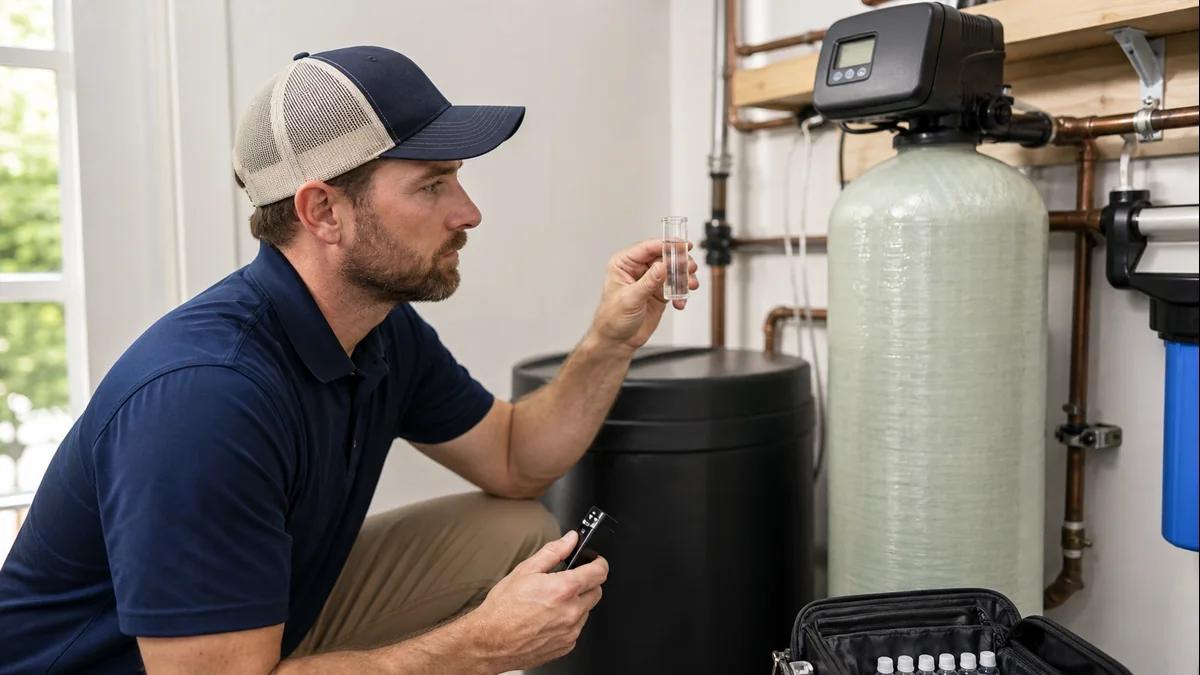
Direct answer: A Cary all-in-one system needs periodic salt checks, an occasional look at the brine tank, and an annual professional check-up — your installer sets the exact interval to your system and household. Local hardness runs 1.6–3.7 gpg by ZIP, so most Cary systems regenerate rarely and use little salt, keeping upkeep light. The annual chloramine-to-chlorine switch is often the first time you'll notice the carbon stage doing its job.
What maintenance does a Cary all-in-one system actually need?
Three routine things, in order of how often they happen: a periodic look at the salt level, an occasional check on the brine tank's condition, and a scheduled technician visit that inspects the carbon stage and confirms the unit is regenerating on schedule. None of it is complicated, and none requires you to understand the plumbing behind the valve.
The softening side and the carbon side of an all-in-one system are maintained on different tracks. Salt and brine tank care are homeowner tasks handled in a couple of minutes. The carbon stage and valve programming are technician tasks, done on a schedule your installer sets to your household and your measured water.
How often should I check my softener's salt level?
Most homeowners find a quick monthly glance at the brine tank is enough to stay ahead of a low-salt cycle. How often yours actually needs a top-off depends on household water use and where your address falls in Cary's measured hardness range — a system near the top of that range regenerates more often than one at the low end.
Check whenever you're already in the garage or utility closet: keep salt well above the waterline and looking loose and granular, and you're in good shape.
What does a healthy brine tank look like, and what's a warning sign?
Healthy salt looks loose and granular and sits above the water level, so water can move freely through it. The clearest warning sign is a salt bridge: a hard crust above the water, leaving an empty pocket underneath. The tank can look full from the top while the softener is actually running out of usable salt, because the crust blocks it from dissolving into the brine.
A related issue is salt mushing — salt breaking down into thick sludge at the tank's bottom instead of dissolving cleanly. Both usually trace to humidity, the wrong salt type, or letting the tank run too low before refilling — worth mentioning to your technician rather than diagnosing from a guess.
How often does the carbon stage need service?
There isn't a single number that fits every home — your installer sets the carbon stage's service interval based on your specific system and what's actually in your water, not a generic calendar. What drives that interval is the volume of water passing through it and the level of chlorine, chloramine, and other compounds the carbon is adsorbing day to day.
Cary/Apex water is disinfected primarily with chloramine, and the Town of Cary's 2025 Annual Water Quality Report puts total trihalomethanes (TTHM) at 37 ppb (ranging 17–43) and haloacetic acids (HAA5) at 17 ppb (ranging 9–17) — both within legal limits.
EPA's National Primary Drinking Water Regulations table lists TTHM's potential long-term health effect above the legal limit as "liver, kidney or central nervous system problems; increased risk of cancer," and HAA5's as "increased risk of cancer."
Staying under that limit is a compliance ceiling EPA set to its own risk tolerance, not proof the compounds are absent. A carbon stage removes them rather than relying on staying under a number — which is why keeping it serviced on the interval your installer set matters.
Does Cary's hardness level change how often my softener regenerates?
Yes — this is the real local wrinkle in a Cary maintenance plan. The Town of Cary's Public Works FAQ publishes a finished-water hardness of 25–30 ppm (roughly 1.5–1.75 gpg), a plant average the Town calls very soft. Our own testing across Cary addresses measures a wider range — 1.6 to 3.7 gpg by ZIP code — since what reaches a specific tap depends on where that home sits in the distribution system, not just the plant average.
Both figures are accurate; they measure different things. On the WQA/Hach scale, 1.6 gpg reads as slightly hard and 3.7 gpg (about 63 mg/L) crosses into moderately hard, over the 60 mg/L line. A home at the top of that range regenerates more often than one at the bottom — the honest answer to "how often" is address-specific, which a free water analysis settles.
What happens during Cary's annual disinfectant switch, and why does it matter for maintenance?
Once a year, on the state's recommendation, the Cary/Apex Water Treatment Facility switches from chloramine to chlorine-only disinfection and flushes the distribution system. Many homeowners notice a stronger, pool-like smell during that window — and if your carbon stage is keeping up, that smell shows up faintly or not at all, even with a different disinfectant running.
That makes the switch a useful, informal checkpoint. If the smell noticeably breaks through, flag it at your next service visit rather than assuming it will pass on its own. The Town posts the current year's dates on its own site rather than a fixed calendar, since timing shifts year to year.
What does an annual professional check-up cover?
A technician visit covers what a homeowner can't easily inspect: confirming the control valve regenerates on the correct schedule for your actual water use, checking the resin and carbon media's condition, testing hardness at the tap against your original analysis, and catching salt-bridging or mushing before it becomes a bigger problem — before drift shows up later as spotty glasses or a returning odor.
Do I need a maintenance contract, or can I handle some of this myself?
Some of it, yes. Checking the salt level, glancing at the brine tank for bridging, and refilling salt when it runs low are homeowner tasks that take a couple of minutes. Carbon stage service, valve programming, and a full annual inspection are technician tasks, since they require confirming the system against your actual measured water rather than a visual check.
Cary maintenance tasks by cadence
| Task | Typical cadence | Who handles it |
|---|---|---|
| Check salt level in the brine tank | Monthly glance | Homeowner |
| Look for salt bridging or mushing | Same visit as the salt check | Homeowner |
| Refill salt | As needed, when the level runs low | Homeowner |
| Carbon stage service | Interval your installer sets to your system and water | Technician |
| Full system inspection and performance check | Annually | Technician |
| Confirm performance during the annual disinfectant switch | Once a year, during the switch window | Homeowner notices; technician confirms if needed |
Where you fall in Cary's hardness range changes the cadence
| Address hardness (WQA/Hach scale) | What it means for regeneration | Salt habit |
|---|---|---|
| 1.6 gpg — slightly hard, low end of the measured range | Regenerates least often of anywhere in Cary | Salt lasts longest between checks |
| 3.7 gpg — moderately hard, top of the measured range | Regenerates more often | Worth checking salt a bit more frequently |
| Town of Cary's published plant average — 25–30 ppm (≈1.5–1.75 gpg) | A baseline reading at the plant, not your tap | Your actual cadence depends on your address |
Even at the top of that range, Cary is nowhere near the "very hard" tier on the WQA scale — a correctly sized, demand-initiated system still regenerates far less often here than in a genuinely hard-water market.
Keep the routine light and the system dialed in
A Cary maintenance plan is short by design: check the salt, glance at the brine tank, let a technician handle the carbon stage and the annual inspection on the interval set for your address.
The fix for knowing exactly where your home falls in that 1.6–3.7 gpg range — and what that means for your specific schedule — is a free water analysis away. Take the 60-second water quiz to see what an all-in-one system looks like for your Cary home.
FAQ
I just moved into a home near the top of Cary's hardness range — how often will I actually need to check my softener? Expect to check the brine tank a bit more often than a home at the low end of the range, since more grains per gallon means more frequent regeneration. A monthly glance is still a reasonable habit to start with, and a free water analysis will tell you exactly where your address falls.
How do I know if my brine tank has a salt bridge? Look for a hard crust sitting above the water level with an empty space underneath it — the tank can look full from the top while the softener is actually running low on usable salt. If you're not sure what you're looking at, mention it at your next technician visit rather than trying to break it up yourself.
My water started smelling different during the spring disinfectant switch — does that mean my carbon stage stopped working? Not necessarily. A stronger chlorine-like smell during Cary's annual switch to free chlorine is common even with a working system, since the plant is temporarily running a different disinfectant at a higher residual. If the smell is much stronger than usual or doesn't fade once the switch period ends, that's worth flagging at your next service visit.
Can I skip the annual professional check-up if everything seems fine? It's not recommended. A check-up catches issues — like drift between your original water test and current performance, or early salt bridging — before they show up as spotty glasses or a returning taste or odor. The visit is quick, and it's the only way to confirm the system is still matched to your actual water.
Does Cary's water being 'very soft' on the Town's own scale mean my softener barely does anything? No. The Town's 25–30 ppm figure is a plant average measured at the treatment facility; our own address-level testing across Cary runs 1.6–3.7 gpg, slightly hard to moderately hard on the WQA/Hach scale the Hach Total Hardness Test Kit uses. Minerals at either end of that range still build up on fixtures and inside a water heater over time — a softener is still doing real work.
What's the difference between the salt I check myself and the carbon service a technician handles? Salt and brine tank care are a physical, visual check anyone can do in a couple of minutes. The carbon stage removes chlorine, chloramine, and disinfection byproducts through adsorption rather than salt, and confirming it's still performing correctly requires testing against your original water analysis — that's technician work, done on the interval set for your system.
Sources
- Town of Cary — Public Works FAQ
- Town of Cary — Annual Water Disinfection Change
- Town of Cary — 2025 Annual Water Quality Report
- EPA — National Primary Drinking Water Regulations
Related reading: Water Treatment Company Near Me in Cary, NC | Water Softener vs. All-in-One System | How Does Water Softener Regeneration Work? | Why Does Cary Water Smell Like a Chlorinated Pool? | Best Whole-Home System for Cary, Apex & Morrisville
Answer nine practical questions, then request a written quote or well-water analysis.
Start My Water Analysis