
What Maintenance Does a Water Softener Need in Wake Forest, NC?
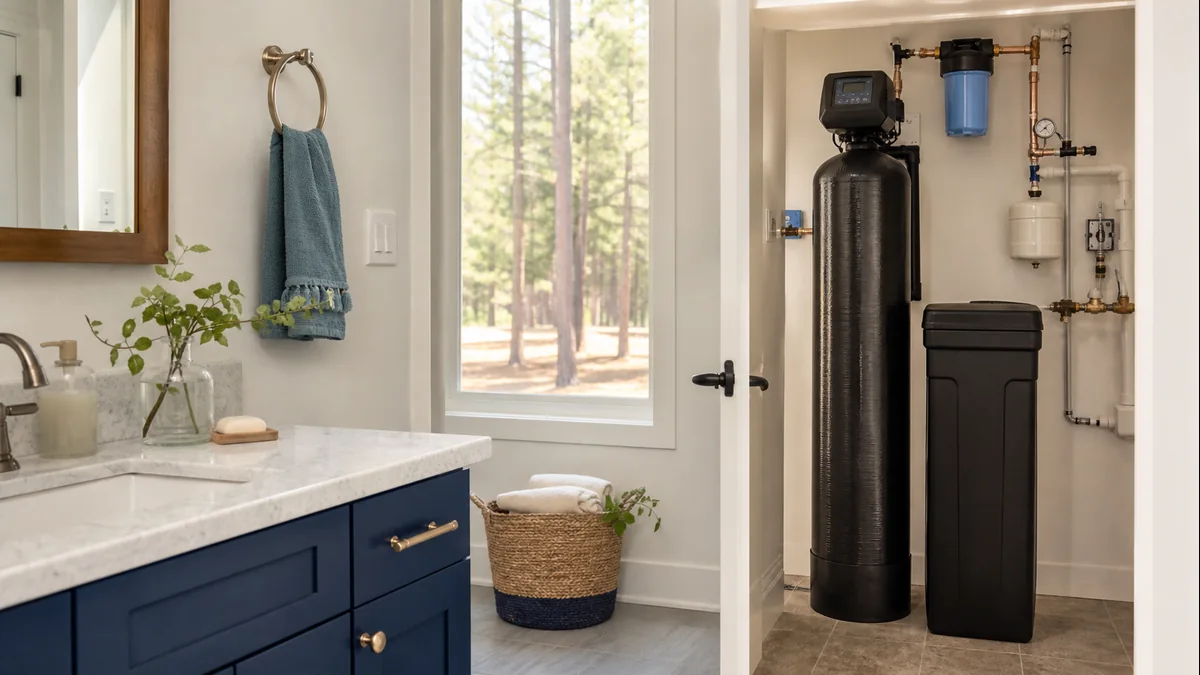
Direct answer: A Wake Forest all-in-one system's upkeep splits into homeowner salt checks and technician-handled carbon and valve service. Wake Forest is on Raleigh Water, whose 2025 report puts hardness at a slightly hard 1.3–2.1 gpg — genuinely low, meaning less frequent regeneration and less salt used. The exact schedule is set for your home at install, based on your measured hardness and water use.
What Does a Wake Forest Water Softener Maintenance Plan Actually Cover?
Two tracks, split by who's responsible. Homeowner tasks are visual and quick: watching the brine tank's salt level and refilling it before it runs dry. Technician tasks require testing and equipment: confirming the control valve is regenerating correctly, inspecting the resin and carbon media, and checking hardness at the tap against your original water analysis.
This page covers what that upkeep consists of and who owns each piece — not what it costs. For dollar figures, see Water Softener Salt Cost Per Year.
Who Handles the Salt Level in a Wake Forest Home?
The homeowner. It's a visual check — glance at the brine tank whenever you're already in the garage or utility closet, and keep the salt sitting above the waterline, loose and granular rather than caked.
Watch for two things: a salt bridge, a hard crust above the water with an empty pocket underneath, and salt mushing, where salt breaks down into sludge instead of dissolving. Both usually trace to humidity, the wrong salt type, or letting the tank run too low before refilling. If you spot either, flag it for your technician rather than trying to break it up yourself. How to Maintain a Water Softener walks through the fuller day-to-day picture.
Why Does the Carbon Stage Matter So Much for a Wake Forest System?
Because Wake Forest is on Raleigh Water, and Raleigh Water normally disinfects with chloramine before switching the entire system to free chlorine once a year on the North Carolina Department of Environmental Quality's recommendation, flushing the distribution system to speed the changeover. Chlorine residual runs higher than normal system-wide during that period.
Historically that conversion has run from late February into early April, but the exact dates shift year to year — check Raleigh Water's own chlorine conversion announcement each spring rather than a fixed calendar.
A well-serviced carbon stage is built to absorb that swing without a change reaching your glass. If a taste or odor does break through during that window, mention it at your next technician visit instead of waiting for your next scheduled check.
Is Wake Forest's Water Hard Enough to Affect Maintenance?
Yes, and the direction is in your favor. Raleigh Water's 2025 Consumer Confidence Report puts average hardness at 25.2 ppm, ranging 21.9–35.3 ppm — about 1.3 to 2.1 gpg. Our own in-home testing across the wider service area, including Wake Forest, reads 1.6 to 3.7 gpg by ZIP code.
On the Water Quality Association (WQA) scale the Hach Total Hardness Test Kit, Model 5-B uses, that's slightly hard — not soft, and not plain "hard," since that band starts at 7 gpg.
| Parameter | Raleigh Water 2025 value | Legal limit |
|---|---|---|
| Hardness (avg / range) | 25.2 ppm (21.9–35.3) | — |
| TTHM (avg / up to) | 34.2 ppb (up to 42.8) | 80 ppb |
| HAA5 (avg / up to) | 22.0 ppb (up to 33.6) | 60 ppb |
Lower hardness is a real maintenance benefit: a softener regenerates less often and uses less salt on slightly hard water than it would on hard or very hard water elsewhere. That doesn't remove the salt checks above — it means the cadence set for your home tends to be an easy one to live with.
What Does a Professional Check-Up Cover in a Wake Forest Home?
A technician visit covers what a homeowner can't check from outside the tank: confirming the valve regenerates correctly for your household's actual water use, inspecting the resin and carbon media's condition, testing hardness at the tap against your original analysis, and catching salt bridging or mushing before it turns into spotty glasses or a returning taste or smell.
That same visit confirms the carbon stage kept pace through the year, including through Raleigh Water's annual chlorine conversion — the closest thing to a stress test the system sees.
Does Wake Forest Have Chlorine Byproducts to Know About?
Yes, and they're the reason the carbon stage exists in an all-in-one system. Raleigh Water's 2025 CCR shows total trihalomethanes (TTHM) averaging 34.2 ppb, up to 42.8, against an 80 ppb limit, and haloacetic acids (HAA5) averaging 22.0 ppb, up to 33.6, against a 60 ppb limit.
EPA's National Primary Drinking Water Regulations table lists TTHM's potential health effect from long-term exposure above the legal limit as "Liver, kidney or central nervous system problems; increased risk of cancer," and HAA5's as "Increased risk of cancer."
Raleigh Water is fully compliant on both figures — there's no violation here. But "compliant" describes a ceiling EPA set at the edge of its own risk tolerance, not proof the compounds are absent below it. A carbon stage removes TTHM and HAA5 directly rather than relying on staying under a legal number, which is why keeping that stage serviced matters in Wake Forest.
Can I Handle Any of This Myself, or Does It All Need a Technician?
Some of it, yes. Checking the salt level, glancing for bridging, and refilling salt when it runs low are homeowner tasks that take a couple of minutes. Carbon stage service, valve programming, and the full system inspection are technician tasks — they require testing against your original water analysis, not a visual check.
If something seems off between visits, here's how to tell if your water softener is broken.
Wake Forest Maintenance Tasks: Who Handles What
| Task | Who handles it |
|---|---|
| Check salt level in the brine tank | Homeowner — a quick look whenever you're near the tank |
| Look for salt bridging or mushing | Homeowner — same visit as the salt check |
| Refill salt | Homeowner — as needed, whenever the level runs low |
| Carbon stage service | Technician — on the schedule set for your home at install |
| Full system inspection and performance check | Technician — on the schedule set for your home at install |
| Confirm hardness reading against original analysis | Technician — same visit as the full inspection |
Does Wake Forest's Historic District Change Anything About Softener Maintenance?
Not the softener maintenance itself, but it can change what a technician finds behind the wall. Older homes in Wake Forest's historic core sometimes carry galvanized or otherwise aging plumbing, which is a separate consideration from the softener's own upkeep. Old home plumbing in Wake Forest's historic district covers what that means for an install.
Keep the Routine Light, Let the Carbon Stage Do the Real Work
A Wake Forest maintenance plan stays short on homeowner tasks and long on why the carbon stage matters, especially through the yearly chlorine switch: check the salt, watch for bridging, and let a technician handle carbon service and the full system inspection on the schedule set for your address. Water Softener Regeneration Explained covers what the regeneration cycle itself is doing between visits.
The only way to know your exact cadence — and to confirm the carbon stage is keeping pace with what Raleigh Water's own 2025 report shows — is a free water analysis. Take the 60-second water quiz to see what an all-in-one system's maintenance plan looks like for your Wake Forest home, or book a free in-home water analysis with Triangle Waterworks.
FAQ
I just moved to Wake Forest and my water smells strongly of chlorine every spring — is that normal? Likely yes. Raleigh Water converts from chloramine to free chlorine once a year on NC DEQ's recommendation and flushes the distribution system, which raises chlorine residual system-wide for that period. A properly serviced carbon stage is built to keep that smell from reaching your glass — if it does break through, mention it at your next technician visit.
How do I know if my brine tank has a salt bridge? Look for a hard crust sitting above the water level with an empty space underneath — the tank can look full from the top while the softener is actually running low on usable salt. If you're not sure what you're seeing, flag it for your technician rather than breaking it up yourself.
Does Wake Forest's lower hardness mean less maintenance overall? It means less frequent regeneration and less salt used, since Raleigh Water's hardness runs slightly hard (about 1.3–2.1 gpg per the 2025 report) rather than hard or very hard. The carbon stage's service schedule doesn't move with hardness — it's set independently, based on chlorine, chloramine, and disinfection byproduct levels.
Can I skip the professional check-up if everything seems fine? It's worth keeping on the schedule set for your home. A check-up catches drift between your original water test and current performance and catches early salt bridging before it becomes a bigger issue, and it confirms the carbon stage is keeping pace with what's actually coming through Raleigh Water's system — including during the yearly chlorine conversion, the stretch that tests it hardest.
What's the difference between the salt I check myself and the carbon service a technician handles? Salt and brine tank care are a physical, visual check anyone can do in a couple of minutes. The carbon stage removes chlorine, chloramine, and disinfection byproducts through adsorption rather than salt, and confirming it's still performing correctly means testing against your original water analysis — that's technician work, set to your system and address.
My house is in Wake Forest's historic district — does that change my softener's maintenance? No, the softener's own upkeep is the same salt checks and technician service described above regardless of the home's age. What can differ is the plumbing behind the wall, which a technician accounts for at install and during service visits on an older home.
Sources
- City of Raleigh — 2025 Water Consumer Confidence Report
- EPA — National Primary Drinking Water Regulations
Related reading: Water Treatment in Wake Forest, NC | Is Wake Forest, NC Water Hard? | Water Softener Cost in Wake Forest, NC | Water Softener Maintenance Plan in Raleigh, NC | Old Home Plumbing in Wake Forest's Historic District
Answer nine practical questions, then request a written quote or well-water analysis.
Start My Water Analysis