
Water Softener Morrisville NC: New Construction Meets Jordan Lake Water
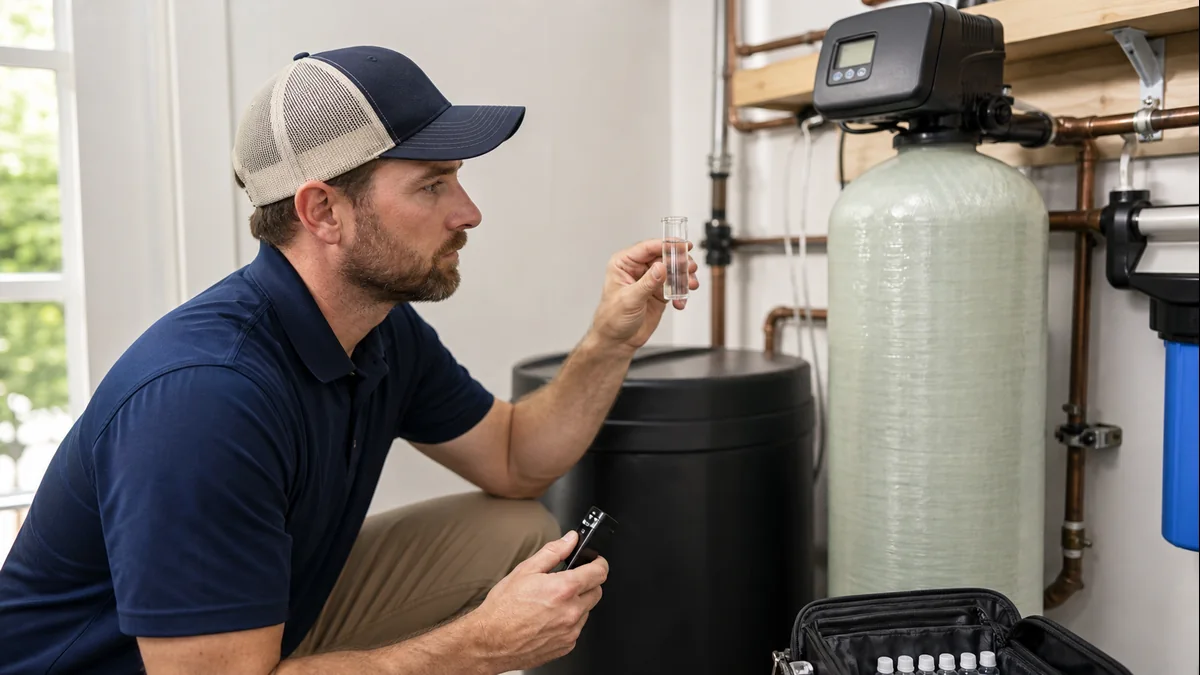
Direct answer: Morrisville — including its Wake County stretch of Research Triangle Park — is served by the Cary/Apex Water Treatment Facility, sourced from Jordan Lake, and tests 1.6–3.7 grains per gallon (gpg), slightly hard at the low end and moderately hard at the top. Morrisville has built out fast around RTP, and a lot of that housing stock is new: new water heaters, new fixtures, new plumbing with no scale history yet. The efficient system for a Morrisville home pairs softening resin (to stop scale before it accumulates) with carbon filtration (to handle chlorine taste, PFAS, and disinfection byproducts) in one all-in-one unit.
How Hard Is Morrisville's Water?
Morrisville shares its water source and treatment facility with Cary and Apex: the Cary/Apex Water Treatment Facility, drawing from B. Everett Jordan Lake. That puts Morrisville in the same 1.6–3.7 gpg range on the Water Quality Association (WQA) hardness scale — the same one the Hach Total Hardness Test Kit (Model 5-B) uses:
| Classification | ppm (mg/L) | Hardness (gpg) |
|---|---|---|
| Soft | <17 | <1.0 |
| Slightly hard | 17 – 60 | 1.0 – 3.5 |
| Moderately hard | 60 – 120 | 3.5 – 7.0 |
| Hard | 120 – 180 | 7 – 10.5 |
| Very hard | 180+ | 10.5+ |
The WQA lines that matter here: soft ends at 1.0 gpg, slightly hard runs 1.0–3.5 gpg, and moderately hard picks up at 3.5 gpg. Morrisville's 1.6–3.7 gpg range starts slightly hard and crosses into moderately hard at the top, which means noticeable scale on fixtures and appliances is a normal outcome here, not an edge case. That's a similar picture to Raleigh, whose 1.6 gpg water is also slightly hard on this scale — see Raleigh water hardness for the full comparison.
Why This Matters More in a Fast-Growing RTP Suburb
Morrisville's identity is tied up with Research Triangle Park — it holds the Wake County portion of RTP, and the town has added housing stock at a pace to match the jobs coming with it. Practically, that means a high share of Morrisville homes have appliances and plumbing that are only a few years old, sometimes only a few months old. New equipment doesn't come with any resistance to scale built in — a brand-new water heater accumulates mineral deposits on its elements at the same rate an older one does, just starting from zero. The advantage of catching this early in Morrisville is real: a softener installed when the home is new means the water heater, dishwasher, and washing machine never have to work against scale buildup at all, rather than trying to undo years of it later. See signs you need a water softener for the buildup patterns homeowners eventually notice if this goes unaddressed.
What's Actually in Morrisville's Tap Water?
Because Morrisville is on the same plant and source as Cary, it carries the same documented contaminant profile from the EWG Tap Water Database: HAA9 at 27.5 ppb — about 458 times the EWG's 0.06 ppb health guideline — TTHM at 38.2 ppb, PFOA at 2.86 ppt, and PFOS at 3.79 ppt, with 13 contaminants total above EWG guidelines. Two things are both true here: this water fully meets EPA's legal requirements, and it also exceeds a stricter, non-regulatory health benchmark on a number of measures. Those aren't contradictory — they're two different bars, and it's worth knowing both. See is Cary, NC water safe to drink for the detailed contaminant breakdown that applies to the shared plant.
Jordan Lake, the source reservoir for this system, has its own documented PFAS history — Duke University researchers measured combined PFAS above 200 ppt in the lake's raw source water in 2017. That's a watershed-level issue upstream of the treatment plant, not something the utility introduced. It does mean PFAS is a real consideration at the tap, and neither hardness nor boiling addresses it — removing PFAS takes activated carbon certified for PFAS removal (NSF/ANSI 53 or P473) or reverse osmosis (NSF/ANSI 58). See whole-house water filtration for Cary-area homes for how carbon removes PFAS at the tap.
One System, Two Jobs
A softener and a carbon filter solve different problems, and Morrisville's water profile needs both:
- Softening resin exchanges calcium and magnesium out of the water before they can scale a water heater, clog a dishwasher's spray arms, or leave spots on glasses and dishes.
- Carbon filtration removes chlorine taste and smell, PFAS, and disinfection byproducts like HAA9 and TTHM — none of which a softener touches.
Combining both into one all-in-one system means a single installation and a single maintenance routine instead of managing two separate boxes. For a household moving into new Morrisville construction, installing this at the outset is the more economical path — protecting appliances from their first use costs far less than replacing a water heater that scaled out early. Pricing is set after a free water analysis, and it typically lands well under the $6,000–$12,000 commonly quoted by national big-brand installers for similar coverage. See water softener cost in Raleigh for more on how the pricing breaks down by household size.
Morrisville Water vs. Raleigh and National Reference Points
| Hardness (gpg) | WQA classification | Source | |
|---|---|---|---|
| Morrisville, NC | 1.6–3.7 | Slightly hard to moderately hard | Cary/Apex plant, Jordan Lake |
| Raleigh, NC | 1.6 | Slightly hard | Raleigh Water system |
| Very hard water (national reference) | 10.5+ | Very hard | Varies by region |
Morrisville isn't in "very hard" territory the way some regions of the country are, but the top of its 1.6–3.7 gpg range is genuinely moderately hard — enough to matter for new appliances and plumbing across the town's newer subdivisions.
Frequently Asked Questions
Is Morrisville water hard enough to need a softener? Morrisville's 1.6–3.7 gpg range, sourced from the same Cary/Apex plant as Cary, runs from slightly hard up into moderately hard at the top — hard enough that scale buildup on water heaters and appliances is a normal, expected outcome for many homes here rather than an unusual case.
I just closed on a new build near RTP in Morrisville — should I install a softener before I even see problems? Yes, that's actually the ideal time. Scale accumulates gradually starting from a water heater's very first use, so installing a softener while the home and its appliances are still new means the equipment never has to work against buildup at all — a much better outcome than trying to reverse scale damage a few years in.
Does Morrisville have the same water as Cary? Yes — Morrisville, Cary, and Apex all draw from the same Cary/Apex Water Treatment Facility, sourced from Jordan Lake, so all three share the same 1.6–3.7 gpg hardness range and the same documented contaminant profile.
My dishwasher glasses come out with spots even though I just moved from a soft-water city — what's going on? That's a hardness issue, and it lines up with what's expected in Morrisville — the town's 1.6–3.7 gpg range crosses into moderately hard water, which leaves the mineral spotting and film on glassware that softer-water cities don't produce. A correctly sized softener resolves it.
Is it safe to drink Morrisville tap water given the Jordan Lake PFAS history? Morrisville's water meets every EPA legal requirement. The Jordan Lake PFAS history is a documented, watershed-level issue in the source reservoir, and EWG's stricter guideline is a separate, non-regulatory benchmark — both are real, but neither means the water is out of compliance. Many households choose carbon filtration to address it beyond the legal minimum.
What's the cost to add a whole-home system to a new Morrisville house? A free water analysis sizes the system to your home first, and pricing typically lands well under the $6,000–$12,000 commonly quoted by national big-brand installers — and adding it while the home is new protects appliances from day one rather than after scale has already set in.
Find Out What Your Morrisville Home Needs
Take our 60-second water quiz to see what your Morrisville home's water actually needs. For most homes on the Cary/Apex system — especially newer construction near RTP — that means an all-in-one softening + carbon filtration system that protects new appliances from scale while handling the chlorine taste, PFAS, and disinfection byproducts that come with the Jordan Lake source.
Answer nine practical questions, then request a written quote or well-water analysis.
Start My Water Analysis