
Do You Need a Water Softener in North Carolina?
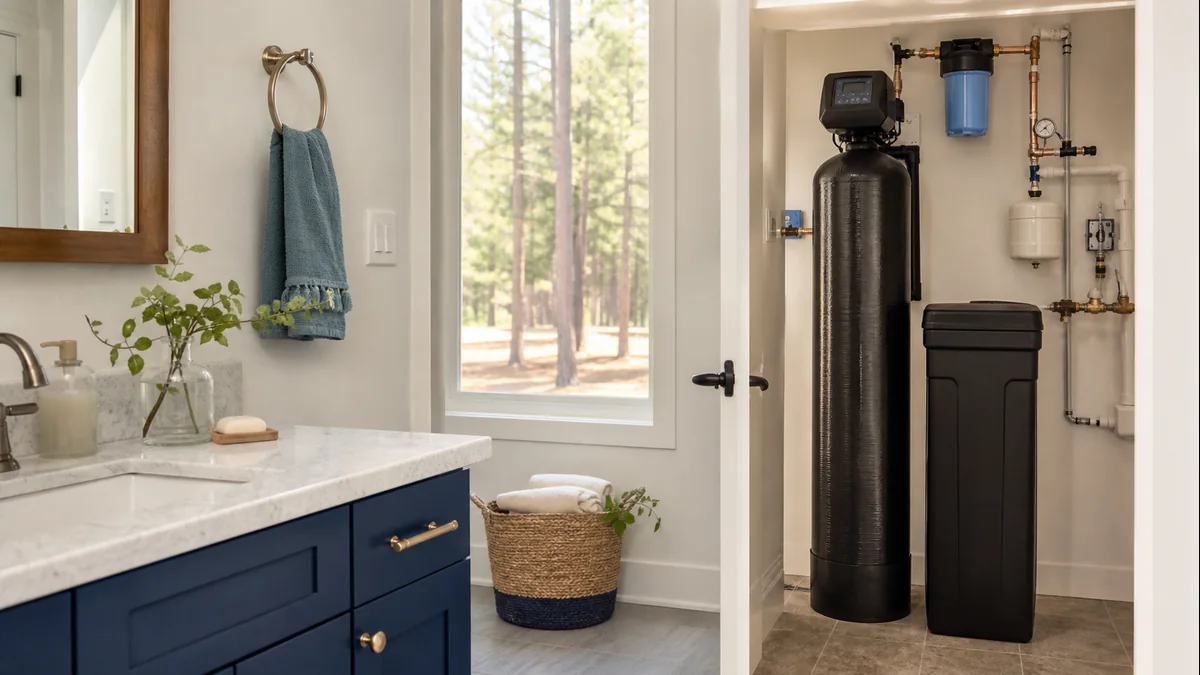
Direct answer: For most Triangle homes, a water softener is one of the best upgrades you can make. Raleigh water tests around 1.6 grains per gallon (gpg), which is slightly hard on the WQA scale (the same scale the Hach Total Hardness Test Kit uses), and Cary's system runs 1.6–3.7 gpg — slightly hard at the low end, but the top of that range crosses into moderately hard. Even on Raleigh's slightly hard supply, the calcium and magnesium that stay in your water keep building up over the years — on your fixtures, inside your water heater, and on every dish and glass — and on Cary's system, the upper end of the range is genuinely hard enough to notice. A softener removes what's left, so your appliances last longer, your dishes come out cleaner, and your skin and hair feel better. On a private well, where hardness runs much higher, a softener isn't just an upgrade — it's essential.
Why a Softener Still Pays Off on Triangle Water
It's easy to assume low-hardness water means there's nothing to fix. But minerals are still in the water, and they don't disappear — they accumulate quietly, a little more every day:
- Buildup happens over time. Even slightly softer water leaves mineral deposits on shower glass, faucets, and inside pipes. You don't notice it in a week — you notice it in the spots on your glassware, the film on your shower door, and the water heater that wears out sooner than it should.
- Your appliances last longer. Scale is the enemy of every appliance that touches water. Softened water helps your water heater, dishwasher, washing machine, and plumbing run cleaner and last longer — protecting the expensive equipment in your home.
- Cleaner dishes and glassware. Softened water rinses cleaner, so you get fewer spots and less film on dishes, glasses, and silverware — with less soap and detergent.
- Softer skin and hair, cleaner laundry. Soap lathers better in softened water, which means softer skin and hair and brighter, softer laundry.
The Numbers — and Why They Don't Tell the Whole Story
| System | Hardness | Classification |
|---|---|---|
| Raleigh Water (Raleigh, Garner, Knightdale, Rolesville, Wake Forest, Wendell, Zebulon) | ~1.6 gpg | Slightly Hard |
| Cary/Apex/Morrisville system | ~1.6–3.7 gpg | Slightly Hard to Moderately Hard |
Raleigh's number is at the low end of the scale — slightly hard. Cary's range spans slightly hard at 1.6 gpg up to moderately hard at 3.7 gpg — and either way, these are plant-tested numbers, not what accumulates in your home over five or ten years of daily use. Buildup is cumulative. A softener protects your home for the long run, not just for today's reading. For more on what these numbers mean locally, see Raleigh water hardness.
What a Softener Does for Your Home
Softeners remove calcium and magnesium through an ion-exchange process, using salt to regenerate the resin. The everyday payoff:
- Protects pipes, your water heater, and appliances from scale buildup
- Soap and detergent lather better, so you use less
- Fewer spots on dishes and glassware
- Softer skin and hair, softer laundry
The harder your water, the bigger the difference — which is why wells (often 7+ gpg) see a dramatic change. But even on Triangle city water, protecting your appliances and getting cleaner dishes adds up over the life of your home.
A Softener Is One Piece — Not the Whole Picture
A softener handles minerals and scale. It does not remove the two things Triangle city water is actually documented for: chlorine/chloramine taste and smell, and contaminants like PFAS and disinfection byproducts. Those need carbon filtration, not softening.
That's exactly why the systems we recommend pair softening + whole-home carbon filtration together — you get the scale protection and cleaner dishes of a softener and cleaner, better-tasting water throughout the house. One system, both jobs. If your main concern is taste, smell, or contaminants, see signs you need a water softener to sort out which piece matters most for your home.
Wells: The Case Is Even Stronger
Roughly 15% of Wake County homes are on private wells, with higher shares in Johnston, Franklin, Chatham, and Granville counties. Well water hardness is property-specific — it depends on the aquifer and geology under your lot — and it usually runs much higher than city water. NC does not regulate private well water after construction, so testing is up to the owner. A comprehensive well water test (hardness plus iron, pH, sulfur, and TDS) tells us exactly how to size your system — see our well water treatment guide.
How to Get the Right System for Your Home
- On city water: a softener protects your appliances and gives you cleaner dishes and softer water day to day — and paired with carbon filtration, it also handles taste and contaminants. Take our 60-second water quiz and we'll recommend the right fit.
- On a well: get a comprehensive test first so we size the system to your actual water. We provide a free water analysis for well owners.
Sizing comes down to household size and daily water use — see what size water softener do I need for the details.
What It Costs
Whole-home systems are sized and quoted after a free water analysis, priced to what your water needs — softening, carbon filtration, iron, pH, sulfur, or a combination.
FAQ
Is Raleigh water hard or soft? Raleigh Water tests around 1.6 gpg — slightly hard on the WQA scale (the scale the Hach Total Hardness Test Kit uses) — but even at that level, minerals carry through and build up over time, which is why a softener still protects your appliances and improves your everyday water.
Will a softener make a difference on Cary or Raleigh water? Yes. You'll see cleaner dishes and glassware, softer skin and hair, better lather, and longer-lasting appliances — plus protection from the gradual buildup that even softer water leaves behind.
If I'm on a well, do I need a softener? Almost certainly — well hardness runs much higher and varies property to property. We test first so we size it right.
Does a softener remove PFAS or chlorine byproducts? No — that's carbon filtration's job, which is why our recommended systems pair softening with whole-home carbon so you get both.
What size softener do I need? It depends on household size and daily water use. Take the water quiz or request a free analysis and we'll size it for you.
Ready for cleaner, softer water and appliances that last longer? Take our 60-second water quiz for city water, or request a free water analysis if you're on a well.
Answer nine practical questions, then request a written quote or well-water analysis.
Start My Water Analysis