
How Does Water Softener Regeneration Work?
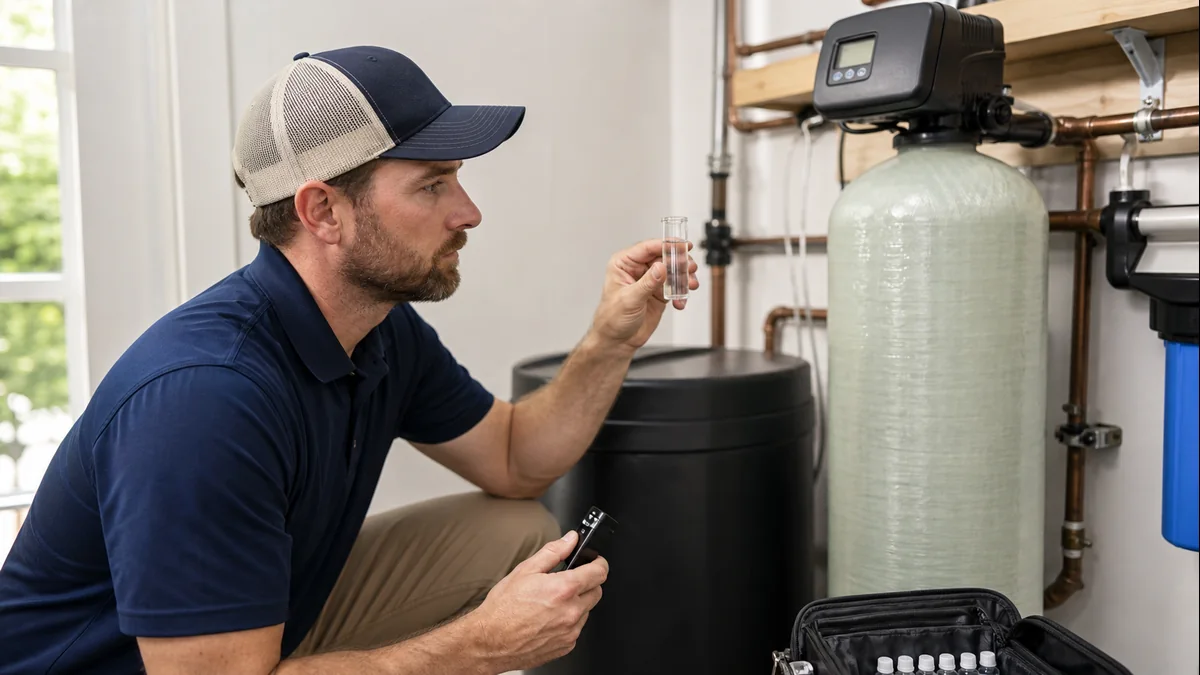
Direct answer: A water softener holds resin beads coated in sodium ions. As hard water passes through, the beads trade their sodium for the calcium and magnesium in your water — that's ion exchange. Once the beads are loaded with hardness minerals, the system flushes them with a saltwater brine solution, which strips the calcium and magnesium out to the drain and reloads the beads with sodium so the cycle can start again. On Triangle water, a correctly sized, demand-initiated all-in-one system does this rarely and inexpensively.
What actually happens inside a water softener during regeneration?
Regeneration is the softener recharging its own resin so it can keep removing hardness. Inside the tank, thousands of small resin beads carry sodium ions on their surface. As your household's water flows through the resin bed, calcium and magnesium ions — the minerals that make water "hard" — are more chemically attracted to the resin than sodium is, so they displace the sodium and stick to the beads instead. The water that comes out the other side has had its calcium and magnesium swapped out; that's softened water.
Every bead has a limited amount of surface area, so this trade only works for so long before the beads are holding as much calcium and magnesium as they can. At that point, the softener runs a regeneration cycle: a brine solution (water mixed with the salt in the softener's brine tank) floods the resin bed. Because there's now a heavy concentration of sodium in the brine, the chemistry reverses — sodium displaces the calcium and magnesium off the beads, and that hardness rinses away to the drain. The resin ends up recoated in sodium, ready to soften water again. The cycle then simply repeats, over and over, for as long as the system runs.
What's the difference between demand-initiated and timer-based regeneration?
The difference is what triggers the regeneration cycle. Older and simpler softeners use a timer-based (or time-clock) control: it regenerates on a fixed schedule the installer or homeowner sets, whether or not the household actually used enough water to load the resin. A demand-initiated regeneration (DIR) system instead tracks actual water use with a meter and only regenerates once the resin has genuinely reached its capacity.
| Timer-based regeneration | Demand-initiated regeneration | |
|---|---|---|
| What triggers a cycle | A fixed schedule (e.g., every few days) | Actual measured water use reaching resin capacity |
| Regenerates even with low usage? | Yes — runs on schedule regardless | No — only when the resin needs it |
| Salt and water use | Higher, because unnecessary cycles still run | Lower, because cycles only happen when needed |
| Best fit | Older systems, simpler controls | Modern all-in-one systems on any hardness level, especially lower-hardness water |
Because a demand-initiated system regenerates based on how much water your household has actually run through it — not a calendar — it's the more efficient approach almost everywhere, and especially so on water that isn't very hard to begin with.
Why does regeneration matter more for homes in the Triangle specifically?
Because local hardness levels are on the low-to-moderate side of the WQA hardness scale, which means a demand-initiated softener here has less work to do and regenerates infrequently. Raleigh Water tests at roughly 1.6 grains per gallon (gpg) — slightly hard on the Water Quality Association (WQA) scale, the same one the Hach Total Hardness Test Kit (Model 5-B) uses. Cary, Apex, and Morrisville span a wider range, roughly 1.6–3.7 gpg, slightly hard at the low end and moderately hard at the top of that range. Either way, a demand-initiated system sized correctly for your household and your actual tested hardness only regenerates once meaningful hardness minerals have actually built up in the resin — and at Triangle hardness levels, that threshold takes a while to reach.
That's a genuine advantage of buying here rather than a compromise. A softener regenerating less often uses less salt and runs at a lower ongoing cost over its life — you get the full benefit of ion exchange (protecting your water heater, dishwasher, and plumbing from scale buildup, better lather, cleaner glassware) without the resin working overtime the way it would on much harder well water. See Raleigh water hardness for the source numbers and what size water softener you need for how household size and hardness combine to determine sizing.
Will regeneration make my water taste salty?
No. Softened water is not salty in the way people picture salt sprinkled into a glass of water. During ion exchange, calcium and magnesium ions in your water are swapped for sodium ions — but those sodium ions are dissolved in solution at a much lower concentration than table salt, and taste is governed by concentration, not the mere presence of sodium. The brine itself — the concentrated saltwater used to recharge the resin — stays inside the regeneration cycle and rinses to the drain; it isn't what comes out of your faucet. What reaches your tap is water that's been through ion exchange, not water mixed with brine.
Will I notice regeneration happening in my house?
Typically, no. Regeneration is designed to run during off-peak hours — commonly overnight — specifically so it doesn't interrupt water pressure or hot water while the household is using either. Because a demand-initiated system only regenerates once it's actually needed, and Triangle hardness levels mean that threshold is reached relatively rarely, most households simply never notice the cycle taking place at all.
Does the carbon filter regenerate too?
No — and this is a common point of confusion with all-in-one systems. The carbon stage that removes chlorine and chloramine taste, PFAS, and disinfection byproducts works by adsorption: contaminants stick to the carbon media as water passes through it, rather than being exchanged with sodium the way hardness minerals are. Carbon media doesn't get "recharged" with a brine rinse — it's serviced separately from the softening resin, on its own maintenance schedule, as part of keeping the whole-home system performing correctly. Only the softening side of an all-in-one system uses the salt-and-brine regeneration cycle described above.
The Softening Standard Behind the Resin
Residential water softeners sold in the U.S. are built to NSF/ANSI 44, the standard covering cation exchange — the ion-exchange process described above. It's worth knowing the standard's name if you're comparing systems, though the specific certified claims on any product still matter more than the standard name alone. For a full picture of how softening resin and carbon filtration work together in one system, see water softener vs. all-in-one system; if you're weighing ion exchange against a salt-free conditioner, see salt-free conditioner vs. water softener.
Frequently Asked Questions
How does water softener regeneration work in simple terms? Resin beads inside the softener hold sodium ions and trade them for the calcium and magnesium in your incoming water. Once the beads are loaded with those hardness minerals, a brine (saltwater) rinse flushes the hardness out to the drain and reloads the beads with sodium, so the process can repeat.
What's the difference between demand-initiated and timer-based regeneration? A timer-based system regenerates on a fixed schedule regardless of how much water was actually used. A demand-initiated system uses a meter to track real water use and only regenerates once the resin has genuinely reached capacity — which means less salt and water used overall.
I just moved to Cary and I'm worried a softener will make my water taste like salt — is that true? No. The sodium ions exchanged into your water during softening are dissolved at a low concentration, nothing like table salt in a glass of water. The concentrated brine used to recharge the resin stays in the regeneration cycle and drains away — it isn't part of the water that reaches your faucet.
I've heard regeneration wastes a lot of water and salt — is that a real concern here? It depends on the system. A demand-initiated softener sized to your household and Triangle's actual hardness levels only regenerates when the resin needs it, which is relatively infrequent given how low Raleigh's hardness runs (slightly hard on the WQA scale) and how moderate Cary/Apex/Morrisville water is at the high end. That keeps both salt and water use low compared to an older timer-based unit.
Will regeneration happen while I'm in the shower or running the dishwasher? It's designed not to. Regeneration is generally scheduled for off-peak hours, commonly overnight, specifically to avoid interrupting water use during the day. Combined with how infrequently a demand-initiated system needs to regenerate on Triangle water, most households never notice it happening.
Does the carbon filtration part of my all-in-one system need the same salt-and-brine regeneration as the softener? No. Carbon removes chlorine taste, PFAS, and disinfection byproducts by adsorption, not ion exchange, so it doesn't regenerate with brine at all. It's maintained separately from the softening resin as part of the system's overall service schedule.
See What Regeneration Looks Like for Your Home
Take our 60-second water quiz to see how an all-in-one system — sized to your household and your actual local hardness — would run on your water, including how infrequently it would need to regenerate.
Answer nine practical questions, then request a written quote or well-water analysis.
Start My Water Analysis