
When Should You Replace a Water Softener in Clayton, NC?
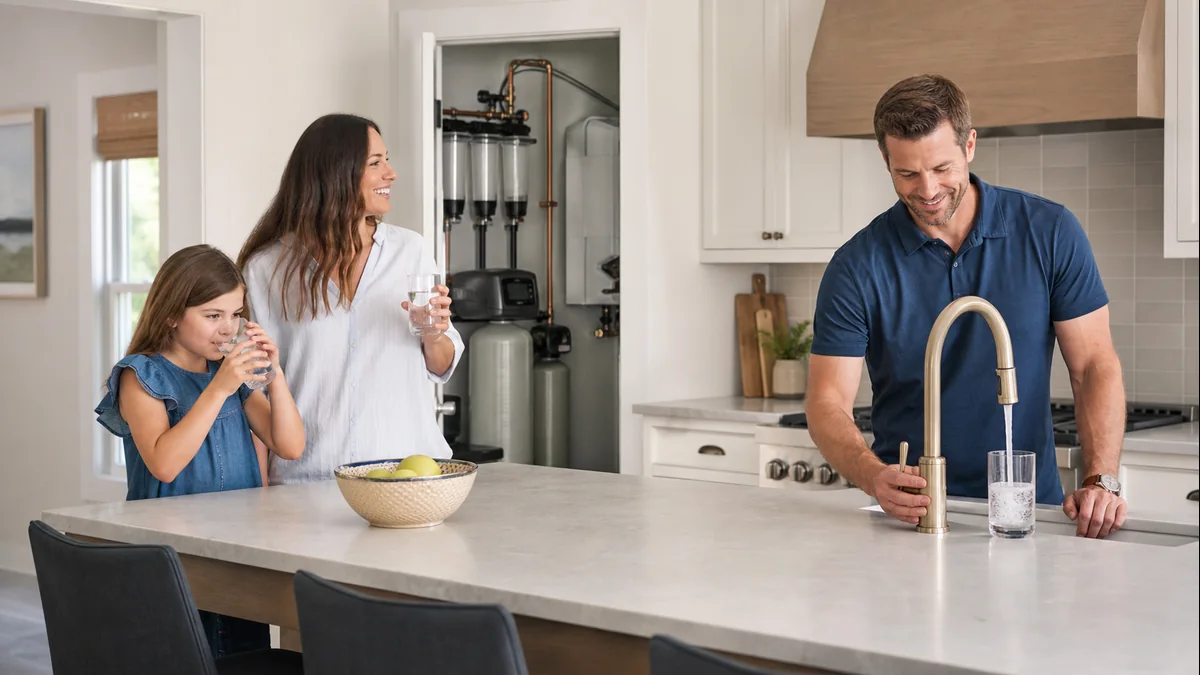
Direct answer: A Clayton water softener is worth replacing when hardness symptoms return, salt use climbs, or regeneration cycles stack up — signs the resin has lost capacity, not a quick fix. A softener-only unit also never touched chlorine taste or disinfection byproducts. An all-in-one softening-and-carbon system, sized after a free water analysis, closes both gaps at once.
What Signs Point to an Aging Softener in Clayton?
Clayton has grown fast, and a softener installed years ago is old enough that returning symptoms are worth a real look. It's the combination that matters, not any single sign:
- Glassware and shower doors filming over or spotting again after a stretch of coming out clear
- A harder time working up suds with the same soap or shampoo
- Faucets, showerheads, or the coffee maker collecting scale that wasn't there before
- Towels and clothes feeling rougher or looking duller straight out of the wash
- Salt disappearing faster than usual, or the tank barely dropping between fill-ups
- More regeneration cycles per week than the unit has historically run
One symptom alone often has an ordinary explanation. Several turning up together on an older unit points toward the resin bed losing its ability to exchange calcium and magnesium.
Brine Tank Blockage or Exhausted Resin — How Do You Tell the Difference?
Two physical blockages inside the brine tank mimic resin failure without actually being it. A salt bridge is a hard crust that forms above the waterline, leaving the tank looking full while nothing dissolves into brine underneath. Salt mush is a wet, sludge-like buildup at the bottom that blocks the same process from below.
Breaking up either one and running a normal regeneration cycle often fixes the problem outright. If spotting or poor lathering keeps coming back with fresh salt and a tank drawing down normally, the resin itself is the more likely cause — not something a cleared tank can reverse.
Why Do Rising Salt Bills and Frequent Regeneration Both Point to the Resin?
As resin beads age, they hold less calcium and magnesium with each cycle, so the control valve compensates by regenerating more often to keep up with the same household demand. That means more salt and more water spent for a smaller softening result every time it runs.
A softener regenerating daily, especially alongside returning hardness symptoms, is wearing out from the inside rather than hitting a scheduling quirk. Both signs together make a stronger case than either alone.
What Does Clayton's Own Water Data Say About Hardness?
Clayton publishes its own hardness figure directly on its Drinking Water page, stated verbatim: "The typical level of hardness for the water coming into Clayton is 30 milligrams per liter (mg/L)." That's the Town's own published number.
On the Water Quality Association (WQA) scale the Hach Total Hardness Test Kit, Model 5-B uses, 30 mg/L converts to roughly 1.75 grains per gallon — which falls inside the slightly hard band, not the "soft" label Clayton's own page applies using an older USGS-style scale it reproduces. Both labels are accurate; they're the same measured water read against two different classification scales, not a disagreement about the number itself.
Slightly hard is real, measurable hardness — not extreme, but not mineral-free either. Calcium and magnesium at that level accumulate on fixtures, glassware, and inside a water heater cumulatively over years, which is exactly the gradual wear a softener is meant to intercept. See how Clayton's hardness compares across the Triangle.
What Does Municipal Disinfection Mean for Clayton's Water?
Like any municipal system, Clayton's water is disinfected to control bacteria as it moves through the distribution network. That step can react with organic material in the source water to form byproducts — trihalomethanes (TTHM) and haloacetic acids (HAA5) — which EPA regulates under enforceable limits.
EPA's National Primary Drinking Water Regulations table lists TTHM's potential long-term health effect above the legal limit as "Liver, kidney or central nervous system problems; increased risk of cancer," and HAA5's as "Increased risk of cancer." Staying under those limits is compliant, and that's real — but it's a ceiling set at the edge of EPA's own acceptable risk, not a guarantee everything under it is worth ignoring.
A carbon filtration stage removes these compounds directly rather than relying on staying under a legal number.
A standalone softener does nothing about any of this. Its resin bed exchanges calcium and magnesium — that's the entire job it was built for.
Old Softener vs. Something Worth Checking First: A Comparison
| What's Happening | Likely Cause | What To Do |
|---|---|---|
| Salt sitting untouched, tank not dropping | A crusted salt bridge or sludgy salt mush is blocking brine formation | Break it up, run a cycle, and reassess — often not a failed unit |
| Regeneration timing seems off once in a while | Valve schedule or a shift in household water use | Keep an eye on it rather than assuming failure |
| Suds and clear glassware fading back in even with fresh salt and a working tank | Resin has less exchange capacity left than it used to | A real case for replacement |
| Salt disappearing faster while regeneration frequency also climbs | Both point to the same underlying cause: worn resin | A real case for replacement |
| Several of the above stacking up on an older unit | The system as a whole is nearing the end of its service life | Replacement is the stronger move |
| Chlorine taste or smell in the water no matter what the softener is doing | Outside the job a standalone softener was ever built to do | Time to look at an all-in-one upgrade |
Why Does an All-in-One System Beat Replacing With Another Softener?
Swapping an old softener for another softener repeats the exact gap it always had. A standalone unit only ever does one job — ion exchange for calcium and magnesium — and never touches chlorine taste or disinfection byproducts.
An all-in-one system pairs softening resin with a carbon filtration stage in one piece of equipment:
- Keeps shielding the water heater, dishwasher, washer, and plumbing from scale buildup
- Adds a carbon stage that pulls chlorine taste and smell out at every faucet
- Handles disinfection byproducts a softener-only unit was never built to touch
- Consolidates two jobs — softening and filtration — into one install instead of two
- Gets matched to your actual water through a free analysis rather than a guess
See how a standalone softener stacks up against the all-in-one system if you're weighing the two for the first time. Replacing an aging unit is the moment to close that gap — the resin alone never touched the chlorine taste and byproducts a carbon stage removes.
What Happens When You Replace a Softener in Clayton?
It starts with a free water analysis, so the replacement gets sized to what's actually in your water today rather than whatever the original unit was set up for years ago. From there, a licensed water treatment specialist ties the new all-in-one system into your existing plumbing in place of the old softener — sizing and installation aren't a DIY swap. See who installs water softeners in Clayton for what that process looks like locally.
Clayton's own hardness figure is a system-wide typical level — what runs through a given address can vary by where it sits in the distribution network, another reason an address-level test beats guessing from a published average. What a full system costs in Clayton covers what to expect once you're ready to move forward.
FAQ
Our softener has been running for years without issue — how do I know if it's finally due for replacement? Age alone isn't the signal — the pattern of symptoms is. If spotting, poor lathering, or rising salt use start showing up together after years of trouble-free running, that points toward the resin losing capacity, not a one-off issue.
I've seen Clayton's water called both "soft" and hard-water-adjacent — which is it? Both descriptions are accurate; they use different scales. Clayton's own figure — 30 mg/L, about 1.75 gpg — falls inside the slightly hard band on the Water Quality Association scale the Hach test kit uses, even though the Town's page calls it "soft" on an older scale. It's real, measurable hardness, just not an extreme case.
What's the quickest way to rule out a brine tank issue before assuming I need a whole new softener? Break up any crust or sludge in the tank, drop in fresh salt, and let a full regeneration cycle run. If the symptoms clear up, that was the entire issue. If spotting or weak lathering is still showing up afterward with salt being used normally, the resin — not the tank — is the more likely explanation.
My softener isn't that old, but it's already using more salt than it used to — is that a bad sign? Not necessarily. Rising salt use on a newer unit more often points to a valve cycling more than it needs to, or a change in household water use, than to resin already wearing out this early. A free in-home water analysis measures what's actually coming out of your tap, so you're not guessing at the cause.
Should I just install the same kind of softener again, or is there a better option? Replacing like-for-like only solves the hardness half of the equation. Clayton's water is also disinfected as it moves through the system, which a standalone softener never addressed — an all-in-one system with a carbon stage handles both in a single install.
What's the most reliable way to know whether my current softener still needs replacing? Test the water directly instead of guessing from symptoms alone. A free water analysis measures exactly what's coming out of your tap right now and confirms whether an aging unit is still keeping up.
Get a Free Water Analysis for Your Clayton Home
An older softener letting hardness symptoms back in — and never addressing chlorine taste or disinfection byproducts — is worth handling now, not carrying into another season. Take the 60-second water quiz to see how an all-in-one system fits your Clayton home, or book a free in-home water analysis with Triangle Waterworks.
Sources
Related reading: What Does a Water Softener Cost in Clayton, NC? | Who Installs Water Softeners in Clayton, NC? | Water Softener vs. All-in-One System | Water Hardness by Town in the Triangle
Answer nine practical questions, then request a written quote or well-water analysis.
Start My Water Analysis