
How Do I Know When to Replace My Water Softener in Garner, NC?
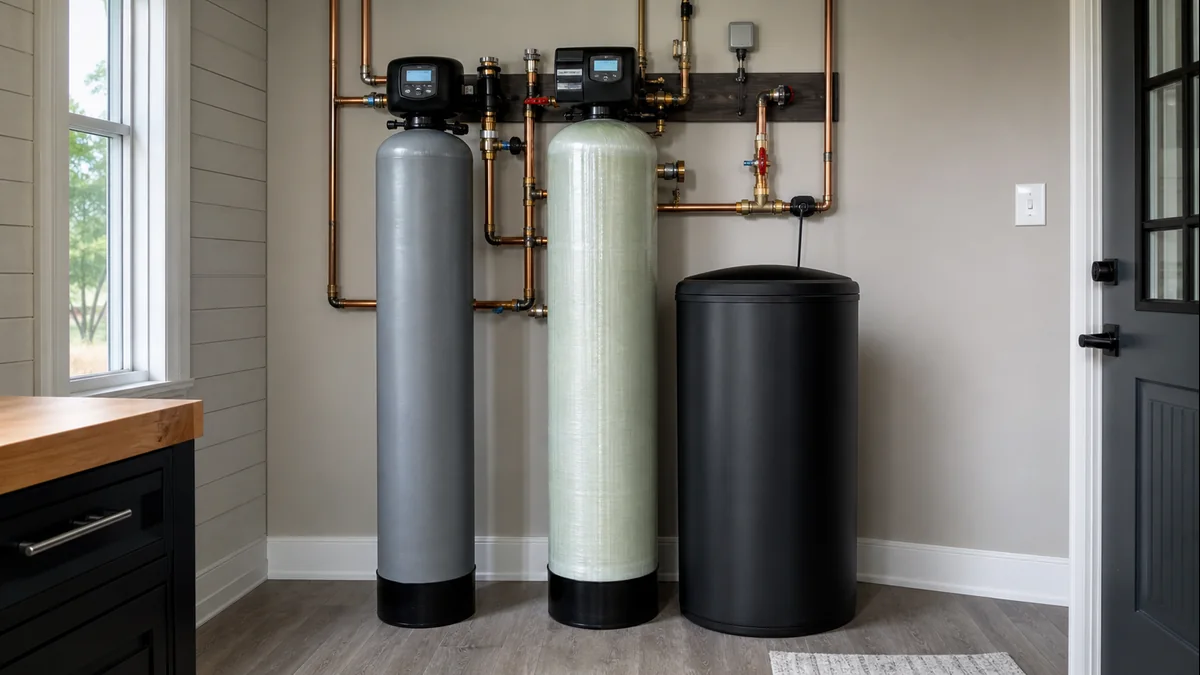
Direct answer: Symptoms returning between regenerations, salt use climbing, and a softener regenerating constantly or not at all are the clearest signs a Garner unit has reached the end of its service life. The better replacement move is an all-in-one softening-and-carbon system — a softener-only unit never touched Raleigh Water's chloramine, TTHM, or HAA5 levels in the first place. A free water analysis confirms what your Garner home actually needs.
What Are the Warning Signs My Garner Water Softener Needs Replacing?
Garner is served by Raleigh Water, and most replacement calls trace back to one of four patterns showing up in daily use, not a diagnostic light on the unit itself.
- Hardness symptoms coming back between regenerations — spotting on glasses, stiffer laundry, or less lather even though the softener is still cycling on schedule.
- Salt use climbing noticeably faster than it used to, or barely dropping at all between refills.
- The unit regenerating constantly, running through cycles far more often than its programmed schedule suggests it should.
- The unit not regenerating at all — a control valve or timer that's stopped triggering the cycle altogether.
Any one of these on its own is worth a look. Two or more together is a strong signal the resin bed or the control valve is no longer doing its job.
Why Is My Water Suddenly Hard Again Between Regenerations?
Resin beads lose ion-exchange capacity gradually, so a softener can keep running its programmed schedule while treating less and less water effectively between cycles. That's why the change is easy to miss at first — there's no single day the unit "breaks," just a slower return of the hardness feel you'd stopped noticing.
If spotting, dull laundry, or thinner lather shows up again well before the next scheduled regeneration, that's resin that's fouled or exhausted, not a settings problem you can dial back into place.
Why Does My Softener Keep Using More Salt Than It Used To?
Rising salt consumption usually means the resin bed needs more brine to do the same job it used to do with less — a sign of declining capacity, not a sign to simply buy more salt. Salt that barely moves between refills points the other direction: brine isn't reaching the resin at all, often because of a hardened crust (salt bridging) blocking the tank.
Either pattern means the unit's regeneration cycle isn't delivering water the way it was designed to, and neither one resolves itself by adjusting the salt dosage.
What Does It Mean If My Softener Regenerates Constantly — or Not at All?
A softener cycling far more than its programmed schedule is usually chasing a resin bed that can't hold capacity anymore, triggering regeneration after regeneration without producing softer water to show for it. A unit that's stopped regenerating altogether is the opposite failure — a control valve or timer no longer sending the signal at all, so hardness passes straight through untreated regardless of how full the tank looks.
Both patterns point to the same conclusion: the unit's core function, not just a setting, has stopped working as designed.
Why Doesn't a Softener-Only Replacement Solve Garner's Water Quality Issues?
Because a water softener is ion exchange only — it swaps calcium and magnesium for sodium, and that is the entire job it was built to do. It has no carbon media, so a softener-only replacement leaves chloramine taste, PFAS, and disinfection byproducts completely untouched, the exact same gap the old unit had.
Raleigh Water's 2025 Consumer Confidence Report puts total trihalomethanes (TTHM) at an average of 34.2 parts per billion, up to 42.8, and haloacetic acids (HAA5) at an average of 22.0 ppb, up to 33.6 — both within the legal limits of 80 and 60 ppb.
EPA's National Primary Drinking Water Regulations table lists TTHM's potential health effect from long-term exposure above the legal limit as "Liver, kidney or central nervous system problems; increased risk of cancer," and HAA5's as "Increased risk of cancer."
Raleigh's water is legally compliant, and that compliance is real — it isn't in dispute. But the legal limit is a ceiling EPA set at the edge of its own acceptable risk, not a promise that everything under it is worth ignoring. A carbon stage removes both compounds directly rather than relying on staying under that number.
Why Upgrade to an All-in-One System Instead of Another Softener?
Because replacement is the one moment a Garner homeowner gets to fix both problems in a single install, for close to the same effort as swapping in another softener-only unit. The softening side still protects the water heater, dishwasher, washer, and plumbing from scale the old unit was handling. The carbon side finally addresses what the old unit never could.
Our own testing across the Garner area measures 1.6 to 3.7 grains per gallon depending on ZIP code — slightly hard to moderately hard on the Water Quality Association scale the Hach Model 5-B test kit uses. Raleigh Water's own 2025 report shows a lower plant-wide average, 25.2 ppm (roughly 1.3 to 2.1 gpg), across a system range of 21.9 to 35.3 ppm.
Both figures are accurate at once — a plant average leaving the treatment facility versus what actually reaches a specific Garner address. That gap is exactly why a reading from your own tap is the number that should decide what you install.
| Old unit's symptom | What's actually happening | What a replacement should fix |
|---|---|---|
| Spotting or dull laundry returns between regenerations | Resin has lost ion-exchange capacity | New softening resin, sized for your measured hardness |
| Salt use climbing or barely moving | Bridging or declining resin efficiency | A properly sized, correctly maintained brine system |
| Regenerating far more than scheduled | Resin bed chasing capacity it no longer has | Fresh resin restores predictable cycling |
| Chloramine taste, PFAS, TTHM/HAA5 | Never addressed by softening resin at all | Carbon stage in an all-in-one system |
Take the Guesswork Out of Replacing It
A softener that's already showing salt bridging, climbing salt use, or symptoms creeping back between cycles is only going to get less consistent from here. Take the 60-second water quiz to see how an all-in-one system fits your Garner home, or book a free water analysis so a technician confirms what your current unit is and isn't still handling.
FAQ
My softener still runs on schedule, but my dishwasher glasses are spotty again — does that mean it needs replacing? Yes, most likely. A unit can keep cycling on its programmed schedule while the resin inside has lost real softening capacity, so returning spotting is a genuine symptom even when nothing looks wrong on the display.
I've noticed I'm going through salt a lot faster than I used to — is that a sign my softener is failing? Often, yes. Rising salt use typically means the resin bed needs more brine to do the job it used to do with less, which points toward declining capacity rather than a settings fix.
How do I know if what I'm seeing is a softener problem or a Garner water quality problem? Signs tied directly to the unit — salt bridging, climbing salt use, constant or absent regeneration — point to the softener itself. A taste or smell change unrelated to those signs is more likely a citywide factor, like Raleigh Water's annual disinfectant switch.
Is it worth replacing a softener-only unit with the same kind of unit, or should I upgrade? Replacing like-for-like only fixes the hardness side. Since Garner's water also carries chloramine taste and disinfection byproducts a softener never addresses, an all-in-one system with a carbon stage covers both in the same install.
My softener regenerates way more often than it used to — should I just wait and see? Frequent, unscheduled regeneration usually means the resin bed can't hold capacity anymore and is chasing a problem it can't solve on its own. That pattern tends to get more noticeable, not less, so it's a reasonable point to start comparing replacement options.
Does Triangle Waterworks repair existing softeners, or only replace them? Triangle Waterworks sells and installs new systems rather than servicing other brands' existing equipment. If your current unit is showing these symptoms, replacement with a properly sized all-in-one system is the path forward.
Sources
- City of Raleigh — Water Consumer Confidence Report 2025
- EPA — National Primary Drinking Water Regulations
Related reading: Water Treatment in Garner, NC | Water Softener Cost in Garner, NC | How to Tell If Your Water Softener Is Broken in Raleigh, NC | Who Installs Water Softeners in Garner, NC | How to Read Your Water Quality Report in Garner, NC
Answer nine practical questions, then request a written quote or well-water analysis.
Start My Water Analysis