
When Should You Replace a Water Softener in Wake Forest, NC?
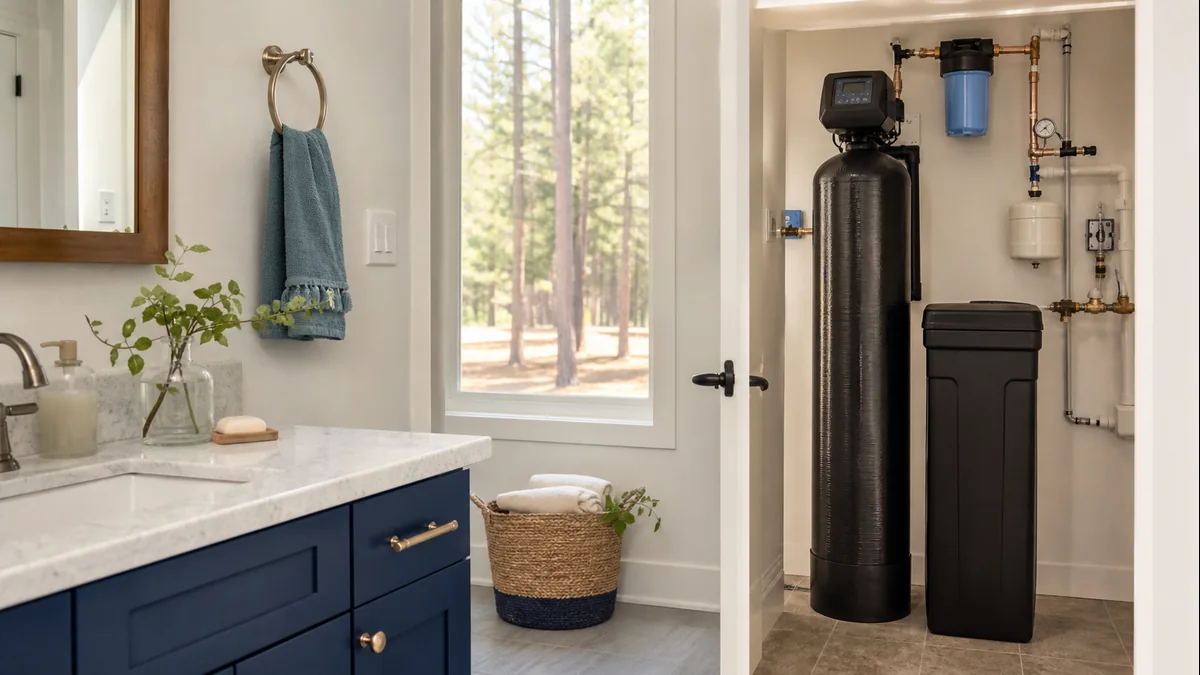
Direct answer: A water softener in Wake Forest has reached the end of its life when hardness symptoms return despite a clean brine tank, salt use keeps climbing, or the unit regenerates constantly — signs the resin itself has lost capacity, not a simple fix. The smarter replacement is an all-in-one softening-and-carbon system: your old unit never touched Raleigh Water's chlorine, chloramine, or disinfection byproducts. A free water analysis confirms it.
What Are the Signs a Water Softener in Wake Forest Has Reached the End of Its Life?
A handful of patterns show up together on an aging unit, and the combination matters more than any single symptom. Watch for:
- Spotting or a cloudy film returning on glassware and shower doors after months or years of it being gone
- Soap and shampoo that suddenly won't lather the way they used to
- Scale creeping back onto faucets, showerheads, or inside the coffee maker
- Laundry coming out stiffer or duller than it has been
- Salt use climbing, or a brine tank barely drawing down between refills
- The unit cycling or regenerating far more often than it used to, sometimes daily
One symptom alone often has a simple explanation. Several appearing together on a system that's been in service for years is what points toward the resin bed itself losing its ability to exchange calcium and magnesium.
Is This a Fixable Issue, or Does It Mean the Resin Is Done?
The honest answer depends on the cause. A hard crust in the brine tank (a salt bridge) or a wet sludge at the bottom (salt mush) are common, physical blockages — not a sign the unit has failed. Clearing either one and letting the softener run a normal cycle typically restores it.
Resin exhaustion is different: a gradual, cumulative loss of exchange capacity from years of cycles that clearing a brine tank can't reverse. If spotting or poor lathering persists after a clean tank and working salt, that points toward the resin — and toward planning a replacement.
Why Does Rising Salt Use or Constant Regeneration Point to the Resin, Not a Setting?
Because both are the unit compensating for lost capacity, not a scheduling quirk. As resin beads age, they hold less calcium and magnesium per cycle, so the control valve has to regenerate more often to keep up with the same household demand — burning more salt and water for less softening.
A unit that suddenly starts regenerating daily, alongside hardness symptoms actually returning, is showing wear from the inside out. That combination is a stronger signal than any one of the three alone.
Is Wake Forest's Water Actually Hard? What the Numbers Say
Wake Forest doesn't run its own treatment plant or publish its own water quality report. It's supplied by Raleigh Water, the same system serving Raleigh, Garner, Knightdale, Rolesville, Wendell, and Zebulon.
Raleigh Water's 2025 Consumer Confidence Report shows average hardness of 25.2 ppm, with a system range of 21.9 to 35.3 ppm — roughly 1.3 to 2.1 grains per gallon (gpg). On the Water Quality Association (WQA) scale the Hach Total Hardness Test Kit, Model 5-B uses, that range falls in the slightly hard band, not hard.
Triangle Waterworks' own in-home testing across the service area measures higher: 1.6 to 3.7 gpg by ZIP code, slightly hard to moderately hard on the same scale. Neither figure contradicts the other — Raleigh's is a plant-wide average, and ours is measured address by address.
The gap is exactly why an old unit's original sizing may no longer match what's actually coming out of your tap. See the full local hardness picture for Wake Forest.
What Was Your Old Softener Never Built to Handle?
A water softener is ion exchange for calcium and magnesium — the entire job it's designed to do. It has no carbon media, so it does nothing about chlorine or chloramine taste, or the disinfection byproducts that form when a disinfectant reacts with organic material in the source water.
Raleigh Water's 2025 report puts total trihalomethanes (TTHM) at an average of 34.2 ppb, ranging up to 42.8, against a legal limit of 80 ppb. Haloacetic acids (HAA5) average 22.0 ppb, ranging up to 33.6, against a limit of 60 ppb. Both are fully compliant, with no violations reported.
EPA's National Primary Drinking Water Regulations table lists TTHM's potential long-term health effect above the legal limit as "Liver, kidney or central nervous system problems; increased risk of cancer," and HAA5's as "Increased risk of cancer."
Compliance here is real and should be taken at face value. But it's a ceiling EPA set at the edge of its own acceptable risk, not a guarantee everything under it is worth ignoring — a carbon stage removes these compounds directly, rather than relying on a legal number your old softener was never built to touch.
Replace or Address First: A Quick Comparison
Most isolated symptoms are worth checking before assuming a full replacement. Multiple symptoms together on an aging unit point toward planning one.
| What You're Seeing | What It Usually Means | What It Signals |
|---|---|---|
| Salt tank barely drawing down | Salt bridge or salt mush blocking brine from reaching the resin | Often a simple blockage, not a failed unit |
| Occasional off-schedule regeneration | Valve timing or a household usage change | Worth a look, not necessarily end-of-life |
| Spotting/poor lathering returns after a clean tank and working salt | Resin losing exchange capacity | Points toward replacement |
| Salt use climbing plus more frequent regeneration, together | Resin working harder for less result | Points toward replacement |
| Multiple hardness symptoms on an aging, long-serving unit | System nearing the end of useful life | Replacement is the stronger call |
| Chlorine taste, odor, or disinfection-byproduct concerns regardless of hardness symptoms | Something a standalone softener was never built to address | Points toward an all-in-one upgrade |
Why Upgrade to an All-in-One System Instead of Replacing Like-for-Like?
Because replacing an old softener with another softener repeats the same gap. A standalone unit only ever did one job — exchanging calcium and magnesium through ion exchange. It never touched chlorine or chloramine taste, and never addressed the disinfection byproducts Raleigh Water's own report documents — the same TTHM and HAA5 compounds EPA ties to increased cancer risk above the legal limit.
An all-in-one system that pairs softening resin with a carbon filtration stage:
- Continues protecting your water heater, dishwasher, washer, and plumbing from mineral buildup
- Removes chlorine and chloramine taste and odor at the tap
- Addresses the disinfection byproducts a standalone softener has no effect on
- Runs as one system instead of managing separate softening and filtration equipment
- Gets sized to your home's actual water after a free water analysis, not guessed at
Replacing a worn-out unit is the moment to close that gap, not repeat it.
What Does Replacing a Softener in Wake Forest Actually Involve?
It starts with a free water analysis, so the new system gets sized to what's actually coming out of your tap, not an assumption carried over from the old install. From there, installation ties the new system into your existing plumbing in place of the old unit.
What a full system costs in Wake Forest and choosing the right company for the job both cover what to expect once you're ready to move forward.
FAQ
My glasses have been coming out spotty again for a few weeks even though our softener has worked fine for years — is it time to replace it? A returning symptom on a unit that's been running well for years is a common early sign the resin is losing exchange capacity. Check the brine tank first for a salt bridge or salt mush, since either is a simple blockage — if symptoms persist after that's cleared and salt is being used normally, that points toward the resin and toward planning a replacement.
Our softener is only a few years old, but it's already using more salt than it used to — does that mean it's failing? Not necessarily. Rising salt use on a relatively young unit more often points to a valve cycling more than it should or a change in household water use, rather than resin wearing out this early. It's worth having the actual cause identified before assuming the resin is done.
How do I tell a fixable brine tank issue from resin that's actually worn out? Clear any visible salt bridge or mush, add fresh salt, and let the softener run a normal cycle. If symptoms disappear, the blockage was the whole problem. If spotting or poor lathering persists with a clean tank and working salt, that points toward the resin rather than the tank.
Is Wake Forest's water actually hard, or is that just marketing? On the Water Quality Association scale, Raleigh Water — which supplies Wake Forest — measures as slightly hard on its own published average, and our own address-level testing across the service area reads slightly hard to moderately hard depending on ZIP code. It's a real, verifiable hardness case, just not an extreme one.
Should I replace my old softener with the same kind of unit, or upgrade to something different? Replacing like-for-like only fixes the hardness side. Since Wake Forest's water — through Raleigh Water — also carries chlorine, chloramine taste, and disinfection byproducts a standalone softener never addressed, an all-in-one system with a carbon stage covers both problems in the same install.
How do I get a straight answer on whether my current system needs replacing? Test your water directly instead of guessing from symptoms alone. A free water analysis measures exactly what's coming out of your tap right now and confirms whether an aging unit is still keeping up, so the decision is based on facts rather than guesswork.
See What a Free Water Analysis Turns Up
An aging softener letting hardness symptoms back in — and doing nothing about chlorine, chloramine, or disinfection byproducts — is worth addressing now, not living with another season. Take the 60-second water quiz to see how an all-in-one system fits your Wake Forest home.
Sources
- City of Raleigh — Raleigh Water 2025 Consumer Confidence Report
- EPA — National Primary Drinking Water Regulations
Related reading: Water Treatment in Wake Forest, NC | What Does a Water Softener Cost in Wake Forest, NC? | Is Wake Forest, NC Water Hard? | How to Tell If Your Water Softener Is Broken in Raleigh, NC | Best Water Softener Company in Wake Forest, NC
Answer nine practical questions, then request a written quote or well-water analysis.
Start My Water Analysis