
Water Softener Salt Cost Per Year in the Triangle
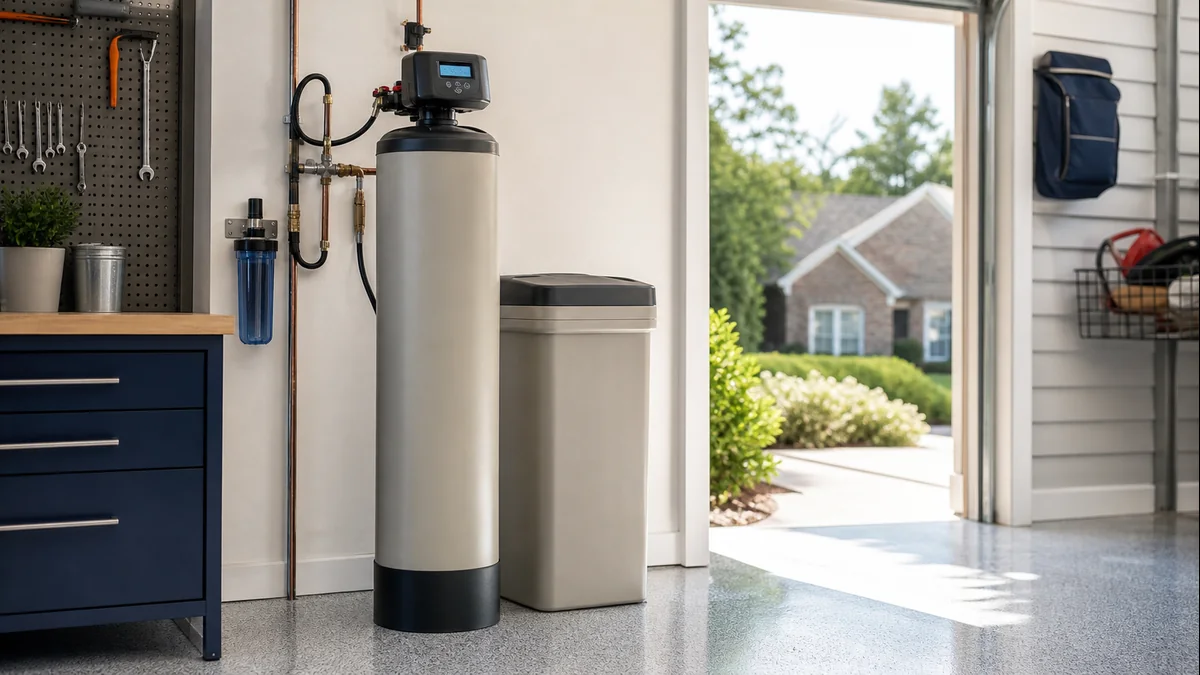
Direct answer: A water softener on Triangle city water costs roughly $8 to $24 a year in salt — about one 40-pound bag in Raleigh, up to two bags a year at the top of Cary, Apex, and Morrisville's hardness range. That figure is calculated from two published numbers: the EPA WaterSense estimate for indoor household water use and the NSF/ANSI 44 minimum salt-efficiency standard. Because salt use scales directly with hardness times water volume, the Triangle's comparatively low hardness keeps this cost low — a real advantage of running a properly sized, metered softener here.
How much salt does a water softener use per year?
It depends on two things: how much water your household runs through the softener, and how hard that water is. The EPA WaterSense program estimates the average American family uses more than 300 gallons of water a day at home, with roughly 70% of that used indoors — about 210 gallons a day indoors for a family of four. The NSF/ANSI 44 standard sets the efficiency bar for softeners at a minimum of 3,350 grains of total hardness exchanged per pound of salt. Multiply your daily indoor water use by your water's hardness in grains per gallon (gpg) to get daily grains removed, multiply by 365 for the year, then divide by 3,350 to get pounds of salt needed annually. That's the entire calculation — no proprietary formula, just two published inputs.
Show me the actual math for Raleigh and Cary
Here's the calculation laid out with the inputs named, using 210 gallons/day indoors for a family of four and the 3,350 grains/lb NSF/ANSI 44 minimum:
- Raleigh at 1.6 gpg: 210 × 1.6 = 336 grains/day → ≈122,600 grains/year ÷ 3,350 ≈ 37 lb of salt a year — about one 40-lb bag.
- Cary at the 1.6 gpg low end (the same floor as Raleigh): ≈37 lb/year — about one bag.
- Cary at the 3.7 gpg top end: 210 × 3.7 = 777 grains/day → ≈283,600 grains/year ÷ 3,350 ≈ 85 lb/year — about two 40-lb bags.
Rounded for Triangle city water overall, that's about one to two 40-pound bags a year. These numbers are calculated directly from the EPA usage figure and the NSF/ANSI 44 efficiency minimum — a real household's actual use will vary with household size, water habits, and how many people live there, but the range gives you an honest starting estimate rather than a guess.
What does that cost in dollars?
Retail 40-lb bags of sodium-chloride softener salt run roughly $8–$12 at major retailers — Home Depot lists have run $9.58–$11.58, Walmart around $8.34. Applying that to the bag counts above:
| Location | Hardness | Salt used per year | Bags per year | Annual cost |
|---|---|---|---|---|
| Raleigh | 1.6 gpg | ≈37 lb | ~1 bag | ≈$8–$12 |
| Cary/Apex/Morrisville (low end) | 1.6 gpg | ≈37 lb | ~1 bag | ≈$8–$12 |
| Cary/Apex/Morrisville (top end) | 3.7 gpg | ≈85 lb | ~2 bags | ≈$16–$24 |
Potassium chloride is a common alternative to sodium chloride and typically costs more per bag — the figures above assume standard sodium-chloride softener salt.
Why does lower hardness mean lower salt cost?
Because salt use is a direct function of hardness multiplied by water volume — there's no separate "base cost" that stays flat regardless of hardness. A softener regenerates by flushing accumulated hardness minerals off its resin bed with a brine solution, and the harder the water (and the more of it that runs through), the more often that regeneration has to happen and the more salt each cycle consumes. Raleigh's 1.6 gpg means the resin bed captures fewer hardness grains per gallon than it would in a genuinely hard-water region, so it needs fewer regeneration cycles to do the same job. That's not a downside of buying here — it's a direct, ongoing cost advantage: the softener still protects your water heater, appliances, and fixtures from mineral buildup, just for a fraction of what the same system would cost to run somewhere in the "very hard" band, which the Water Quality Association (WQA) scale — the same one the Hach Total Hardness Test Kit uses — puts at 10.5 gpg and above.
Metered regeneration vs. time-clock regeneration — why it matters for cost
Not every softener regeneration schedule qualifies for the NSF/ANSI 44 efficiency rating used in the math above. There are two basic regeneration types:
- Demand-initiated (metered) regeneration — the softener tracks actual water use and regenerates only when the resin bed's capacity is close to used up. This is the only regeneration type that qualifies for the NSF/ANSI 44 efficiency rating.
- Time-clock (fixed-schedule) regeneration — the softener regenerates on a preset calendar schedule regardless of how much water actually ran through it. Time-clock regeneration does not qualify for the NSF/ANSI 44 efficiency rating, because it often regenerates on a fixed schedule even when the resin hasn't come close to its capacity — wasting salt and water on cycles the household didn't actually need.
This is a concrete, citable reason to insist on a metered system rather than a time-clock unit: a metered softener regenerates only when needed, which is what keeps the salt-cost math above realistic. A time-clock softener can burn through meaningfully more salt over a year for the same household, simply because it's regenerating on autopilot rather than on actual demand.
Comparison: metered vs. time-clock regeneration
| Metered (demand-initiated) | Time-clock (fixed-schedule) | |
|---|---|---|
| Regenerates based on | Actual water use / resin capacity | Preset calendar schedule |
| Qualifies for NSF/ANSI 44 efficiency rating | Yes | No |
| Salt use for the same household | Matches the math above | Can run higher — unneeded cycles |
| Water use per cycle | Bound by the 5.0 gal/1,000 grains service limit when rated | Not tied to efficiency limits |
The NSF/ANSI 44 service-cycle limit also caps water use during regeneration itself: no more than 5.0 gallons of water per 1,000 grains of hardness removed. That's a second reason a metered, efficiency-rated system costs less to run than a time-clock unit — it's also more efficient with the water used in each regeneration cycle, not just the salt.
What if I'm on a well instead of city water?
Wells commonly run considerably harder than Triangle city water and often carry iron, sulfur, or low pH alongside hardness — none of which show up in the city-water math above. Because salt use scales directly with hardness, a well that tests into the "hard" or "very hard" bands — 7 gpg and up on the WQA scale — will use meaningfully more salt per year than any Triangle city-water example here. There's no substitute for testing: a well softener should be sized after a free water analysis, which measures your actual hardness (and anything else in the water) rather than relying on a citywide average.
Frequently Asked Questions
How much salt does a water softener use per year in Raleigh? About 37 lb a year, or roughly one 40-lb bag, costing about $8–$12 annually. That's calculated from the EPA WaterSense indoor-use estimate and the NSF/ANSI 44 minimum salt efficiency of 3,350 grains per pound, using Raleigh's measured 1.6 gpg hardness.
I just installed a softener in Cary and want to know what to budget for salt each year — what's realistic? Depending on where in Cary's 1.6–3.7 gpg hardness range your home falls, expect somewhere between about one and two 40-lb bags a year, or roughly $8–$24. A metered, efficiency-rated system will land toward the low end of that range for a given hardness level.
Does the type of regeneration schedule really change my salt cost? Yes. A demand-initiated (metered) softener regenerates only when needed and is the only type that qualifies for the NSF/ANSI 44 efficiency rating. A time-clock softener regenerates on a fixed schedule regardless of actual use, which can mean unnecessary cycles and higher salt use for the same household.
I'm on well water and worried my salt bill will be much higher — is that true? Likely yes, since wells commonly run harder than Triangle city water and salt use scales directly with hardness. The right way to know your real number is a free water analysis, which measures your actual hardness rather than relying on a citywide estimate.
Is potassium chloride cheaper than regular softener salt? No — potassium chloride typically costs more per bag than standard sodium-chloride softener salt, which is what the cost estimates in this article assume.
Where do these salt-use numbers actually come from? Two published sources: the EPA WaterSense estimate of about 210 gallons of indoor water use per day for a family of four, and the NSF/ANSI 44 standard's minimum efficiency of 3,350 grains of hardness removed per pound of salt. Multiplying hardness by daily water use and dividing by that efficiency figure produces the pounds-per-year estimate — actual results vary by household size and habits.
Ready to see your household's real number?
Take the 60-second water quiz if you're on city water, or request a free water analysis if you're on a well — that's the only way to get a softener sized to your actual hardness rather than a citywide estimate.
Related reading: Water Softener Cost in Raleigh, NC · Water Softener Sizing by Grains · Raleigh Water Hardness · Do I Need a Water Softener in North Carolina? · Well Water Treatment System Cost NC
Answer nine practical questions, then request a written quote or well-water analysis.
Start My Water Analysis