
What Size Water Softener Do I Need? (The Actual Math)
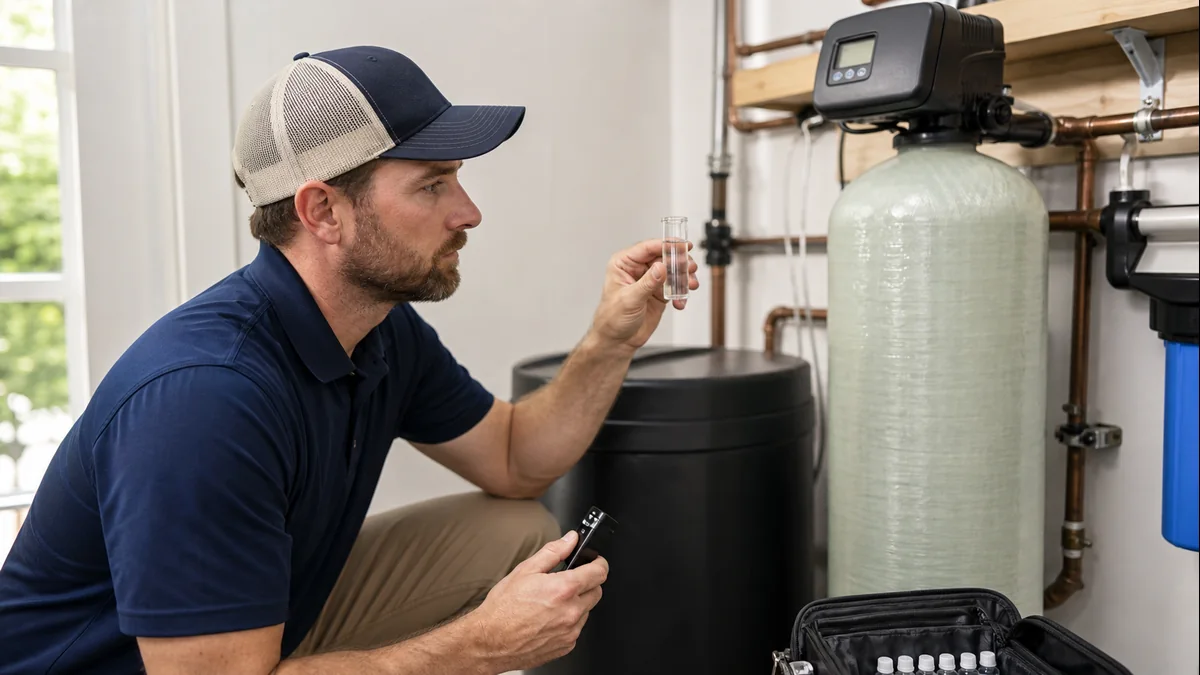
Softener size is calculated as people in the household × 75 gallons per person per day × your water's hardness in grains per gallon (gpg) × 7 days — the result is the grains of hardness your softener needs to remove each week. Round up to the next standard capacity (commonly sold in 24,000 / 32,000 / 48,000 / 64,000-grain units), not down.
The Formula, Broken Down
Each piece of the calculation is doing a specific job:
- People in the household — how many people are using water day to day
- 75 gallons per person per day — the standard water-use assumption per person
- Your water's hardness (gpg) — how many grains of calcium/magnesium are in every gallon
- × 7 days — because softener capacity is typically rated and shopped for in weekly terms, matching how often most units regenerate
Multiply those together and you get the total grains of hardness the softener has to remove in a week. That number is what you compare against a softener's rated grain capacity when deciding what size to buy.
Worked Example: Raleigh City Water (1.6 gpg)
Raleigh Water tests at roughly 1.6 gpg. Here's what the formula produces for different household sizes:
| Household size | Calculation | Grains/week needed |
|---|---|---|
| 2 people | 2 × 75 × 1.6 × 7 | 1,680 |
| 4 people | 4 × 75 × 1.6 × 7 | 3,360 |
| 6 people | 6 × 75 × 1.6 × 7 | 5,040 |
Even a 6-person household on Raleigh water only needs to remove about 5,000 grains a week — a fraction of what the smallest standard softener (24,000 grains) is built to handle. That's good news: it means a correctly sized softener on Raleigh water regenerates rarely and uses very little salt, making it an inexpensive, low-maintenance addition — especially as part of an all-in-one system that also filters out chlorine taste/smell and PFAS. See Raleigh water hardness for the source numbers.
Worked Example: Cary City Water (1.6–3.7 gpg)
Cary's hardness spans a wider range than Raleigh's and varies by location within the system, so it's worth running the math at both ends of the range:
| Household size | Calculation (at 3.7 gpg, high end) | Grains/week needed |
|---|---|---|
| 2 people | 2 × 75 × 3.7 × 7 | 3,885 |
| 4 people | 4 × 75 × 3.7 × 7 | 7,770 |
| 6 people | 6 × 75 × 3.7 × 7 | 11,655 |
Even at Cary's upper hardness range, a 6-person household lands just under 12,000 grains a week — still well under a 24,000-grain softener's capacity. At Cary's lower end (1.6 gpg), the numbers drop to roughly 43% of these figures. Either way, the softener side of the system runs efficiently on Cary water, so the ongoing cost is low while it still keeps minerals from building up in your plumbing and appliances year after year.
Worked Example: A Well Testing Higher
City water numbers are known quantities. A private well is not — hardness varies by property and has to be tested directly. To show how the same formula behaves once hardness climbs, here's the math using two illustrative test results:
| Household size | If your well tests at 20 gpg | If your well tests at 30 gpg |
|---|---|---|
| 4 people | 4 × 75 × 20 × 7 = 42,000 grains/week | 4 × 75 × 30 × 7 = 63,000 grains/week |
This is where the "32K vs 48K vs 64K" confusion homeowners run into online actually comes from — once hardness climbs into well-water territory, the weekly grain load jumps into the range of the larger standard softener sizes. These two numbers are examples of how the formula scales, not a claim about what any particular NC well tests at — get your own well tested before sizing anything.
Why You Round Up, Not Down
Once you have your weekly grain total, pick the next standard capacity size above it, not the one closest to it. A softener that's undersized regenerates constantly, wears out faster, and risks letting hard water through between cycles when household use spikes (guests, laundry days, etc.). A softener that's modestly oversized just regenerates less often — there's little downside.
Frequently Asked Questions
What's the formula for sizing a water softener? People in the household × 75 gallons per person per day × your water's hardness in grains per gallon × 7 days. The result is the grains of hardness the softener needs to remove weekly.
Is 75 gallons per person per day accurate for my house? It's the standard assumption used in softener sizing calculations industry-wide. Actual household use varies, but this figure is what the sizing formula is built around.
What softener sizes are commonly sold? Residential softeners are typically sold in 24,000, 32,000, 48,000, and 64,000-grain capacities. Which one fits depends on your household size and your water's actual tested hardness.
Do I need to know my exact water hardness before sizing a softener? Yes. Without a real gpg number — from your city utility's published data or a direct well test — any sizing calculation is a guess. Never size (or buy) a softener off an assumed hardness number.
Why do Raleigh and Cary homeowners usually get such small numbers from this formula? Because Raleigh (1.6 gpg) is genuinely slightly hard on the WQA scale and even Cary's system (1.6–3.7 gpg, moderately hard at the top of that range) still runs on the lower end compared to a well. Run through the formula, most homes here land well under even the smallest standard softener capacity — which means a correctly sized softener is cheap to run (low salt, infrequent regeneration) while it keeps protecting your home's plumbing and appliances. See do I need a water softener in North Carolina.
Ready to See What Size Fits Your Home?
Take our 60-second water quiz to get a recommendation sized to your address and household — for most city-water homes, that's an all-in-one system that pairs an efficiently sized softener with carbon filtration for chlorine, PFAS, and disinfection byproducts. On a well? Start with a free water analysis so your system is sized off a real number, not a guess.
Answer nine practical questions, then request a written quote or well-water analysis.
Start My Water Analysis