
Water Softener vs. All-in-One System: Which Covers More?
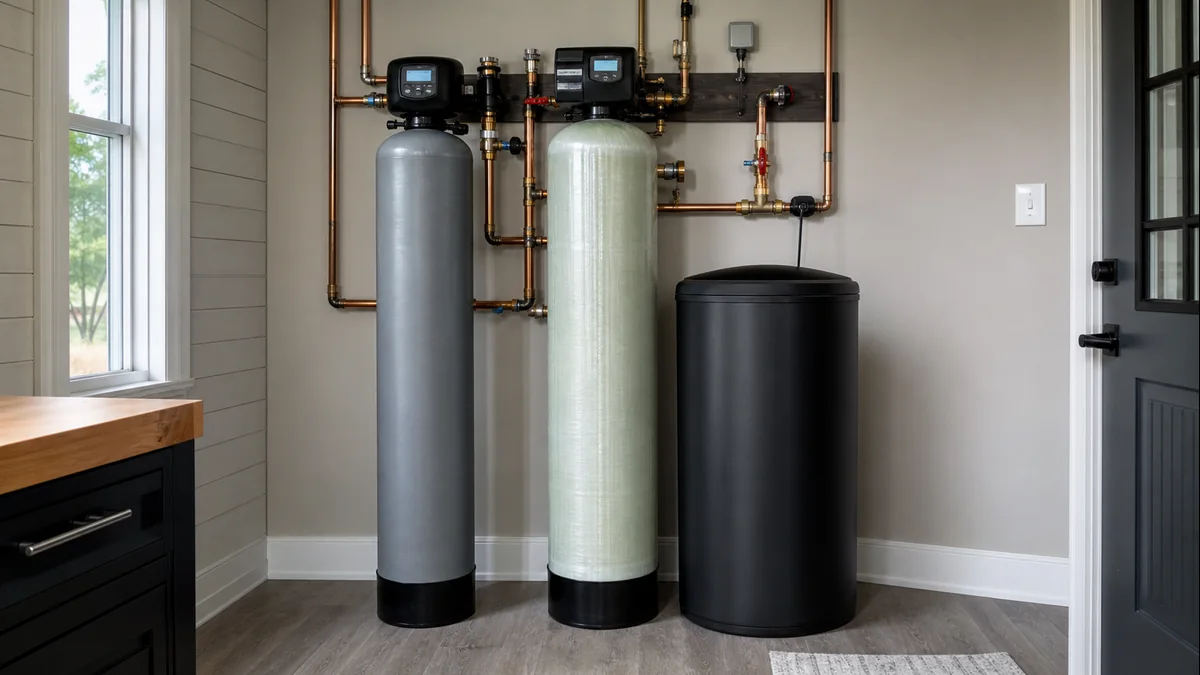
Direct answer: A standalone water softener only does one job — ion exchange that swaps calcium and magnesium for sodium to stop scale. It does nothing for chlorine taste, disinfection byproducts, or PFAS, which are exactly what's documented in Raleigh and Cary tap water. An all-in-one system pairs that same softening resin with a carbon filtration stage in a single unit, so it covers hardness and the documented contaminants at once — one install, one warranty, one system doing both jobs a standalone softener can't.
What's the actual difference between a softener and an all-in-one system?
A standalone softener is a single-purpose device: water passes through resin beads charged with sodium ions, and as calcium and magnesium pass by, they trade places with the sodium. That's the entire mechanism — it's ion exchange, not filtration, and it has no effect on anything in the water that isn't a hardness mineral.
An all-in-one system runs water through that same softening resin and adds a carbon filtration stage in the same unit. The carbon stage adsorbs chlorine and chloramine, disinfection byproducts like haloacetic acids and trihalomethanes, and — when certified for it — PFAS. The softening stage still handles hardness. It's best of both worlds in one cabinet: the mineral problem and the chemical problem, solved by one system instead of two.
Why doesn't a standalone softener cover what's actually in Triangle water?
Because a softener was never built to. Ion exchange resin is selective — it's designed to grab calcium and magnesium ions and nothing else. Chlorine, haloacetic acids, trihalomethanes, and PFAS aren't hardness minerals, so the resin doesn't interact with them at all.
That matters here specifically because those are the contaminants actually documented in Triangle water. Raleigh Water tests show HAA9 at 19.9 ppb and TTHM at 21.7 ppb. Cary's numbers run higher — HAA9 at 27.5 ppb (roughly 458 times the EWG health guideline of 0.06 ppb) and TTHM at 38.2 ppb, along with PFOA at 2.86 ppt and PFOS at 3.79 ppt. Both utilities are in full legal compliance with EPA limits — these numbers exceed a stricter, non-regulatory EWG health benchmark, not the legal standard. Cary's water also shows 13 contaminants above EWG guidelines total. None of that changes with a softener installed. It changes with carbon filtration, which is the half a standalone softener simply doesn't have.
Does softening still matter if carbon filtration handles the contaminants?
Yes — softening and filtration solve two different problems, and Triangle water has both. Even where local water is slightly hard rather than hard, calcium and magnesium are still present and still accumulate over years of daily use inside a water heater, on fixtures, and on glassware. Raleigh Water tests around 1.6 grains per gallon, and Cary, Apex, and Morrisville run 1.6–3.7 gpg, with the top of that range crossing into moderately hard territory. Softening addresses that ongoing mineral buildup, protects the water heater, dishwasher, washer, and plumbing from scale, and gives better lather, cleaner glassware, and softer laundry. Carbon filtration doesn't touch any of that — it's a chemical filter, not a mineral one. Each stage does a job the other one can't.
Does the carbon stage do anything for the softening resin itself?
Yes, and this is a real engineering reason to run them together rather than as two separate boxes. Resin bed life is shortened by exposure to chlorine, iron, and sediment. In an all-in-one system, the carbon stage sits ahead of the resin, so it strips chlorine out of the water before that water ever reaches the softening resin — protecting the resin bed rather than just protecting the person drinking the water downstream. A standalone softener with no pre-filtration doesn't get that protection; its resin takes the full brunt of whatever's in the water ahead of it.
Softener vs. carbon filter vs. all-in-one: side-by-side
| Standalone softener | Carbon-only filter | All-in-one system | |
|---|---|---|---|
| Removes hardness (calcium/magnesium) | Yes | No | Yes |
| Removes chlorine taste/odor | No | Yes | Yes |
| Removes disinfection byproducts (HAA9, TTHM) | No | Yes | Yes |
| Addresses PFAS (with proper certification) | No | Yes | Yes |
| Protects water heater, dishwasher, washer, plumbing from scale | Yes | No | Yes |
| Protects its own media from chlorine damage | No — resin takes full exposure | N/A | Yes — carbon stage sits ahead of the resin |
| Number of installs / warranties | One | One | One |
| Covers what's documented in Raleigh/Cary water | Partial | Partial | Full |
Bought separately, a softener and a carbon filter are two devices solving two halves of the problem, usually with two installs and two warranties to track. The all-in-one system folds both into a single cabinet, a single install, and a single warranty — while the carbon-ahead-of-resin layout also protects the softening media itself.
Frequently Asked Questions
I just moved to Cary and my glasses come out of the dishwasher spotty — do I need a softener or a filter? Spotting on glassware is a hardness symptom, and Cary's water runs 1.6–3.7 gpg with the top of that range moderately hard — a real softening case. Since Cary's water also carries documented chlorine byproducts and PFAS that a softener alone won't touch, an all-in-one system addresses the spotting and the water chemistry at the same time.
We're on Raleigh water and someone told us we don't need a softener since it's soft — so why would we buy the softening half at all? Raleigh water tests slightly hard at about 1.6 gpg, but slightly hard isn't mineral-free — calcium and magnesium are still present and still build up in a water heater and on fixtures over years of daily use. The softening half protects against that cumulative buildup while the carbon half handles the documented HAA9 and TTHM levels in Raleigh's supply — both halves matter even on a supply that tests slightly hard rather than hard.
Can I just add a carbon filter to the softener I already have? In some cases a carbon stage can be added ahead of an existing softener, but the fit, sizing, and plumbing depend on your existing equipment. An all-in-one system is built as a single unit from the start, which is usually simpler than retrofitting two separate devices together.
Does the carbon stage in an all-in-one system also handle PFAS, or is that a separate add-on? Removing PFAS requires carbon media specifically certified for it (NSF/ANSI 53 or P473) or reverse osmosis (NSF/ANSI 58). Ask your installer which certification the system's carbon stage carries, and get it in writing.
How much salt does the softening side of an all-in-one system use? On Triangle city water, based on EPA usage figures and the NSF/ANSI 44 efficiency standard, most households use roughly one to two 40-lb bags of salt a year — closer to one bag at Raleigh's hardness and closer to two at the top of Cary's range.
What if I'm only worried about chlorine taste, not hardness — do I still need the softening half? Even if taste is your main concern today, the mineral buildup from calcium and magnesium continues in the background regardless of what you notice day to day, protecting your water heater and plumbing over the long run. Since the all-in-one system includes both stages at one published price, there's no reason to leave the softening half out.
Which one is right for your home?
If you're on city water in Raleigh, Cary, Apex, or Morrisville, take the 60-second water quiz to see how your local water chemistry maps to a system. If you're on a well, start with a free water analysis — well water varies enough from lot to lot that sizing needs a real test, not a general comparison.
For more background, see whole house water filter vs. water softener, haloacetic acids in drinking water, trihalomethanes in tap water, how to remove PFAS from water, and signs you need a water softener.
Answer nine practical questions, then request a written quote or well-water analysis.
Start My Water Analysis