
How to Choose a Water Treatment Company Near You in Cary, NC
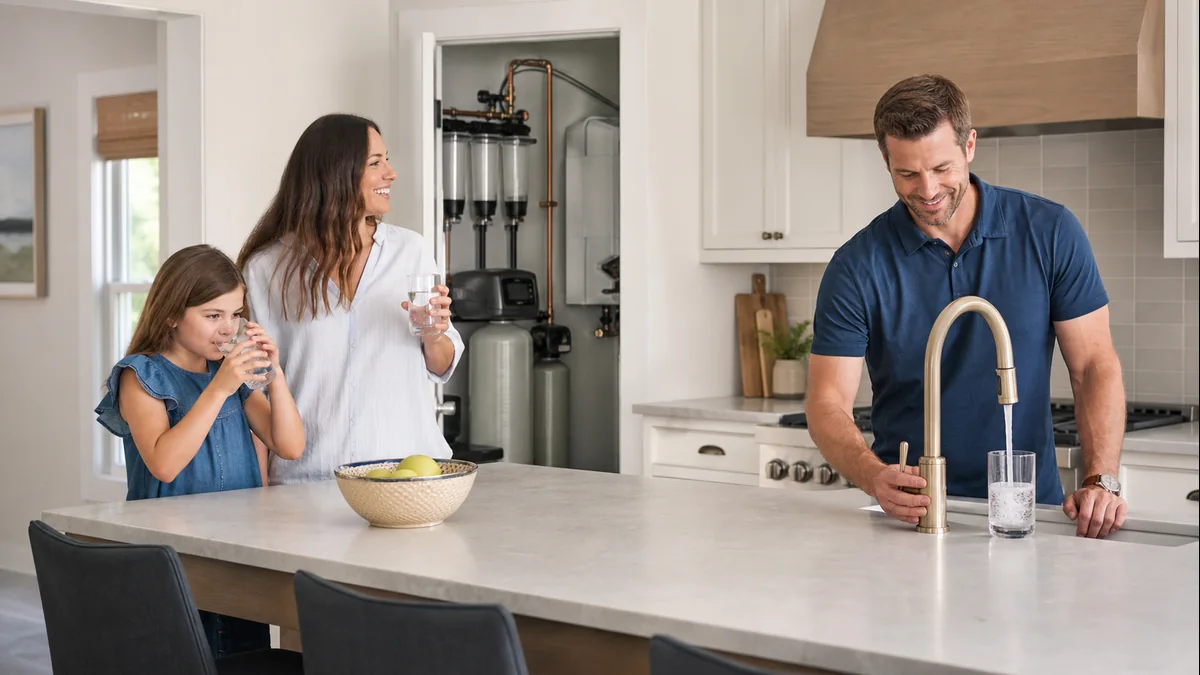
Direct answer: The right water treatment company near you in Cary tests your specific address rather than quoting off a chart, understands the Cary/Apex Water Treatment Facility and its Jordan Lake source, installs as a licensed North Carolina plumbing contractor, and sizes a single all-in-one system — softening plus carbon — to your tested numbers instead of a generic catalog tier.
What should a Cary homeowner actually look for in a local water treatment company?
The short list is four things: a water test before any recommendation, familiarity with the specific system that treats Cary's water, licensed installation, and one system that handles both halves of the problem instead of two separate boxes.
- Tests your address, not a chart. Hardness across the Cary/Apex/Morrisville service area runs 1.6–3.7 gpg depending on ZIP code, based on our own testing — a real range, not one number that applies everywhere in town.
- Knows the local plant. A company that can explain where your water comes from and how it's treated before it reaches your tap is diagnosing your actual water, not selling a generic "city water" package.
- Installs as a licensed plumbing contractor, because that's what North Carolina law requires for this work.
- Covers softening and carbon in one system, so you're not choosing between protecting your plumbing and improving taste and safety — you get both.
For the broader case on why one combined system beats splitting the job into two, see the all-in-one system built for Cary, Apex, and Morrisville. For a closer look at what an all-in-one softening-plus-carbon system looks like specifically for a Cary address, see water softener systems in Cary, NC.
Does the Cary/Apex Water Treatment Facility affect what system I need?
Yes — knowing the source and treatment train tells you exactly what the carbon side of your system is working against. The Cary/Apex Water Treatment Facility is co-owned by Apex and Cary, with Cary as lead agency operating the plant, and it draws from B. Everett Jordan Lake in the Cape Fear River Basin at a capacity of 56 million gallons a day.
The treatment train adds powdered activated carbon at the raw-water pump station, then ozonates, coagulates with alum and polymer, filters through sand and carbon, adjusts fluoride and pH for corrosion control, and finally adds chlorine and ammonia separately in the clearwell to form chloramines for the trip through the distribution system. Duke researchers also measured combined PFAS above 200 ppt in raw Jordan Lake source water back in 2017 — a watershed-level finding about the lake itself, not a failure at the plant, which treats to compliance.
A company that knows this treatment sequence understands why the carbon stage of your system matters as much as the softening stage: chloramines, disinfection byproducts, and PFAS all pass straight through a softener untouched, because a softener only exchanges calcium and magnesium.
How does a local specialist compare to a national brand's catalog approach?
| Local Cary specialist | National brand catalog | |
|---|---|---|
| Sizing | Configured after a free water test at your address | Standard tiers sized off a company average |
| Local water knowledge | Knows the Cary/Apex plant, Jordan Lake source, and chloramine cycle | Generic messaging applied to any city in the country |
| Installer | Licensed NC plumbing contractor | Varies by franchise; verify before signing |
| System | One all-in-one unit (softening + carbon) | Often sold as add-on modules |
| Pricing | Set after your water test, no fixed number published | Whole-home quotes commonly run $6,000–$12,000 |
Triangle Waterworks doesn't publish a fixed price for the same reason the table above matters: every system is configured to what your water actually tests at, not to a nationwide average. The free water analysis is what replaces the catalog tier.
For a fuller side-by-side on this exact comparison, see Cary water softener vs. national brands.
Is Cary's water actually hard, or is the Town right that it's soft?
Both figures are accurate — they're measuring different things on different scales, and neither one is wrong. The Town of Cary's Public Works FAQ publishes finished-water hardness of 25–30 ppm, or roughly 1.5–1.75 gpg, which the Town calls very soft. What we measure in homes across the service area, using our own testing, runs 1.6–3.7 gpg depending on ZIP code.
| Scale point | Value | What it measures |
|---|---|---|
| Town of Cary FAQ | 25–30 ppm (≈1.5–1.75 gpg) | Average finished water leaving the plant |
| Triangle Waterworks testing | 1.6–3.7 gpg | What we measure at individual taps across the service area |
| WQA/Hach classification | 1.0–3.5 gpg = slightly hard; 3.5–7.0 gpg = moderately hard | The Water Quality Association scale the Hach test kit uses |
Two honest reasons those numbers differ. First, the Town's language reflects an older, different classification approach; on the WQA/Hach scale — the one the Hach Total Hardness Test Kit, Model 5-B reads out in — 1.0 to 3.5 grains per gallon is labeled slightly hard, and 3.5 to 7.0 gpg is moderately hard. Second, a plant average measures water leaving the facility; what actually reaches your fixtures depends on where you are in the distribution system, and our measurements run as high as 3.7 gpg — moderately hard on that scale — at the top of the range. The number that settles it for your house is a test at your own address, which is exactly what the free analysis provides.
Hardness aside, Cary's own EWG Tap Water Database figures show HAA9 at 27.5 ppb and TTHM at 38.2 ppb, along with PFOA at 2.86 ppt and PFOS at 3.79 ppt — 13 contaminants total above EWG's stricter guidelines. These figures are fully compliant with EPA's legal limits; EWG's benchmarks are a separate, non-regulatory standard set well below the legal threshold. That gap is what the carbon half of an all-in-one system is built to close, regardless of where hardness lands. For more on what's in Cary's tap water, see is Cary, NC water safe to drink.
Does installing a whole-home water system in Cary require a licensed contractor?
Yes — North Carolina law defines this as licensed plumbing work. N.C. Gen. Stat. § 87-21 defines plumbing contracting to include the installation of "whole-house water purification or treatment systems." That means the installer tying a system into your home's main water line should be a licensed NC plumbing contractor — one of the simplest things to verify before you sign anything.
What questions should I ask before I sign with any company?
Ask these regardless of which company you're talking to:
- Will you test my water before quoting a system, or are you quoting off a standard tier?
- Are your installers licensed North Carolina plumbing contractors?
- Is this one combined system, or am I buying softening and carbon separately?
- What does the warranty actually cover, and can I see it in writing before I sign?
- Do you know what treatment facility supplies my specific address?
A company that answers all five clearly, in writing, before asking for a signature is doing the job the way it's supposed to be done.
Frequently Asked Questions
I just moved to Cary and my glasses come out spotty from the dishwasher — is that hardness? It can be. Cary/Apex/Morrisville hardness measures 1.6–3.7 gpg across the service area depending on ZIP code, and spotting typically shows up more toward the higher end of that range. A free water test at your specific address is the fastest way to confirm whether hardness is the cause and how to size a system around it.
My neighbor says Cary's water is very soft, so why does my water heater already have scale buildup? The Town's published figure is a plant average on a different classification scale than the one the water-treatment industry uses; on the WQA/Hach scale, that same range reads as slightly hard to moderately hard. Mineral buildup is also cumulative over years, and what reaches your specific tap can run higher than the plant average — up to 3.7 gpg in our own measurements.
How do I verify a water treatment company is actually a licensed plumbing contractor? Ask for the company's NC plumbing contractor license and confirm it through the NC State Board's public license lookup before signing anything. Whole-home water treatment installation is defined as plumbing-contracting work under N.C. Gen. Stat. § 87-21, so this is a legitimate, verifiable question to ask any installer.
What's actually different between a local company's quote and a national brand's quote? A local specialist sizes your system after testing your specific water, while national brand whole-home quotes commonly run $6,000–$12,000 off standard tiers regardless of what your address actually needs. Triangle Waterworks doesn't publish a fixed price for the same reason — pricing is set after your free water analysis, not off a catalog.
Does Cary's annual switch from chloramine to chlorine mean I need a different filter part of the year? No — the carbon stage of an all-in-one system is built to handle both disinfectants Cary/Apex uses throughout the year, including the annual free-chlorine period the system runs for flushing. You may notice a stronger chlorine smell during that window, which the carbon stage is designed to address either way.
I'm building new construction in Cary — when should I get my water tested? Get it tested before or right at move-in, so a system can be sized to your address from day one rather than retrofitted later. New construction on the Cary/Apex system starts from the same source and treatment train as every other address in town, but the water reaching your specific tap still depends on where you are in the distribution system.
The fastest way to see what a Cary address like yours actually needs is the 60-second water quiz, or book a free water analysis and get numbers specific to your home instead of a town average or a national catalog tier.
Answer nine practical questions, then request a written quote or well-water analysis.
Start My Water Analysis