
What to Expect From a Water Treatment Company Near Me in Clayton, NC
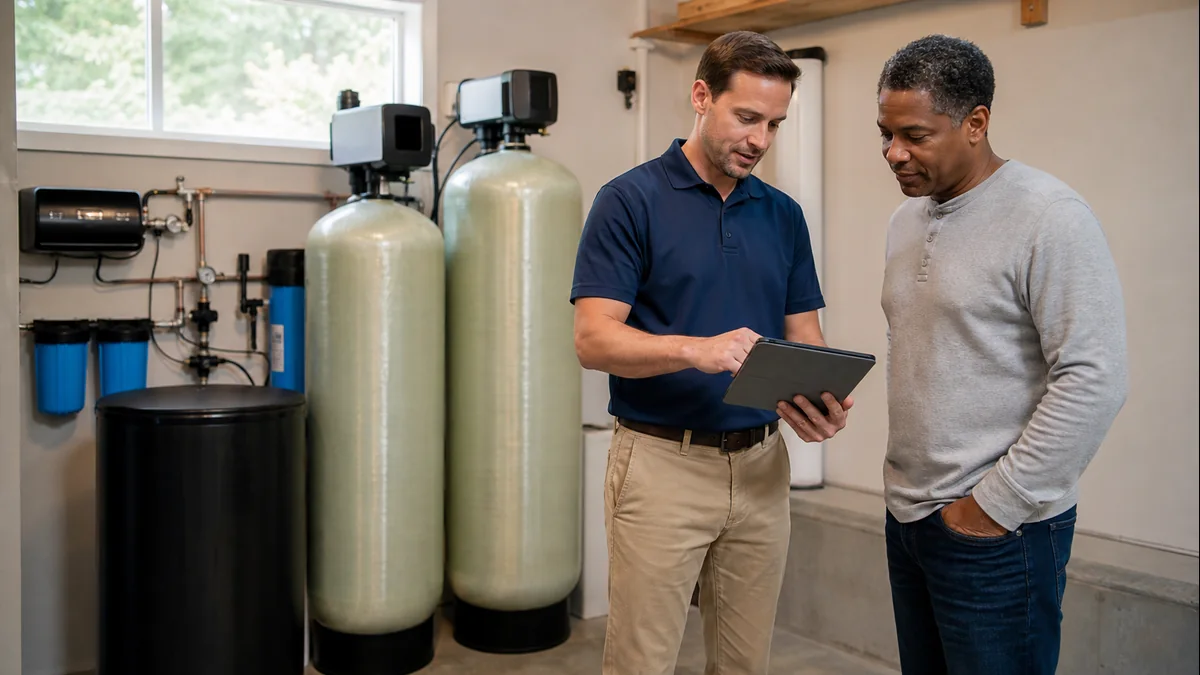
Direct answer: A water treatment company near me in Clayton should lead with what the Town's own 2025 report shows: TTHM up to 64.2 ppb and HAA5 up to 44.3 ppb, both compliant but the strongest carbon case in the area. Hardness reads 30 mg/L — slightly hard on the WQA/Hach scale — and an all-in-one system handles both in one install.
What Does Clayton's Own Water Report Show About Disinfection Byproducts?
Clayton's 2025 Annual Drinking Water Quality Report gives one of the strongest disinfection-byproduct cases of any town in the area. It shows total trihalomethanes (TTHM) at 52 ppb on average, ranging as high as 64.20 across the year, against a legal limit of 80 ppb. Haloacetic acids (HAA5) came in at 30.49 ppb, ranging to 44.30, against a limit of 60 ppb.
Both figures are fully compliant — Clayton isn't violating anything. But they run meaningfully higher than nearby systems: Raleigh's 2025 average is 34.2 ppb TTHM, and Apex's 2024 range tops out at 53. Clayton's own published numbers make the carbon half of a system an easy call here.
| Parameter | Clayton 2025 value | Range | EPA limit |
|---|---|---|---|
| TTHM | 52 ppb | 26.20–64.20 | 80 ppb |
| HAA5 | 30.49 ppb | 20.20–44.30 | 60 ppb |
Is Clayton's TTHM Level Something to Worry About?
It's worth taking seriously, even though nothing here is a violation. EPA's National Primary Drinking Water Regulations table lists TTHM's potential health effect from long-term exposure above the legal limit as "Liver, kidney or central nervous system problems; increased risk of cancer," and HAA5's as "Increased risk of cancer."
Those effects are what EPA had in mind when it set the 80 and 60 ppb limits — "legally compliant" is a ceiling set at the edge of EPA's own risk tolerance, not a guarantee that everything under it is worth ignoring. A carbon filtration stage removes TTHM and HAA5 directly, rather than relying on staying under a legal number, which is exactly why the carbon side of an all-in-one system matters here.
Is Clayton, NC Water Hard?
Clayton's own Drinking Water page states the typical hardness level is 30 milligrams per liter. On the WQA/Hach scale — the same scale the Hach Total Hardness Test Kit reads out on — 30 mg/L converts to roughly 1.75 grains per gallon, which sits in the slightly hard band.
Clayton's own page classifies that same figure as "soft," using an older USGS-style band it reproduces on its site. Both labels are accurate; they're two different scales measuring the same number, not a disagreement — and it's worth naming the scale so a homeowner can check it themselves.
| Scale used | Clayton's 30 mg/L reading | Classification |
|---|---|---|
| Older USGS-style band (Clayton's own page) | 30 mg/L | "Soft" |
| WQA/Hach scale (the Hach Model 5-B test kit) | ≈1.75 gpg | "Slightly hard" |
Our own testing across the wider service area, address by address, measures 1.6 to 3.7 gpg by ZIP code — a range that reads slightly hard to moderately hard on that same WQA/Hach scale.
What Should a Clayton Water Treatment Company Do Before Quoting a Price?
Ask whether a company tests your specific address before naming a number. On a Triangle Waterworks visit, a technician samples water at your tap, walks through the reading in grains per gallon, and explains what a softening stage handles versus what a carbon stage handles — before any equipment gets named or priced.
If a company skips straight to a number before testing anything, ask what that price is actually based on.
Where Does Clayton's Water Come From?
Clayton's water is purchased surface water sourced from the Neuse River. Knowing the source matters because it explains what a carbon stage is working against — a river source and the TTHM and HAA5 levels above, rather than a well or a groundwater aquifer.
What Does the Free Water Analysis Cover?
It measures your water's hardness, at your address, in grains per gallon — a real number to weigh against Clayton's own 30 mg/L figure and the wider 1.6–3.7 gpg range measured across the service area. The visit is also where a technician walks through what Clayton's own TTHM and HAA5 numbers mean for the carbon side of a system.
The analysis comes with no obligation. Booking one doesn't commit you to buying anything — it gives you the numbers that make any decision, including waiting, an informed one.
How Do I Book a Free Water Analysis in Clayton, and What Happens Next?
Booking takes about as long as a short form: take the 60-second water quiz, or request the analysis directly. Someone follows up to schedule the visit at your address, on your schedule.
At the visit, expect the water test described above, a plain-language walkthrough of your reading, and a price for an all-in-one system — softening resin plus carbon filtration — set from that reading rather than a phone estimate.
FAQ
I just moved to Clayton and I'm worried about the chlorine smell — is that a big deal? Clayton's water is fully compliant, so there's no violation behind that smell, but it does trace to real disinfection byproducts — the Town's own 2025 report shows TTHM up to 64.2 ppb and HAA5 up to 44.3 ppb. A carbon stage removes both directly rather than leaving you to just get used to the smell.
Clayton's own page calls the water "soft" — should I still book a test? Yes. That label uses an older USGS-style scale; on the WQA/Hach scale the same 30 mg/L reading falls in the "slightly hard" band, and our own address-level testing across the service area runs higher in some ZIP codes. A free test tells you exactly where your address falls, and Clayton's disinfection byproduct numbers are worth addressing regardless of hardness.
I'm comparing water treatment companies near me in Clayton — what should the first visit include? It should start with a water test at your address, not a sales pitch. Expect a walkthrough of your hardness reading and Clayton's own published TTHM and HAA5 figures, with a price for an all-in-one system set from that reading rather than a phone quote.
Is Clayton's water actually more of a concern than Raleigh's or Apex's? On disinfection byproducts, Clayton's own 2025 numbers run higher than Raleigh's 2025 average and higher than Apex's 2024 range at the top end — all three are compliant, but Clayton's is the strongest verified carbon case among them. Hardness-wise, all three towns sit in a similar slightly-hard range.
Does a water softener by itself fix what's in Clayton's report? No. A softener is ion exchange for calcium and magnesium only — it has no effect on TTHM or HAA5. Those require a carbon filtration stage, which is why an all-in-one system pairs both in one install rather than addressing hardness alone.
Is there any cost or obligation to book the free water analysis? No. It's free, and booking it doesn't commit you to installing anything — it gives you accurate numbers for your address so any decision, including waiting, is based on real data.
Book Your Free Water Analysis in Clayton
Clayton's own 2025 report shows the strongest disinfection-byproduct case in the area, and the hardness figure is real too. Take the 60-second water quiz, or book a free water analysis to see what an all-in-one system looks like for your Clayton home.
Sources
- Town of Clayton — 2025 Annual Drinking Water Quality Report
- Town of Clayton — Drinking Water
- EPA — National Primary Drinking Water Regulations
Related reading: Who Installs Water Softeners in Clayton, NC | Water Softener Cost in Clayton, NC | New Construction Water Treatment in Clayton, NC | Who Installs Water Treatment in Johnston County, NC | Triangle NC Water Treatment Service Area
Answer nine practical questions, then request a written quote or well-water analysis.
Start My Water Analysis