
What to Expect From a Water Treatment Company Near You in Wake Forest, NC
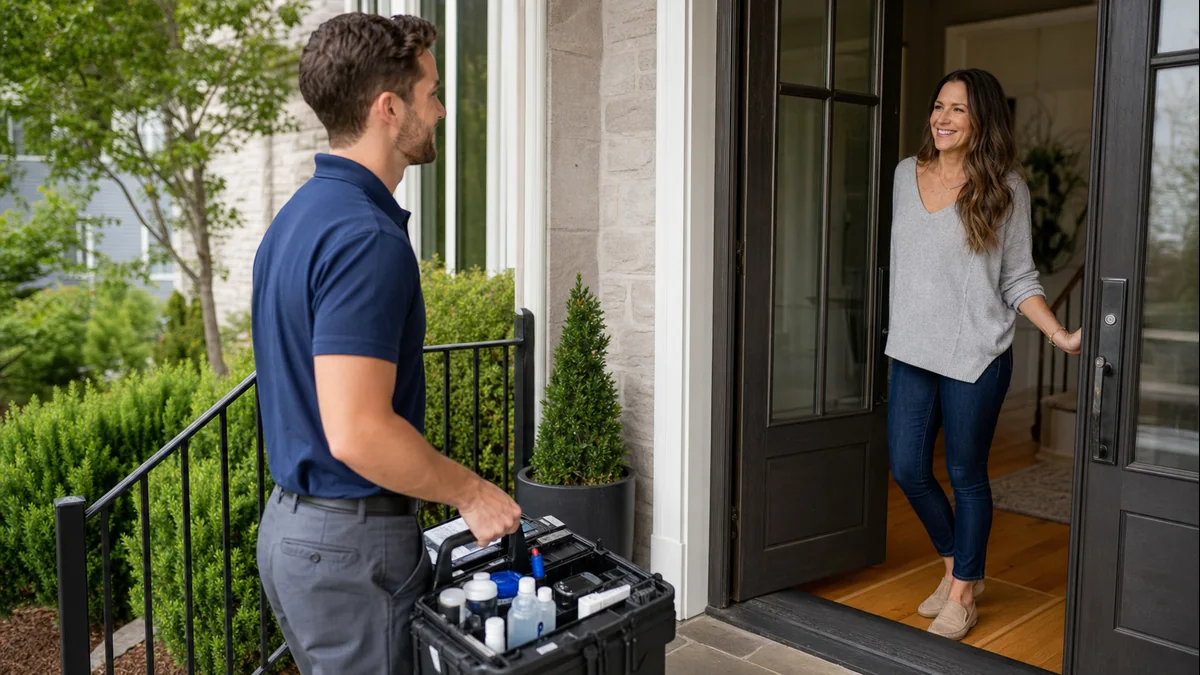
Direct answer: A water treatment company near you in Wake Forest should start with a free, address-level water test, not a phone-quoted price. Wake Forest runs on Raleigh Water's system, which reports slightly hard supply and measurable disinfection byproducts — but only a test at your own tap tells you what your household needs. Book the analysis, then the all-in-one softening-and-carbon system gets sized to your actual number.
What Should Happen When You Search "Water Treatment Company Near Me" in Wake Forest?
The search result is just the starting point — what happens next is what actually matters. A real first step is a free water test at your own address, because Wake Forest has no treatment plant of its own; the town is supplied by Raleigh Water, alongside Garner, Knightdale, Rolesville, Wendell, and Zebulon.
That shared supply means the hardness and disinfection numbers published for "Raleigh water" apply to your Wake Forest tap too — but as a system-wide average, not a reading from your kitchen sink.
Before you book anything, it helps to know what the published numbers actually say, since that's the baseline any honest quote should be tested against, not replace. See the full picture in water treatment in Wake Forest, NC.
Why Does an Address-Level Test Beat a Number Quoted Off a Chart?
Because a townwide average and your actual tap are two different things, and only one of them determines what your system needs. Raleigh Water's own 2025 report puts hardness at an average of 25.2 ppm, ranging 21.9 to 35.3 ppm — roughly 1.3 to 2.1 grains per gallon (gpg), "slightly hard" on the WQA/Hach scale the Hach Total Hardness Test Kit (Model 5-B) uses.
Our own in-home testing across the service area measures higher and varies more: 1.6 to 3.7 gpg depending on ZIP code, slightly hard to moderately hard on that same scale. Neither figure is wrong. Raleigh's is a plant-wide average measured as water leaves the treatment facility; ours is measured address by address, after the water has traveled through the distribution system.
That gap is exactly why a company quoting a system before testing your water is quoting a guess, not a number.
What Does Raleigh Water's Own 2025 Report Say About the Supply Reaching Wake Forest?
It reports full compliance, plus specific numbers worth knowing before you book a test. Beyond the hardness range above, total trihalomethanes (TTHM) average 34.2 parts per billion (ppb), ranging up to 42.8, against a legal limit (MCL) of 80 ppb. Haloacetic acids (HAA5) average 22.0 ppb, ranging up to 33.6, against an MCL of 60 ppb. Both are fully compliant — Raleigh Water isn't violating anything.
The same report carries no atrazine, simazine, or other pesticide line at all. Under a Consumer Confidence Report's own disclosure rule, only detected substances get a row, so a missing pesticide row is a genuine non-detect, not a gap in the data.
EPA's National Primary Drinking Water Regulations table lists TTHM's potential health effect from long-term exposure above the MCL as "Liver, kidney or central nervous system problems; increased risk of cancer," and HAA5's as "Increased risk of cancer."
Compliance is real, and it should be taken at face value. But an MCL is a ceiling EPA set at the edge of its own acceptable risk, not proof that everything under it deserves no further attention — a carbon filtration stage removes both compounds directly, rather than relying on staying under the legal number.
What Should You Ask a Water Treatment Company Before You Book an Appointment?
A short list of direct questions tells you more than any sales page will:
- "Will you test my water before you quote a price?" The test should come first, and it should be free.
- "What does the test actually measure?" Ask specifically whether it covers hardness, and whether it addresses chlorine taste, chloramine, and disinfection byproducts — or hardness alone.
- "Who does the physical installation?" A whole-home system ties into your main line, which is licensed plumbing work in North Carolina.
- "What does the system treat, and what does it leave alone?" A softener-only system handles calcium and magnesium; it does nothing for chlorine taste or disinfection byproducts, since softening is ion exchange only.
- "Can I get a number without an in-home sales visit first?" A straight answer to this question tells you a lot about how the rest of the process will go.
What Does a Free Water Analysis From Triangle Waterworks Actually Include?
It starts with a hardness reading and a look at what else is relevant at your specific address — not a Wake Forest average, not a Raleigh Water system-wide figure, but a number from your own tap. From there, sizing is based on your household's fixture count and usage.
The system recommended is the all-in-one design: softening resin paired with a carbon stage in one unit, since Wake Forest's water carries both a genuine (if modest) hardness case and disinfection byproducts that softening alone can't touch.
The softening side protects your water heater, dishwasher, and plumbing from scale that accumulates gradually over years, and it runs efficiently here because the incoming hardness is on the lower end of the scale to begin with. The carbon side removes chlorine and chloramine taste and reduces TTHM and HAA5, addressing what a softener was never built to touch.
Pricing is set after that test, not before it — see who installs water treatment in Wake Forest, NC for what installation day itself looks like once sizing is confirmed.
How Does a Real Water Test Compare to a Quote Without One?
| Quote based on a test | Quote based on a chart or phone call | |
|---|---|---|
| Starting point | Your address's own hardness reading | A townwide or national average |
| Sizing accuracy | Matched to your household's fixture count and usage | Assumes a "typical" home |
| Covers TTHM/HAA5 | Confirmed against Raleigh Water's own 2025 report | Not addressed unless you ask directly |
| Risk of over- or under-sizing | Low — built from real numbers | Higher — built from assumptions |
| What settles a dispute later | The original test result | Nothing to point back to |
The right question isn't which company is "near me" — it's which one will test before it quotes. That's the difference a search result alone can't show you.
Get Your Own Number Before You Compare Any Quote
Raleigh Water's system is fully compliant, but its published averages — 25.2 ppm hardness, 34.2 ppb TTHM, 22.0 ppb HAA5 — describe the plant, not your specific Wake Forest address. That's worth settling now rather than guessing your way through a comparison. Take the 60-second water quiz or book a free water analysis to get your own reading and a system sized to it.
FAQ
I just moved to Wake Forest and don't know where to start looking for a water treatment company — what's the first call I should make? Start with whichever company will test your water for free before quoting anything. Because Wake Forest runs on Raleigh Water's supply, the baseline numbers are published and compliant, but your own address's reading is what a system should actually be sized from.
My dishes and glasses come out spotty even though Raleigh's report calls the water "slightly hard" — should I still get tested? Yes. Raleigh's 25.2 ppm average is a plant-wide figure, and our own testing measures up to 3.7 gpg by ZIP code — spotting is consistent with the higher end of that range, and an address-level test is the only way to confirm where your home falls.
Is it worth asking a company about disinfection byproducts, or is that overthinking it? It's a fair question to ask, not overthinking. Raleigh Water's 2025 report shows TTHM averaging 34.2 ppb and HAA5 averaging 22.0 ppb, both compliant but both compounds a softener does nothing about — a company that can't explain how its system handles them is leaving out half the picture.
How long does the free water analysis actually take? It's typically a short visit or a quick address-level assessment, not a lengthy in-home sales process. The goal is a real number you can compare against Raleigh Water's own published figures, not a pitch.
Do I need a different kind of system if I'm on well water instead of Wake Forest's city supply? Yes — well water is a different situation with its own testing needs, sized separately from a city-water system. This page is written for Wake Forest addresses on the Raleigh Water system specifically.
What should I actually expect to pay? There's no single number to quote here, because pricing follows your test, not a catalog tier — every system is sized to a specific household's hardness reading and usage. Third-party national big-brand whole-home installs commonly run $6,000–$12,000 for comparison, but the only accurate number for your home comes after the free analysis.
Sources
- City of Raleigh — Raleigh Water 2025 Consumer Confidence Report
- EPA — National Primary Drinking Water Regulations
Related reading: Water Treatment in Wake Forest, NC | Who Installs Water Treatment in Wake Forest, NC | Water Softener Cost in Wake Forest, NC | Is Wake Forest, NC Water Hard? | How to Read Your Water Quality Report in Wake Forest, NC
Answer nine practical questions, then request a written quote or well-water analysis.
Start My Water Analysis