
Water Treatment in Holly Springs, NC: What Your Home Actually Needs
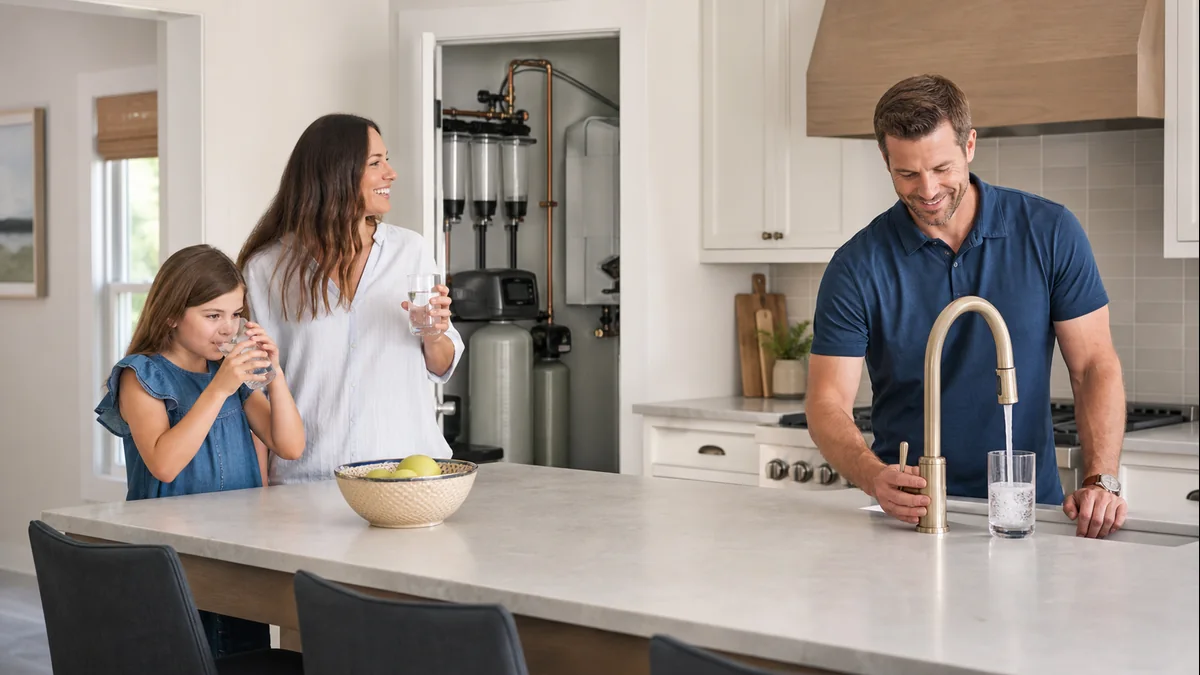
Direct answer: Holly Springs is supplied by Harnett Regional Water, which draws from the Cape Fear River — a surface-water source, unlike the reservoir-fed systems some neighboring towns use. No specific hardness number for Holly Springs has been verified from the utility, so the honest first step is a free water analysis. From there, most Holly Springs homes do best with an all-in-one system that softens water and filters it through carbon in a single unit.
Where Does Holly Springs Water Come From?
Holly Springs gets its treated water from Harnett Regional Water, a regional utility that sources from the Cape Fear River rather than a local reservoir or a well field. That's a meaningfully different starting point than towns served directly by Raleigh Water or the Cary/Apex plant on Jordan Lake — different river, different intake, different treatment plant.
Surface-water sources like the Cape Fear River carry more organic material through the system than a deep reservoir does, which means treatment plants apply more disinfectant to keep the water safe as it travels from the river to your tap. That's normal, it's how the utility keeps the water safe, and it's also exactly why the carbon-filtration side of a whole-home system matters for a Holly Springs address — more on that below.
Is Holly Springs Water Hard or Soft?
Nobody can honestly answer that with a specific number right now — a verified grains-per-gallon (gpg) figure for Harnett Regional Water hasn't been published in a form we can point to, and guessing at one would do you a disservice. Hardness varies by source, by season, and by treatment process, so the only way to know your home's actual number is to test it.
That's not a reason to wait on treatment — it's the reason the process starts with a free water analysis instead of a guess. Once you know your home's actual hardness reading, sizing a softener stops being a guessing game and becomes simple math: gallons used per day × your water's real gpg. Our water softener sizing guide walks through that formula once you have a number to plug in.
Why the Cape Fear River Source Matters for Carbon Filtration
Any water utility that treats surface water — a river, in this case, rather than a groundwater well field — has to work harder to keep organic material and pathogens in check between the source and your faucet. Disinfection is what keeps that water safe to drink, and it's also the process that can leave behind chlorine taste and smell, plus a class of chemical byproducts called disinfection byproducts (DBPs), including compounds like HAA9 and TTHM, which form when disinfectant reacts with organic matter in the water.
This is precisely the gap that hardness testing doesn't cover and that a softener alone doesn't touch. A softener is an ion-exchange process built to swap out calcium and magnesium — it has no effect on chlorine taste, smell, or disinfection byproducts. Removing those requires activated carbon filtration, which is why Triangle Waterworks builds every whole-home system as softening resin and a carbon stage in one unit, rather than selling the two as separate add-ons.
| What it does | Softening resin | Carbon filtration |
|---|---|---|
| Removes calcium/magnesium (scale) | Yes | No |
| Protects water heater, dishwasher, plumbing | Yes | No |
| Removes chlorine taste & smell | No | Yes |
| Reduces disinfection byproducts (HAA9, TTHM) | No | Yes |
| Needs your home's real hardness number to size | Yes | Not hardness-dependent |
What Should a Holly Springs Homeowner Do First?
Start with a free water analysis before buying anything. A technician tests your home's actual water — hardness, chlorine levels, and other relevant readings — at your kitchen tap, not at the treatment plant miles away. Plumbing age, pipe material, and even how far your house sits from the water main can all shift what actually reaches your faucet versus what Harnett Regional Water reports at the system level.
Once you have real numbers, sizing the right system is straightforward. For most Holly Springs homes, that means a single whole-home unit combining:
- Softening resin sized to your home's tested hardness, protecting your water heater, washing machine, dishwasher, and plumbing from gradual scale buildup
- A carbon filtration stage that removes chlorine taste and smell along with disinfection byproducts that hardness testing alone will never catch
- One footprint, one installation, one system to maintain instead of stacking separate softener and filter units
Pricing depends on household size and tested water conditions, set only after that free analysis — and it typically lands well below the $6,000–$12,000 that national big-brand quotes commonly run for comparable whole-home coverage.
How Is This Different From What My Neighbors in Raleigh or Cary Deal With?
Raleigh Water customers are working with a reservoir-fed system that tests soft (about 1.6 gpg), and Cary's system off Jordan Lake spans a wider range (1.6–3.7 gpg, moderately hard at the top). Holly Springs, on Harnett Regional Water's Cape Fear River supply, is simply a different system with a different source — which is exactly why we don't borrow a number from Raleigh or Cary and slap it on a Holly Springs home. See our breakdown of Raleigh's actual hardness numbers for how a verified reading looks once a utility publishes one, and why "soft" doesn't mean "nothing to treat."
Frequently Asked Questions
Is Holly Springs water hard? There's no verified hardness figure published for Harnett Regional Water at this time, so we won't guess at a number. A free water analysis gives you your actual reading, which is also the number a softener needs to be sized correctly.
I just bought a house in Holly Springs and the water smells like chlorine — is that normal? Yes, and it's common on surface-water systems like the Cape Fear River supply that feeds Holly Springs, where disinfectant levels tend to run a bit higher to keep the water safe over the distance it travels. A carbon filtration stage removes that taste and smell — it's the carbon side of a whole-home system doing its job, not a sign anything is wrong with your plumbing.
Do I need a water softener if I live in Holly Springs? Until your home is tested, the honest answer is "we don't know your number yet" — which is exactly why the free analysis comes first. Most Triangle homes benefit from softening because minerals accumulate gradually regardless of exactly where a home falls on the hardness scale, and pairing it with carbon filtration means you're also covered for chlorine taste and disinfection byproducts in one system.
What's the difference between a water softener and a whole-house filter for my Holly Springs home? A softener handles hardness minerals only; a whole-house filter (typically carbon-based) handles taste, smell, and chemical byproducts but does nothing about scale. See our comparison of whole-house filters versus softeners for the full rundown — in practice, most Holly Springs homes are best served by a single all-in-one unit that does both.
How much does a whole-home water system cost in Holly Springs? Pricing depends on your home's size and tested water conditions, set after a free analysis — typically well under the $6,000–$12,000 for comparable national big-brand installs. See our water softener cost breakdown for the fuller pricing picture across the Triangle.
Are there other companies doing water treatment near Holly Springs? Yes — see our roundup of water filtration companies serving the Raleigh area for how the options compare. Whoever you choose, start with an actual test of your home's water rather than a system sized off assumptions.
Ready to See What Your Holly Springs Water Actually Needs?
Take our 60-second water quiz to get matched with the right starting point for your home, or book a free water analysis so a technician can test your actual tap water — hardness, chlorine, and more — before any system gets recommended. For most Holly Springs homes on Harnett Regional Water's Cape Fear River supply, that leads to one all-in-one system handling softening and carbon filtration together, sized to your real numbers instead of a guess.
Answer nine practical questions, then request a written quote or well-water analysis.
Start My Water Analysis