
Water Treatment in Wake Forest, NC: What Your Home Actually Needs
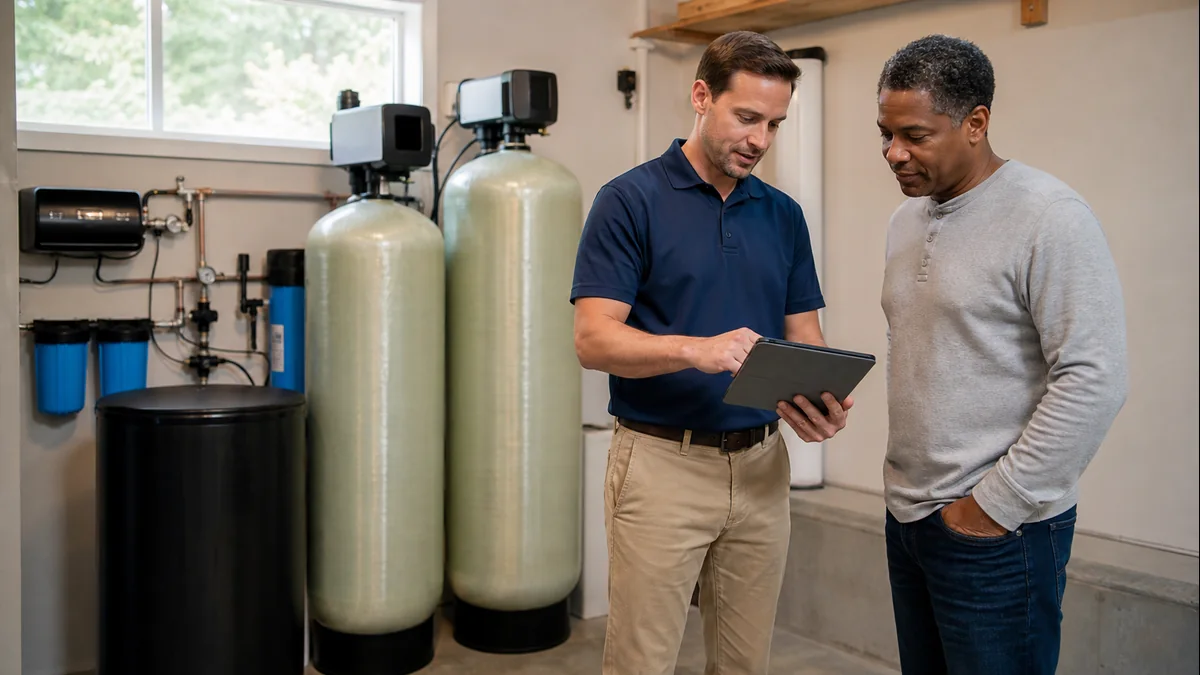
Direct answer: Wake Forest is on the Raleigh Water system, which delivers water at about 1.6 grains per gallon (gpg) — slightly hard on the WQA scale, the same one the Hach Total Hardness Test Kit (Model 5-B) uses. But hardness classification only describes calcium and magnesium; it says nothing about chlorine taste, disinfection byproducts (Raleigh's HAA9 runs 19.9 ppb, TTHM 21.7 ppb), or PFAS. The right setup for a Wake Forest home is an all-in-one system — softening resin plus carbon filtration — that runs cheaply on this low-hardness water while handling what low hardness alone can't.
Is Wake Forest's Water Hard or Soft?
Wake Forest doesn't run its own water plant — it's supplied by Raleigh Water, the same utility serving Raleigh, Garner, Knightdale, Rolesville, Wendell, and Zebulon. That system tests around 1.6 gpg, which lands in the "slightly hard" band on the WQA hardness scale — the same scale the Hach Total Hardness Test Kit (Model 5-B) uses (soft is below 1.0 gpg; slightly hard runs 1.0–3.5 gpg; moderately hard picks up from 3.5–7.0 gpg). If you moved to Wake Forest from a region with 20+ gpg well water or a harder municipal supply, the difference is real — you'll notice less soap scum and less scale buildup here than you did there.
That said, a lot of new Wake Forest residents assume low hardness means "done" — that no treatment is needed at all. That's the part worth correcting.
Does Soft Water Mean I Don't Need Any Treatment?
No — slightly hard water still benefits from treatment, just a different kind of benefit than a hard-water home gets. At 1.6 gpg, Wake Forest water won't crust your shower door in weeks, but calcium and magnesium are still present and still accumulate — inside your water heater, on fixtures, and on glassware — over months and years of use. A softener sized correctly for 1.6 gpg water is inexpensive to run: low salt use, infrequent regeneration cycles, minimal wear. It's not solving an emergency; it's protecting a 10–15 year appliance investment (your water heater, dishwasher, washer) at very low ongoing cost.
Meanwhile, hardness has nothing to do with the other half of what's coming out of your tap.
What's Actually in Wake Forest Tap Water?
Because Wake Forest draws from Raleigh Water, it carries the same disinfection byproduct profile: HAA9 (haloacetic acids) at 19.9 ppb and TTHM (trihalomethanes) at 21.7 ppb. Both are legally compliant with EPA limits — Raleigh Water isn't violating anything — but the Environmental Working Group's health guidelines are stricter than the federal legal limit, and byproducts like these form as part of the standard chlorine disinfection process municipal water needs to be safe to drink. There is no verified PFAS (PFOA/PFOS) figure for Raleigh Water specifically, so we won't state one — but disinfection byproducts alone are enough reason to run tap water through activated carbon before it reaches your glass and shower.
This is the piece a softener alone will never touch. Softening is ion exchange for calcium and magnesium — full stop. It does nothing for chlorine smell, DBPs, or anything else dissolved in the water.
Softener vs. Carbon Filter vs. All-In-One: What Actually Covers Wake Forest Water?
| Concern | Softener alone | Carbon filter alone | All-in-one system |
|---|---|---|---|
| Scale buildup in water heater/appliances | Yes | No | Yes |
| Soap lather / spotty glassware | Yes | No | Yes |
| Chlorine taste & smell | No | Yes | Yes |
| Disinfection byproducts (HAA9/TTHM) | No | Yes | Yes |
| Runs cheaply on Wake Forest's 1.6 gpg water | Yes (low salt use) | N/A | Yes |
| One system, one install | No | No | Yes |
Given Wake Forest's actual water profile — slightly hard water, real DBP levels — treating only one side leaves a gap. A softener-only setup ignores taste and byproducts; a carbon-only setup ignores the slow mineral buildup that's still happening at 1.6 gpg. An all-in-one system handles both from a single unit, and because the hardness side is so low here, that half of the system barely works for its keep — cheap salt, cheap maintenance, full protection.
What Does a Whole-Home System Cost in Wake Forest?
Pricing follows a free water analysis that confirms what your specific home's water needs (Wake Forest homes on well water, in the unincorporated edges of town, can differ meaningfully from Raleigh Water customers), and it typically comes in well under the $6,000–$12,000 national big-brand quotes commonly run for comparable whole-home setups. For the full cost breakdown by household size and system type, see our water softener cost guide for the Raleigh area.
Frequently Asked Questions
I just bought a house in Wake Forest and the inspection didn't mention water treatment — do I need anything? Most likely yes, but not because Wake Forest water is "bad." At 1.6 gpg it's slightly hard, so you won't see dramatic hardness problems, but you're still on Raleigh Water's system, which carries measurable disinfection byproducts (HAA9 19.9 ppb, TTHM 21.7 ppb). A free water analysis will tell you exactly what your home's water looks like and whether the previous owners had any treatment installed already.
Why does my water in Wake Forest still leave spots on glasses if it's supposedly soft? Slightly hard water at 1.6 gpg still contains some calcium and magnesium — it's low, not zero — and those minerals concentrate as water evaporates off glass and dishes, leaving spots over time. A correctly sized softener eliminates this even at low hardness levels, and because Wake Forest's water is low in hardness to begin with, that softener runs efficiently with minimal salt.
Is Wake Forest water safe to drink straight from the tap? Raleigh Water, which supplies Wake Forest, is legally compliant with EPA drinking water standards. Some substances, like disinfection byproducts, are measured above the EWG's stricter non-regulatory health guideline while remaining under the federal legal limit — both facts are true at once, and the carbon stage of a whole-home system is what addresses those byproducts. See what to look for in a whole-house filter for city water.
Does a water softener remove chlorine taste from my Wake Forest tap water? No. A softener is an ion-exchange system built specifically for calcium and magnesium — it has no effect on chlorine, chloramine, or disinfection byproducts. Removing chlorine taste and DBPs requires activated carbon filtration, which is why an all-in-one system pairs both technologies rather than asking a softener to do a carbon filter's job.
How is Wake Forest's water different from Cary's or Apex's? Wake Forest is on Raleigh Water (1.6 gpg, sourced separately from Cary's system), while Cary and Apex draw from Jordan Lake through the Cary/Apex Water Treatment Facility and run 1.6–3.7 gpg — slightly hard at the low end, moderately hard at the top. Different source, different hardness range, but the same underlying need for both hardness protection and carbon filtration in any Triangle city-water home. See Raleigh water hardness: the actual numbers for the full comparison.
Should I choose a softener or a whole-house filter for my Wake Forest home? For most Wake Forest households, the honest answer is both, combined into one all-in-one system, rather than picking one over the other — hardness protection and contaminant removal solve two different problems. See our full breakdown at whole house filter vs. water softener for how the two technologies actually divide the work.
Find Out What Your Wake Forest Home Actually Needs
Every Wake Forest home is on the same Raleigh Water supply, but pipe age, fixture type, and household size all change what a system should be sized for. Take our 60-second water quiz to see what fits your home — for most Wake Forest households on city water, that means an all-in-one softening + carbon filtration system built to run efficiently on low-hardness water while removing chlorine taste and disinfection byproducts.
Answer nine practical questions, then request a written quote or well-water analysis.
Start My Water Analysis