
How Often to Test Well Water in NC (There's No Law — Here's the Rule)
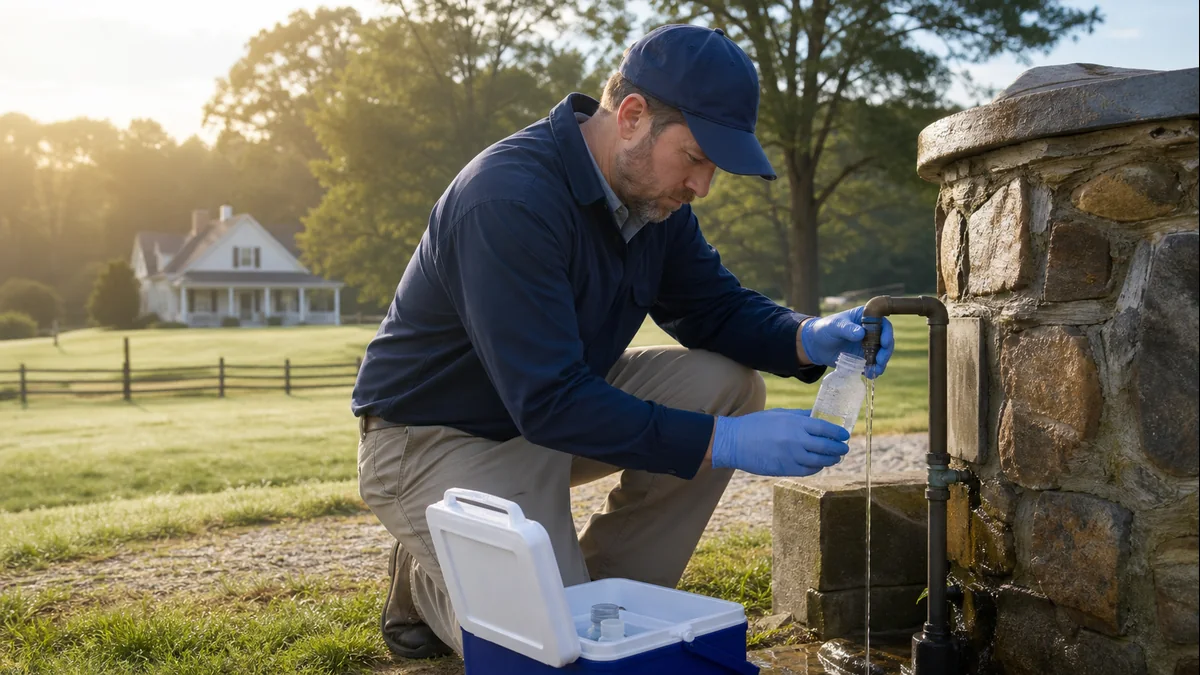
North Carolina does not regulate private well water quality after construction, so there's no state-mandated testing schedule. Testing is entirely the homeowner's responsibility. The common-sense standard: a comprehensive test — covering bacteria, nitrates, iron, pH, hardness, sulfur, and TDS — once a year, and again any time you notice a change in taste, smell, or appearance.
Does NC require well water testing?
No. Once a private well is constructed and passes initial standards, North Carolina doesn't mandate ongoing water quality testing the way it regulates public water systems. That means nobody is checking your water for you on a schedule — no annual notice, no automatic retest. If you're on a well, you're the only one who knows what's actually coming out of your tap unless you test it yourself.
This surprises a lot of new well owners, who assume some agency is monitoring their water the way city utilities publish annual water quality reports. On a private well, that report doesn't exist unless you generate it.
How often should you test well water?
Once a year for a full panel is the standard recommendation, with a few situations that call for testing sooner:
- Annually — comprehensive test covering the main categories below
- Right after moving in — even if the previous owner tested, get your own baseline
- After any noticeable change — new smell, taste, staining, or cloudiness
- After nearby flooding, construction, or land disturbance — anything that could affect the aquifer your well draws from
- If a household member is pregnant, an infant, or immunocompromised — worth a bacteria/nitrate retest even without symptoms
What should a comprehensive well water test include?
Not all "well water tests" cover the same thing. There are two categories, and you typically need both:
| Category | Who tests it | What it covers |
|---|---|---|
| Bacteria & nitrates | County health department | Health-based contamination risk |
| Iron, pH, hardness, sulfur, TDS | Comprehensive water analysis | Aesthetic/quality issues that drive treatment decisions |
A bacteria-only test from the county tells you if your water is safe from a contamination standpoint. It won't tell you why your water stains orange, smells like sulfur, or corrodes your pipes — that requires the fuller panel.
Where can you get well water tested in NC?
County health departments handle bacteria and nitrate testing — this is the core safety check and the right place to start if you've never tested. For the broader quality panel (iron, pH, hardness, sulfur, TDS) that determines what treatment equipment you actually need, a comprehensive water analysis is the more complete route. If your bacteria test comes back positive, see coliform bacteria in well water: what to do next for the standard response.
What this means for well owners locally
Roughly 15% of homes in Wake County are on private wells, with an even higher share in Johnston, Franklin, Chatham, and Granville counties. That's a lot of households where testing is entirely self-directed — no reminder postcard, no city notice. If you're in one of these counties and can't remember your last test, that's the signal to schedule one.
FAQ
Is well water testing required by law in North Carolina? No, not after initial construction. NC does not regulate private well water quality on an ongoing basis — testing is voluntary and up to the homeowner.
How much does a well water test cost? Costs vary by test type and provider. County health departments typically handle bacteria/nitrate testing; a comprehensive analysis covering iron, pH, hardness, sulfur, and TDS is available free through Triangle Waterworks.
What happens if I never test my well water? Nothing happens automatically — no agency flags it. The risk is entirely to you: undetected bacteria, or slow damage from acidic or iron-heavy water going untreated for years.
Do I need to test every year even if my water looks and tastes fine? Yes, ideally. Several common well issues — nitrates, certain bacteria, low-level pH problems — don't show up as visible symptoms until they've been present a while.
What's the difference between a bacteria test and a full water analysis? A bacteria test (county health department) checks for contamination and is health-based. A full water analysis checks iron, pH, hardness, sulfur, and TDS — the factors that determine what treatment equipment, if any, you need.
Get a free well water analysis
If it's been more than a year, or you've never tested, start with a free Triangle Waterworks water analysis covering iron, pH, hardness, sulfur, and TDS. See the well water treatment guide for NC for the full test-diagnose-treat order, or first-time well owner: what to do if you just moved into a well-water home.
Answer nine practical questions, then request a written quote or well-water analysis.
Start My Water Analysis