
Who Installs Water Softeners in Garner, NC?
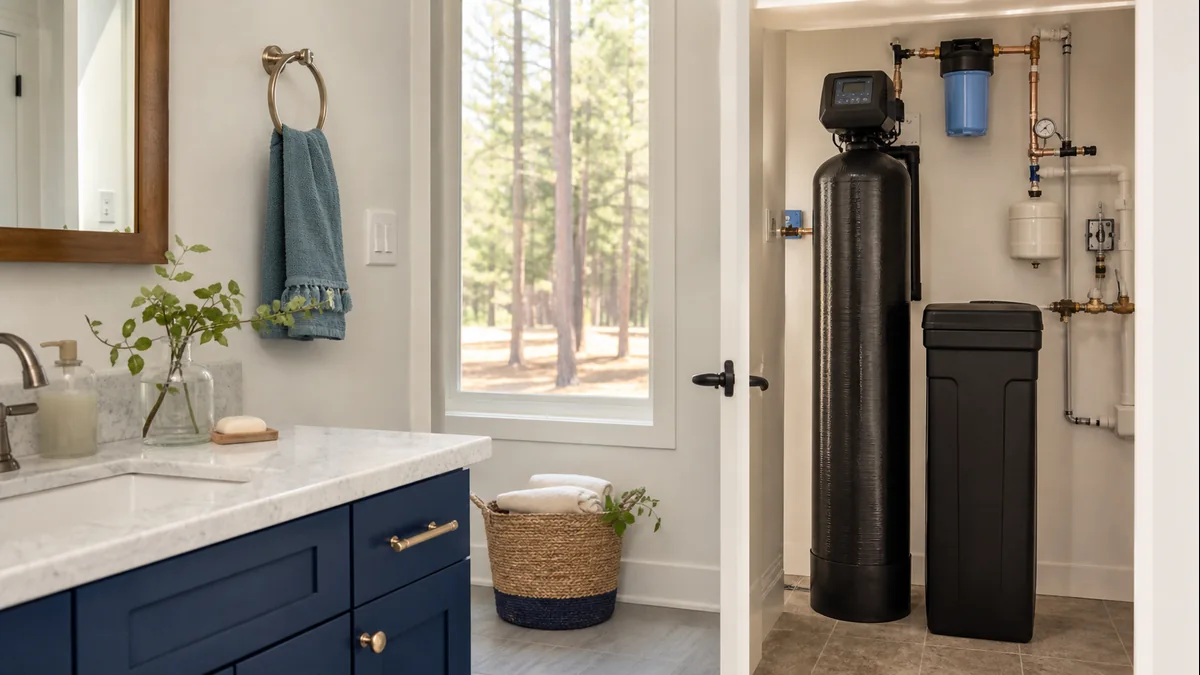
Direct answer: In North Carolina, only a licensed plumbing contractor can legally install a whole-home water softener — plumbing contracting work under state law, not a DIY project. In Garner, that installer starts with a free water analysis, not a phone-quoted guess, since Raleigh Water's hardness varies by ZIP. Most Garner homes need more than softening alone — an all-in-one system that also strips chlorine byproducts, starting with that free test.
Who actually installs water softeners in Garner?
A licensed plumbing contractor, working with a water treatment company that specializes in sizing and configuring the equipment itself. Under N.C. Gen. Stat. § 87-21, "whole-house water purification or treatment systems" fall under the same licensing requirement as plumbing, heating, and fire-sprinkler contracting.
That means the person tying a softener into your main water line has to hold the same license as anyone connecting, repairing, or altering your potable water system. That rules out a handyman install or a DIY kit for a whole-home unit, even though it might look like a simple tank-and-valve setup.
Garner is served by Raleigh Water — the same utility supplying Raleigh, Knightdale, Rolesville, Wake Forest, Wendell, and Zebulon. A local installer who works Garner addresses regularly has actually tested this specific supply at the tap, not just skimmed a regional average, which matters once you get to sizing.
What does a professional water softener installation actually involve, at a high level?
It starts with confirming what your water needs, then sizing and placing equipment to match: a water test, a recommendation built around what that test shows rather than a generic package, placement near where the main line enters your house, and a walkthrough of how to maintain it going forward.
Every home's plumbing layout, water use, and household size differ, so specifics like timing and exact on-site steps depend on your house — a licensed local installer walks you through what your particular install involves before a crew shows up, not after. Ask your installer directly about crew size, timeline, and anything specific to your property; a good installer answers plainly rather than guessing.
Does Garner require a permit for the installation?
Yes. Garner runs its own Inspections Department out of Town Hall rather than routing plumbing permits through Wake County, and a whole-home water system ties into the main water supply — which makes it plumbing work requiring a permit and inspection, the same as anywhere else in the state. Your installer files with Garner's Inspections Department and schedules the inspection as part of the job; it's not something you're expected to sort out yourself.
Why does it start with a free water analysis instead of a phone quote?
Because a phone quote can't see your water, and your water is what determines the right system. Garner's supply comes from Raleigh Water at roughly 1.6 grains per gallon (gpg) on average — "slightly hard" on the WQA scale, the same classification system the Hach Total Hardness Test Kit (Model 5-B) uses: soft is below 1.0 gpg, slightly hard runs 1.0–3.5 gpg, moderately hard picks up from there. That average is a starting point, not a site-specific answer.
Across our own testing throughout the broader Triangle service area, hardness at the tap runs 1.6 to 3.7 gpg depending on ZIP code — slightly hard at the low end, and moderately hard at the top of that range (3.7 gpg works out to about 63 mg/L, just over the 60 mg/L line separating "slightly hard" from "moderately hard" on the WQA scale).
A published utility average can't tell you where your specific address falls in that range — a free water analysis at your house can. It's the only honest basis for a real price, since two homes a few streets apart can land at different points on that range.
What should I ask any installer before I sign anything?
Ask what the water analysis actually measured at your address, and ask to see the numbers — hardness in grains per gallon, and anything else the test picked up. Ask whether the recommended system handles only hardness or also handles chlorine taste, chloramine, and disinfection byproducts, since those need two different stages (softening resin for hardness; activated carbon for the rest).
Ask what's included in the installed price — is it truly one number, or does it grow with add-ons later. And ask how long the installer has serviced Raleigh Water's supply, since local experience beats a national playbook. If an installer can't answer these plainly, that's a reason to walk, not to sign.
A confident local installer answers all of this without hesitation — the free test already did the hard part of the guessing.
Why does the carbon-filtration side matter as much as the hardness side in Garner?
Because hardness is only half of what's documented in Garner's water. Raleigh Water — Garner's supply — carries measurable disinfection byproducts: HAA9 at 19.9 ppb and TTHM at 21.7 ppb, both compliant with EPA limits but present, and both untouched by softening resin, which is ion exchange for calcium and magnesium only.
"Compliant" is a ceiling, not a guarantee of zero risk. EPA's own National Primary Drinking Water Regulations table lists the potential health effects of long-term exposure above the legal limit for these exact compounds: TTHMs are tied to "liver, kidney or central nervous system problems; increased risk of cancer," and HAA5 to "increased risk of cancer." A carbon stage removes them at the tap rather than relying on staying under a legal number.
Raleigh Water also runs an annual switch from its normal chloramine disinfection to free chlorine only, on the N.C. Department of Environmental Quality's recommendation, historically for a stretch spanning late winter into early spring — exact dates shift year to year, so check the City's own announcement. Chlorine residual runs higher system-wide during that period, and none of it is something a softener addresses.
That's why an all-in-one system — softening and carbon filtration in one install — isn't optional polish for most Garner homes. It's the difference between actually removing these compounds and just staying under the legal limit for them, and a softener alone leaves that gap wide open.
Garner installer comparison: what to expect at each level
| Local licensed installer (all-in-one system) | National big-brand call center | |
|---|---|---|
| Starting point | Free water analysis at your address | Phone-estimated package |
| Licensing | Licensed plumbing contractor, per N.C. Gen. Stat. § 87-21 | Regional subcontractor, varies by job |
| Permit handling | Installer files with Garner's Inspections Department | Varies by contractor |
| What's covered | Softening resin + carbon filtration in one install | Varies by brand and package |
| Local water knowledge | Has tested Raleigh Water's supply directly | Works from a national average |
| Price range (installed) | Set after a free water analysis | Commonly $6,000–$12,000 |
The price varies because homes need different things: a lower-hardness address near 1.6 gpg needs a smaller system than one nearer 3.7 gpg, and carbon capacity for chloramine and byproducts shifts the number too. A free water analysis turns those variables into one accurate quote for your house.
Is Garner's water actually hard enough to justify a softener?
At the top of the local range, yes by the WQA scale — 3.7 gpg is over the line into moderately hard. At the lower end, near Garner's 1.6 gpg average, the case is different but still real: calcium and magnesium are present at every point on that range, and buildup on fixtures, glassware, and water heaters is cumulative over years.
That's especially relevant in Garner, where a mix of older and newer neighborhoods means some homes have logged far more exposure than others. Whatever your exact number, low hardness is a genuine upside once you install — the system regenerates rarely and uses very little salt.
A free test at your specific address is what settles it, not a townwide average. Don't wait for visible buildup to find out where you actually stand — get the number now.
FAQ
I'm buying a house in Garner and want to know if I'll need a softener before I move in — how do I find out? Request a free water analysis at the address once you have access, or as soon as possible after closing. It measures your actual tap hardness rather than relying on Raleigh Water's system-wide average, and gives you a specific answer for that house instead of a general guess for the town.
I already have a softener that a big national brand installed — do I need to start over with a local company? Not necessarily, but it's worth having a local installer check your current setup against a fresh water analysis, since national packages are often sized to a general estimate rather than your address's actual reading. If your system is undersized or missing carbon filtration for taste and byproducts, that's worth knowing regardless of who installed it originally.
How long does a water softener installation take in Garner? It depends on your home's plumbing layout and what the install involves at your address — ask your installer for a specific estimate once the water analysis and system sizing are done, rather than assuming a fixed number that applies to every house.
Can I install a water softener myself to save money? No — in North Carolina, whole-house water treatment systems are defined as plumbing contracting work under N.C. Gen. Stat. § 87-21, which means the installer has to hold a plumbing contractor's license. A licensed installer also handles the permit filing and inspection with Garner's Inspections Department as part of the job.
What's the difference between a softener and the all-in-one system you keep mentioning? A softener alone handles hardness — calcium and magnesium — through ion exchange. An all-in-one system adds an activated carbon stage in the same install, which addresses chlorine and chloramine taste and disinfection byproducts a softener alone doesn't touch. Given Raleigh Water's documented HAA9 and TTHM levels, both stages together are the more complete answer for a Garner home.
Does the free water analysis cost anything if I decide not to install a system? No — it's free and comes with no obligation. Its purpose is to give you accurate numbers for your address so any decision you make, including deciding to wait, is based on what your water actually contains rather than a townwide average or a guess.
Ready to stop guessing and find out what your water needs?
Don't wait on this — the fix is a free water analysis away. Take our 60-second water quiz to get matched with the right all-in-one system, or request your free water analysis directly. It's the same test a licensed local installer runs before recommending anything.
Related reading: Water Treatment in Garner, NC: A Homeowner's Guide | What Happens During Water Softener Installation in Garner, NC? | Who Installs Water Softeners in Apex, NC? | Does Wake County Require a Permit for Water Softener Installation? | How to Read Your Water Quality Report in Garner, NC
Sources
- N.C. General Assembly — G.S. 87-21, Definitions; contractors licensed by Board
- Town of Garner, NC — Inspections Department
- EPA — National Primary Drinking Water Regulations
Answer nine practical questions, then request a written quote or well-water analysis.
Start My Water Analysis