
Who Installs Water Softeners in Knightdale, NC?
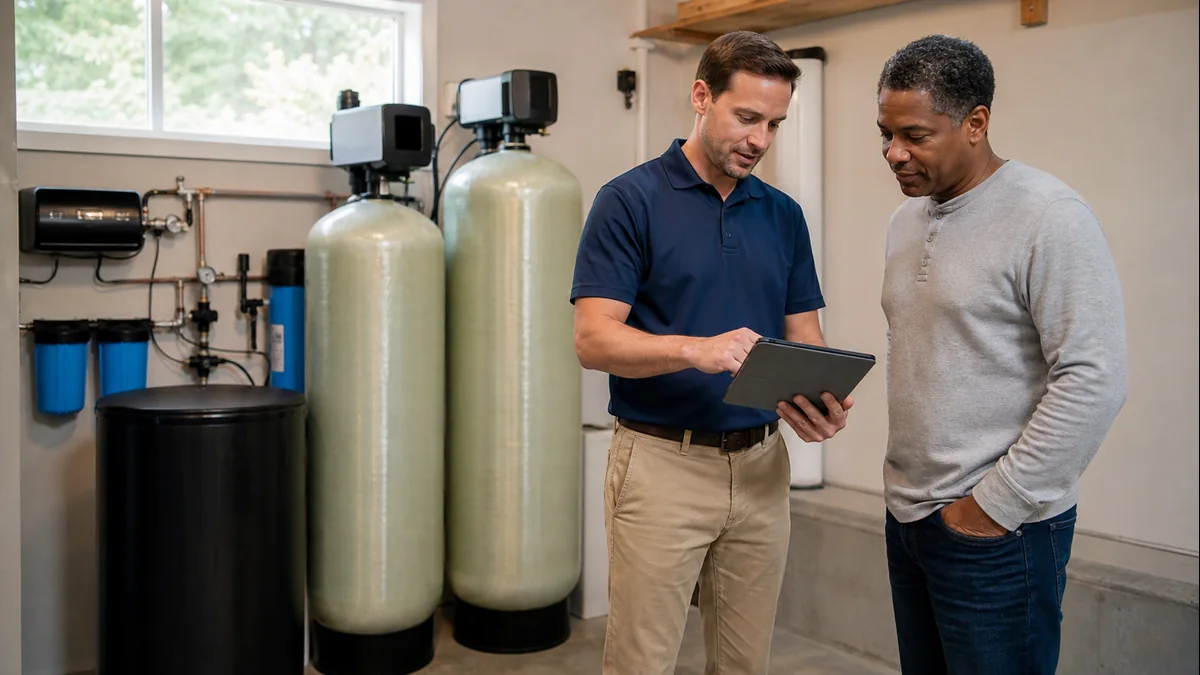
Direct answer: A local, licensed plumbing contractor — not a national call center — installs Knightdale water softeners under N.C. Gen. Stat. § 87-21, with Wake County Permits & Inspections issuing the permit. Installation starts with a free water analysis at your address, not a phone quote. Because Knightdale runs on Raleigh Water, the honest recommendation for most homes is an all-in-one softening-and-carbon system.
Who actually installs water softeners in Knightdale, NC?
A local, licensed water treatment company installs whole-home softeners in Knightdale — not a big-box retailer, not a national brand dispatching a regional subcontractor, and not an unlicensed handyman. Under North Carolina law, tying equipment into a home's main water supply is plumbing contracting work, so whoever does the job is a licensed plumbing contractor, full stop. Knightdale draws its water from Raleigh Water, so a competent installer already knows that system's profile before they ever see your address.
That local familiarity matters more in a town growing as fast as Knightdale, where new subdivisions keep going up alongside a core of older homes near the town center. An installer who actually works the Triangle has tested Raleigh Water at real Knightdale taps — crawl spaces, slab foundations, older supply lines — not just read the utility's published annual report from somewhere else.
Does North Carolina require a softener installer to be licensed?
Yes, and it isn't a judgment call any one company gets to make. N.C. Gen. Stat. § 87-21 defines plumbing contracting to include the installation or replacement of "whole-house water purification or treatment systems," which puts a softener tie-in in the same legal category as any other work on a home's water supply. That's the state's own classification, written into statute — not a claim a company invents to sound official.
The reason the law treats it that way is practical. A whole-home system connects where water enters the house, so every fixture downstream depends on that one connection being made correctly. Licensing exists so someone accountable — trained, tested, on record with the state — is the one making it, not whoever happens to own the right tools.
Who issues the permit for a Knightdale water softener installation?
Not a Knightdale town office — there isn't one for this kind of work. Wake County Permits & Inspections handles plumbing permits for unincorporated Wake County plus four specific towns: Rolesville, Wendell, Knightdale, and Zebulon. Search for a "Town of Knightdale" building department expecting to pull a plumbing permit and you'll come up empty; the county's office is the one your installer actually files with.
That's a small but genuinely useful thing to know before comparing quotes. Asking an installer "did you pull the permit?" in Knightdale is really asking whether they have an existing, working relationship with Wake County's office specifically. We cover the full permit process — what triggers it, what's exempt, how it plays out — in does Wake County require a permit for water softener installation.
What should you look for before hiring a Knightdale installer?
Work through these before signing anything:
- A free test at your address, not a phone-quoted guess. Your installer should measure your actual water before recommending equipment, at no cost and no obligation.
- A license number they hand over without hesitation. A licensed contractor gives it up on request; reluctance is itself an answer.
- Confirmation they file directly with Wake County, not a vague "we handle permits" with no specifics about which office.
- A written scope that separates softening from carbon filtration. Bundling both stages into one vague line item makes it hard to know what you're actually paying for.
- A crew that services Knightdale regularly, not a one-time dispatch from outside the Triangle with no local track record.
A confident local installer answers every item on this list without hedging, because the free test already did the hard part of the guessing for both of you.
What actually happens on install day?
The test comes first, always, and it happens before a crew is ever scheduled — a water analysis establishes your actual hardness and any other findings, and equipment gets sized to that result. Only after that does an installer confirm exactly where the unit will sit: garage, crawl space, or utility closet, depending on your home's layout.
On the day itself, the system ties into the main line where water enters the house, a drain line is run for the regeneration cycle, and the control valve gets wired to power — all licensed plumbing work, not a plug-and-play appliance swap. The installer then commissions the system, running it through a cycle to confirm it's working correctly.
Before leaving, they walk you through basic maintenance. Exactly how long the visit takes depends on your home's plumbing; a good installer tells you what to expect for your specific house, not a generic timeline.
What does Knightdale's water actually contain, and why does that call for an all-in-one system?
Knightdale is on Raleigh Water, and the utility's 2025 Consumer Confidence Report gives an average hardness of 25.2 ppm, ranging 21.9–35.3 ppm — roughly 1.3–2.1 grains per gallon (gpg), which lands in the "slightly hard" band on the WQA/Hach scale, not "soft." That's a plant-wide average measured at the treatment plant.
What actually reaches a given Knightdale tap varies by ZIP code, and our own testing across the service area runs 1.6–3.7 gpg — a genuine hardness case, even if a modest one.
Hardness is only half the picture, though. The same 2025 report puts total trihalomethanes (TTHM) at an average of 34.2 ppb, ranging up to 42.8, and haloacetic acids (HAA5) at an average of 22.0 ppb, ranging up to 33.6 — both under the EPA's 60 ppb HAA5 limit and well under TTHM's 80 ppb limit, and both compounds a softener does nothing about.
"Legally compliant" is a ceiling set by EPA's own risk tolerance, not a guarantee of zero risk. EPA's National Primary Drinking Water Regulations table lists TTHMs' potential long-term health effect above the MCL as "liver, kidney or central nervous system problems; increased risk of cancer," and HAA5's as "increased risk of cancer" — the exact compounds a carbon stage removes, rather than relying on staying under a legal limit.
That's why the honest recommendation for most Knightdale homes pairs softening resin with carbon filtration in a single all-in-one install, instead of a softener alone.
Local installer vs. national big-brand — what's the real difference?
| Local Triangle installer | National big-brand dealer | |
|---|---|---|
| Who tests your water | A technician at your Knightdale address, free | Often a phone estimate; sometimes no test at all |
| Who pulls the Wake County permit | The installer, as a routine part of the job | Varies by branch or franchise |
| Familiarity with Raleigh Water | Services this exact supply daily | Standardized national playbook, not address-specific |
| System configuration | Softening plus carbon, sized to your test results | Often softening-only unless you specifically upgrade |
| Pricing basis | Set after your free water analysis | Commonly $6,000–$12,000, from a phone or in-home sales visit |
The gap isn't just brand markup — it's frequently what's actually included. A national quote sized to a generic household can look competitive on paper while leaving the carbon stage out entirely, missing the disinfection byproducts documented in Raleigh Water's own report.
Get matched with an installer who already knows Knightdale
Slightly hard water and documented disinfection byproducts aren't worth living with while you shop around — the fix is a free water analysis away. Take the 60-second water quiz to get matched with the right all-in-one system for your Knightdale address, or request the free water analysis directly.
FAQ
I'm building a house in Knightdale and my builder didn't include a softener — who do I call, and when? Call a local, licensed water treatment company as soon as you have access to the home, since new plumbing and a new water heater are exactly what's worth protecting from day one. A free water analysis at that point gives you a real hardness reading for your address instead of a builder's general assumption.
Does Knightdale have its own permit office, or does everything route through the county? Everything routes through the county. Wake County Permits & Inspections issues plumbing permits for Knightdale along with unincorporated Wake County, Rolesville, Wendell, and Zebulon — there's no separate Knightdale town office handling this, which is worth knowing before you ask an installer where they filed.
I've lived on a private well at the edge of Knightdale for years — does the same licensing rule apply to me? Yes. N.C. Gen. Stat. § 87-21 covers installing or replacing a whole-house water treatment system regardless of whether the water source is Raleigh Water or a private well — the licensing requirement doesn't change, though a well system is sized entirely off what your own water analysis finds rather than a municipal figure.
What's the difference between a plumber who "also does water treatment" and a dedicated water treatment company? Both can be licensed to do the work, but a dedicated water treatment company typically has more direct, day-to-day experience sizing systems to Raleigh Water's specific profile and to the disinfection byproducts documented in its own reports. Ask either one how many Knightdale-area systems they've installed and how they size the carbon stage.
Can I install a water softener myself and just get it inspected afterward? No — since a whole-home system ties into the main water supply, North Carolina classifies the work as licensed plumbing contracting, and Wake County requires a permit before the work happens, not after. A licensed installer pulls that permit and schedules the inspection as a normal part of the job.
Does the free water analysis cost anything if I decide not to install a system? No — it's free with no obligation attached. Its purpose is giving you accurate numbers for your own address, so whatever you decide, including waiting, is based on what your water actually contains rather than a townwide average.
Sources
- N.C. General Assembly — G.S. 87-21, Definitions; contractors licensed by Board
- Wake County Government — Permits and Inspections
- City of Raleigh — Raleigh Water 2025 Consumer Confidence Report
- EPA — National Primary Drinking Water Regulations
Related reading: Water Treatment in Knightdale, NC | What Drives Water Softener Cost in Knightdale, NC | Does Wake County Require a Permit for Water Softener Installation? | How to Choose a Water Softener | Who Installs Water Treatment Across Raleigh, Cary, Apex, Morrisville, and Wake Forest?
Answer nine practical questions, then request a written quote or well-water analysis.
Start My Water Analysis