
Who Installs Water Softeners in Raleigh, NC?
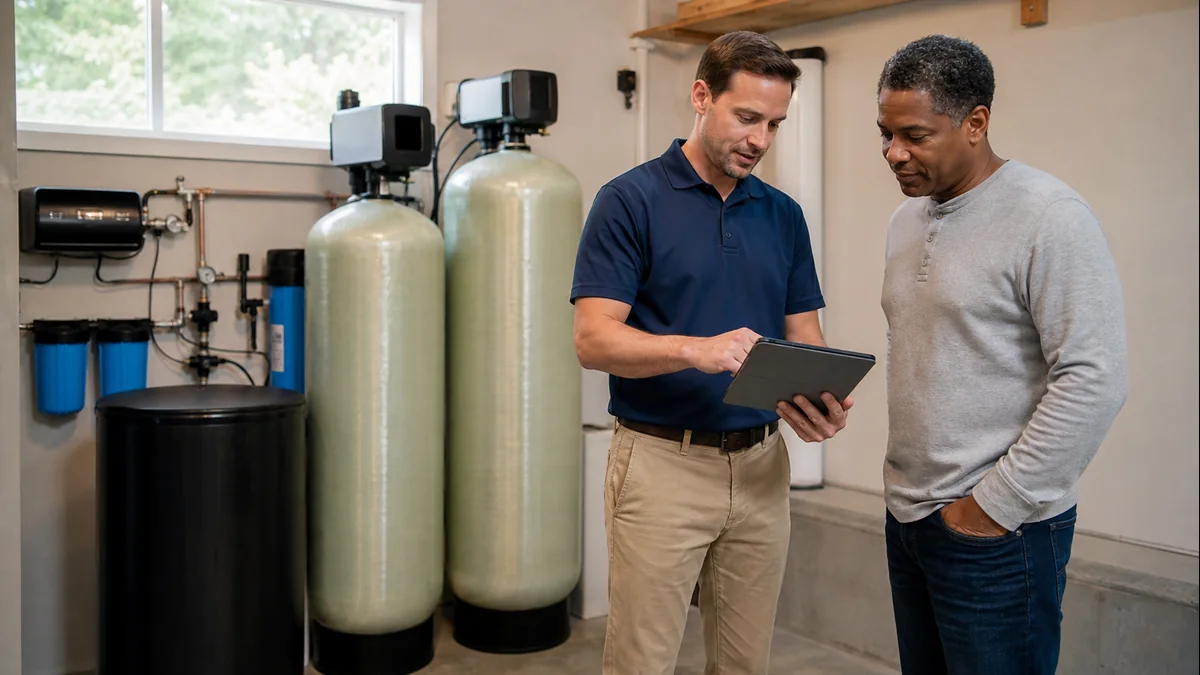
Direct answer: Three types of companies install water softeners in Raleigh: locally based water treatment specialists, general plumbing contractors who add softeners as one service among several, and national franchise dealers. The category matters less than what each one does at your address — whether they test your water first, install with licensed plumbing, and recommend an all-in-one softening-and-carbon system sized to what Raleigh water actually contains.
What Kinds of Companies Install Water Softeners in Raleigh?
Search "who installs water softeners in Raleigh" and the results mix three kinds of businesses. Locally based water treatment specialists work only in water treatment. General plumbing contractors offer softeners as one line item among many other services. National franchise dealers sell a company-wide brand through local territories. Which of the three you're talking to is worth establishing on the first call, because it changes what you should ask next.
None of those three labels tells you, by itself, whether a company will test your water at your address, use licensed plumbers, or recommend equipment sized to Raleigh's actual water rather than a standard package. That dividing line cuts across all three categories, which is why the questions below matter more than which type of company you call first.
| Category | What to ask to find out how they'll handle your address |
|---|---|
| Local water treatment specialist | How many Raleigh-area installs have you done, and do you test my water before quoting? |
| General plumbing contractor | Is water treatment a core part of your business or an occasional add-on, and are your installers NC-licensed? |
| National franchise dealer | Is my price and warranty set for my specific home, and can I get both in writing before I sign? |
How Do I Tell a Water Treatment Specialist From a General Plumber?
Ask what share of the business is water treatment, and ask what they can tell you about Raleigh's water specifically — the chloramine residual, the annual free-chlorine conversion, the disinfection byproduct levels in the current report. Those answers, not the label on the truck, are what tell you how much of a specialty this is for them.
Neither answer disqualifies anyone by itself. A general contractor who's NC-licensed and willing to test your water before quoting can still do the job well. The question tells you how much Raleigh-specific experience sits behind the recommendation you're about to get.
Are National Franchise Dealers Different From a Local Raleigh Installer?
The honest answer is: ask, don't assume the label tells you anything. Neither "national franchise" nor "locally owned" is, by itself, a promise about price, quality, or service. Ask the same three questions of any installer: will you test my address before quoting, is my installer NC-licensed, and can I read the price and warranty before I sign.
A company that answers all three plainly is worth hiring, whatever's on the truck. One that hedges is worth passing on, regardless of size.
Does a Raleigh Water Softener Installer Have to Be Licensed?
Yes. Installing a whole-home water treatment system in North Carolina — including a softener — is licensed plumbing work under N.C. Gen. Stat. § 87-21, because the install ties directly into your home's main water line, ahead of every fixture in the house. That requirement applies the same way no matter which of the three categories above the company falls into.
Ask for the installer's NC plumbing license number and confirm it through the NC State Board's public license lookup before anyone cuts into your plumbing. It takes a couple of minutes and it's the easiest thing on this list to verify.
What Does a Proper Whole-Home Installation Actually Involve?
At a high level, every legitimate whole-home installation follows the same shape. A water test at your address comes first, then sizing based on what that test shows, then placement of the unit at the point where the main line enters your house so every fixture downstream is covered.
From there, a drain line connection handles the regeneration cycle, and a walkthrough of salt and basic maintenance happens before the crew leaves. Ask upfront how long the install is scheduled to take and whether it's expected to be a single visit.
The specifics — exact timing, what's included in the price, how your plumbing layout affects the job — vary by home, so don't expect a script that applies to every house. A good installer walks you through what your install involves before anyone shows up. For a fuller walkthrough of install day, see water softener installation in Raleigh.
Why Does Testing My Own Address Matter More Than Which Company I Pick?
Because Raleigh's own published water numbers are averages, and averages don't describe what's coming out of your specific tap. Raleigh Water's 2025 Consumer Confidence Report puts average hardness at 25.2 ppm, ranging 21.9 to 35.3 ppm across the system — roughly 1.3 to 2.1 grains per gallon (gpg), slightly hard on the WQA/Hach scale the Hach Total Hardness Test Kit (Model 5-B) uses.
Our own testing across the wider service area, done address by address, measures higher: 1.6 to 3.7 gpg by ZIP code, slightly hard to moderately hard on that same scale. See Raleigh water hardness for the full picture.
Neither number is wrong. One is a plant-wide average and the other is measured house by house, and the gap is exactly why a company quoting off a chart is guessing while one that tests your address first isn't. The water analysis should come before the price, not after it.
The same logic applies to what softening alone can't touch. Raleigh's 2025 report shows total trihalomethanes (TTHM) averaging 34.2 ppb, up to 42.8, and haloacetic acids (HAA5) averaging 22.0 ppb, up to 33.6 — both compliant with EPA's legal limits of 80 ppb and 60 ppb.
Raleigh Water normally disinfects with chloramine and converts to free chlorine once a year, on the N.C. Department of Environmental Quality's recommendation, which is why the water can taste noticeably different for a few weeks most springs. Softening resin does nothing about any of that — it only removes calcium and magnesium.
EPA's National Primary Drinking Water Regulations table lists TTHM's potential health effect from long-term exposure above the legal limit as "Liver, kidney or central nervous system problems; increased risk of cancer," and HAA5's as "Increased risk of cancer."
Compliance means Raleigh's numbers stay under that ceiling — it isn't a claim that everything under the ceiling carries zero risk. The limit is EPA's own risk-tolerance line, set with these exact compounds in mind, and a carbon filtration stage removes them directly rather than counting on staying under a legal number.
That's the real answer to who installs water softeners in Raleigh: whichever installer tests your address, ties in with a license, and recommends an all-in-one system covering both halves — softening resin for hardness, carbon for the rest — sized to your numbers, not the system-wide average. How to choose the best water softener company in Raleigh walks through that decision further.
What Should I Ask Any Installer Before I Sign?
- Will you test my water at this address, and is that test free?
- Are you an NC-licensed plumbing contractor, and can I check your license number myself?
- Does the recommended system handle hardness only, or hardness plus chlorine, chloramine, and disinfection byproducts together?
- Is the price and the warranty something I can read in writing before I sign, or only hear on the phone?
- How long have you worked specifically on Raleigh Water's system, as opposed to water treatment in general?
A company that answers all five without hedging is worth hiring, regardless of which of the three categories it falls into. For a longer checklist covering quotes and red flags, see how to choose a water filtration company in Raleigh.
FAQ
I just moved to Raleigh and don't know which type of company to call first — where do I start? Start with a free water analysis at your specific address, regardless of which category of company provides it. That test gives you a real hardness and water-quality number to compare against any quote, so you're evaluating an offer instead of guessing at one.
Does it actually matter if I hire a big national brand instead of a small local company? It matters less than what happens at your address. Ask any installer, national or local, whether they test your water first, whether the installer is NC-licensed, and whether the price and warranty are in writing — a company that clears all three is a reasonable choice either way.
My neighbor's softener was installed by their general plumber, not a water-treatment specialist — should I worry that mine wasn't? Not automatically. A licensed plumbing contractor who tests your water before quoting and covers both hardness and chlorine byproducts in the system can do the job well. What matters is whether those steps happened, not which category of business performed them.
How do I actually check if a Raleigh installer is licensed? Ask for their NC plumbing license number and look it up yourself through the NC State Board's public license lookup. Whole-home water treatment installation is licensed plumbing work under N.C. Gen. Stat. § 87-21, so any legitimate installer should hand this over immediately.
I got three different quotes for a softener in Raleigh and the prices are all over the place — why? Usually because the quotes aren't for the same thing. Different companies size off different assumptions — some off a phone estimate, some off Raleigh's published average, and some off an actual test at your address. Ask each one what number they sized to and the spread typically explains itself.
Is a standalone softener enough, or do I need the carbon stage too? For most Raleigh homes, both. A softener handles calcium and magnesium through ion exchange; it does nothing for chlorine, chloramine, or the disinfection byproducts documented in Raleigh Water's own reports. An all-in-one system covers both in one install.
Get Matched With What Your Raleigh Address Actually Needs
The company that installs your softener matters less than what happens before the crew shows up. Take the 60-second water quiz or request a free water analysis to get your own numbers before you sign with anyone — that's the same first step a good installer, of any type, should already be offering you.
Sources
- City of Raleigh — Raleigh Water 2025 Consumer Confidence Report
- EPA — National Primary Drinking Water Regulations
Related reading: Water Softener Installation in Raleigh | How to Choose the Best Water Softener Company in Raleigh | Water Softener Cost in Raleigh | How to Choose a Water Filtration Company in Raleigh
Answer nine practical questions, then request a written quote or well-water analysis.
Start My Water Analysis