
Who Installs Water Softeners in Wendell, NC?
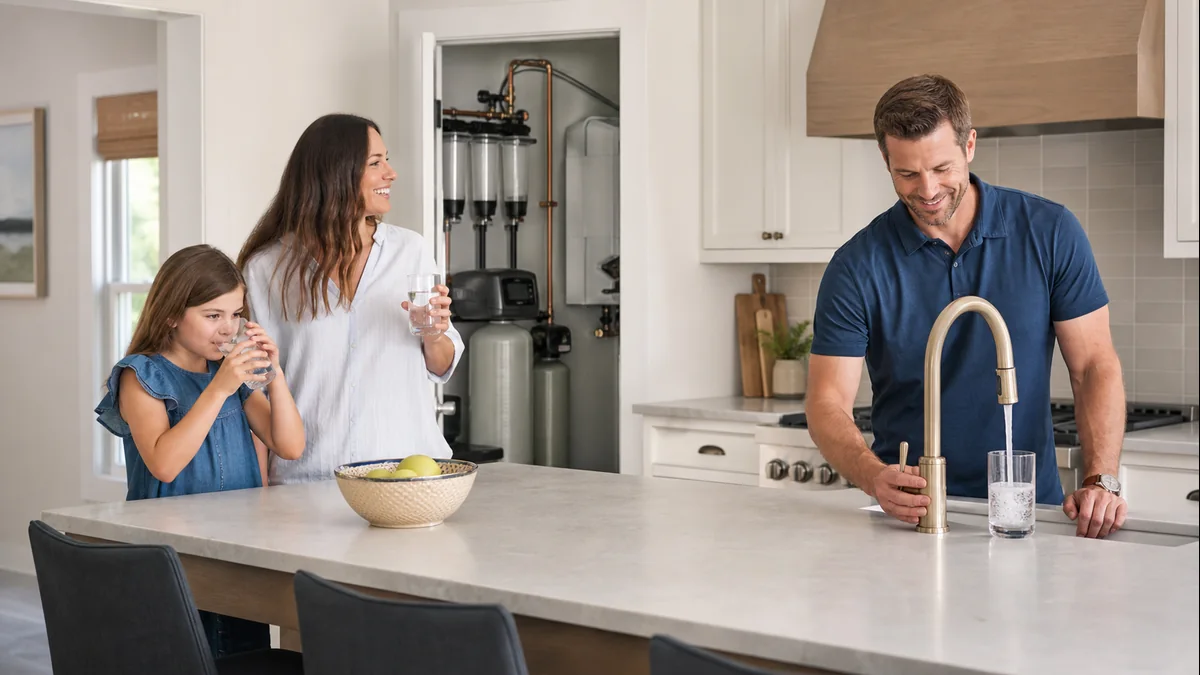
Direct answer: Triangle Waterworks installs water softeners in Wendell: a technician assesses your plumbing and the install location, runs a free in-home water analysis, sizes an all-in-one softening-and-carbon system to what that test measures, then ties it into your existing plumbing. Wendell is served by Raleigh Water, which measures about 1.6 grains per gallon — slightly hard. Book a free analysis to see your address's own number.
Who Actually Shows Up to Install a Water Softener in Wendell?
Triangle Waterworks installs water softeners for homes across Wendell. The same technician who runs your free water analysis typically returns to size and install the system, so the person recommending equipment has already seen your water and your plumbing firsthand. The job breaks into four parts at your home: assessing the install location, testing your water, matching a system to what that test finds, and tying the new equipment into your existing plumbing.
That order matters. It keeps the recommendation tied to your actual home — the plumbing gets assessed and the water gets tested before any system gets sized. For the broader picture of water treatment options near you, see water treatment near me in Wendell, NC.
What Does the Installer Check About Your Plumbing Before Recommending Anything?
The technician walks your home looking for where a system can physically go — garage, crawl space, or utility closet — and how your main water line runs from there to the rest of the house. Wendell has a mix of older in-town lots and newer construction, and the two often have very different plumbing layouts even a few streets apart.
For homes with limited access underneath, that assessment also covers clearance, drainage for the system's discharge line, and how far the main line is from wherever the system ends up. See what a crawl-space installation actually involves in Wendell if that's the layout you're working with. All of it gets looked at in person, at your home, before any sizing conversation starts.
What Happens During the Free In-Home Water Analysis?
A technician tests your water directly at your address rather than working from a townwide estimate. Wendell is served by Raleigh Water, the same utility supplying Raleigh, Garner, Knightdale, Rolesville, Wake Forest, and Zebulon, and that system measures roughly 1.6 grains per gallon (gpg) — slightly hard on the Water Quality Association scale the Hach Total Hardness Test Kit, Model 5-B uses.
That 1.6 gpg figure describes Raleigh Water's system, not your specific tap. Our own in-home testing across the service area runs 1.6 to 3.7 gpg depending on ZIP code, spanning slightly hard to moderately hard — which is exactly why the visit exists. Learn how to test your own tap water in Wendell between now and your appointment if you want a preview of what the technician measures.
How Is the System Sized and Matched to What the Test Finds?
Sizing comes from two numbers measured at the same visit: your address's hardness reading and your household's daily water use. See how grain capacity and sizing actually work for the mechanics behind that calculation. A system sized to a service-area average instead of your actual test either works harder than it needs to or falls short during peak household use.
Because the analysis and the sizing happen together, the recommendation reflects your specific water, sized from what the test actually found.
How Does the System Tie Into Your Existing Plumbing?
Installation connects the new system to your home's main water line, positioned ahead of your water heater so every fixture in the house receives treated water. The technician who assessed your plumbing during the analysis visit already knows where that connection point is and what the install will involve, so install day follows a plan instead of starting from scratch.
For crawl-space homes or tight utility closets, that earlier assessment is what keeps install day from turning into a surprise about access or clearance.
Why Install an All-in-One System in Wendell Instead of a Softener Alone?
Because a standalone softener only ever does one job: exchanging calcium and magnesium through the resin bed. It does nothing about chlorine or chloramine taste, and it does nothing about disinfection byproducts. Raleigh Water's own 2025 Consumer Confidence Report shows TTHM averaging 34.2 ppb and reaching as high as 42.8 ppb, and HAA5 averaging 22.0 ppb and reaching 33.6 ppb — both legally compliant with EPA's limits, and both entirely outside what a softener alone can touch.
Compliant is a ceiling, not a guarantee of zero exposure. EPA's own National Primary Drinking Water Regulations table lists TTHM's potential health effect from long-term exposure above the legal limit as "Liver, kidney or central nervous system problems; increased risk of cancer," and HAA5's as "Increased risk of cancer." A carbon stage removes those compounds directly instead of relying on staying under a legal number.
| What it does | Softening resin | Carbon stage |
|---|---|---|
| Removes calcium/magnesium (scale) | Yes | No |
| Protects water heater, dishwasher, plumbing | Yes | No |
| Removes chlorine/chloramine taste | No | Yes |
| Reduces TTHM and HAA5 | No | Yes |
| Sized from your address's own test | Yes | Yes |
That's why the system installed in Wendell pairs both stages in one unit — softening resin for the minerals, a carbon stage for what's left over from disinfection.
FAQ
I just moved into a Wendell home with an older crawl space — does the installer need to see it before quoting anything? Yes. The install location and the plumbing layout are part of the same visit that measures your water, since where the system goes and how it connects to your main line both depend on physically seeing the space first.
How long does the whole process take from my first call to a working system? The water analysis and plumbing assessment typically happen in one visit, and installation follows once sizing is confirmed. Timing depends on access and how your existing plumbing is laid out, which is part of what gets checked during that first visit.
Do I need to be home for both the water analysis and the install? Yes for both. The technician needs access to your water source and your plumbing to test accurately and connect the system correctly, and you'll want to be there to see what the test finds before installation begins.
Is Raleigh Water's 1.6 gpg figure actually what comes out of my faucet? Not necessarily. That number describes Raleigh Water's system average; our own testing across the area runs 1.6 to 3.7 gpg by ZIP code, so your address could read higher or lower. The in-home analysis is what settles it for your specific tap.
What if my water tests higher than 1.6 gpg — does that change who does the install? No — the same technician handles it either way. A higher reading changes how the system gets sized, not who does the assessment, the analysis, or the tie-in.
Can the water analysis and the install happen on the same visit? Sometimes, depending on scheduling and what the plumbing assessment finds. More often the analysis happens first so sizing is confirmed before the install visit is scheduled, which keeps install day from running into a surprise about access or connection points.
Get Your Wendell Home's Own Water Analysis
Everything above starts with a technician actually seeing your water and your plumbing — not a service-area average standing in for your address. Take the 60-second water quiz or book a free in-home water analysis to get your Wendell home into the assessment step today.
Sources
Answer nine practical questions, then request a written quote or well-water analysis.
Start My Water Analysis