
Who Installs Water Treatment in Johnston County, NC?
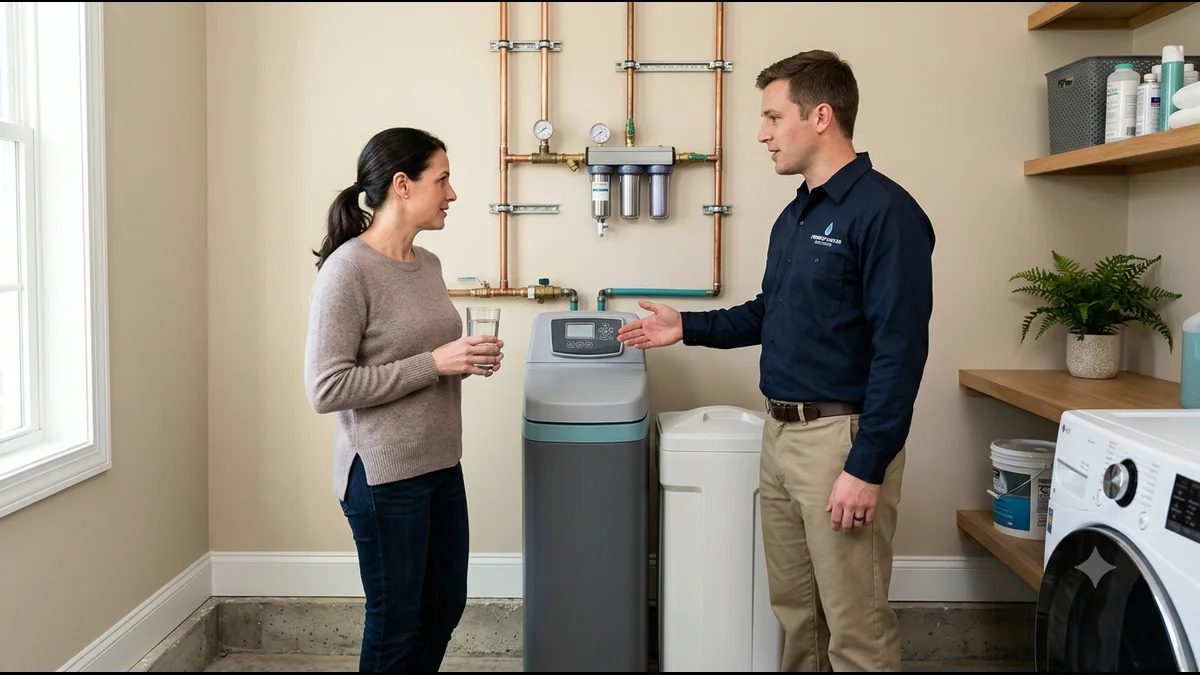
Direct answer: Across Johnston County — Clayton, Smithfield, Selma, Four Oaks, Benson, Archer Lodge, and Wilson's Mills — a whole-home water treatment installation is licensed plumbing contracting work under N.C. Gen. Stat. § 87-21, so the main-line tie-in belongs to a licensed plumber, not a sales-only installer. The county publishes no single hardness figure, so the smart first step is a free address-level water analysis routed to an all-in-one softening-and-carbon system.
Who Actually Installs Water Treatment Systems in Johnston County?
A licensed local plumbing company, not a big-box appliance department or a subcontractor working off a lead-buyer's dispatch list. Johnston County's towns don't share one water system the way Wake County's Raleigh Water customers do — Clayton, Smithfield, Selma, and the smaller towns each sit on different supply arrangements, and a share of homes between them are on private wells instead of any municipal system at all.
That mix is why the installer matters more here than the brand of equipment does. A company that actually operates across the county — not just advertises there — has already handled Clayton's purchased-water setup, a Smithfield or Selma municipal account, and a well household outside Four Oaks or Benson in the same week.
Is Water Treatment Installation Licensed Plumbing Work in Johnston County?
Yes. North Carolina law treats it that way statewide, not just in Johnston County. N.C. Gen. Stat. § 87-21 defines plumbing contracting to include "the installation or replacement of … whole-house water purification or treatment systems," which puts a whole-home unit in the same license category as any other tie-in to your home's main water line.
That matters because a whole-home system isn't a plug-in countertop filter — it interrupts your main supply line, and doing that without a licensed plumber is both a legal and a workmanship risk. Before you hire anyone, ask for the license number directly. It's public information, and a legitimate installer hands it over without hesitation.
Does Johnston County Publish a Hardness Number I Can Check a Quote Against?
Partly. Clayton, the county's largest town by water customers, publishes a typical figure: its Drinking Water page states hardness entering Clayton is 30 mg/L. On the Water Quality Association scale — the same scale the Hach Total Hardness Test Kit, Model 5-B reads out on — that's about 1.75 grains per gallon, "slightly hard." Clayton's own page calls it "soft," using an older, wider USGS-style scale; both labels are accurate on their own scale.
Smithfield, Selma, and the rest of the county publish no figure at all, and Johnston County as a whole doesn't either. Even Clayton's number is a system-wide typical value, not a reading from your own tap — and a quote should be sized from the second, not the first.
A free water analysis gets you that: an actual number for your address, checkable yourself with the Hach Total Hardness Test Kit, Model 5-B (Drop Count Titration), on the same WQA scale a legitimate installer should use.
Are More Johnston County Homes on Private Wells Than in Wake County?
Yes. Roughly 15% of Wake County homes rely on private wells, and that share runs higher in Johnston County. North Carolina does not regulate private well water quality after a well is constructed, so two wells on the same road can test completely differently from each other.
A well household routes to a different fix than a city-water one: an iron removal plus carbon/resin system, sized only after a free water analysis, since wells commonly carry iron, sulfur, or a pH level municipal water doesn't. If your home is on a private well, say so up front — the installer, the test, and the equipment all differ from a Clayton or Smithfield municipal account.
What Should I Ask a Johnston County Installer Before I Hire Them?
Work through these before you sign anything:
- What's your NC plumbing license number? Ask before the quote, not after you've committed.
- Do you test my actual water, or quote from an average? In a county with no published hardness figure, this is the question that separates a real number from a guess.
- Does the quote include softening AND carbon filtration, or just one? Plenty of quotes cover only the mineral side.
- Is the plumbing permit and inspection included in the price? A properly run installation pulls the permit — that shouldn't be left for you to arrange.
- What's the warranty, in writing? Ask what's covered, for how long, and what would void it.
- Who services the system afterward — you, or a subcontractor? Get a direct answer on who actually shows up months or years from now.
Why Is an All-in-One Softening-Plus-Carbon System the Right Installation for Johnston County?
Because the two problems in Johnston County's water — hardness and everything that isn't hardness — need two different treatment technologies, and pricing one without the other leaves half the job undone. The softening side is ion exchange: it pulls calcium and magnesium out of the water, which is what causes scale buildup inside a water heater, film on glassware, and soap that won't lather.
The carbon side handles what softening can't touch at all — chlorine and chloramine taste and odor, plus disinfection byproducts like TTHM and HAA5 that treated water carries by design of the disinfection process itself.
Being legally compliant with EPA limits is a ceiling set by EPA's own risk tolerance, not a guarantee of zero risk: EPA's National Primary Drinking Water Regulations table lists TTHM's potential health effect from long-term exposure above the MCL as "liver, kidney or central nervous system problems; increased risk of cancer," and HAA5's as "increased risk of cancer." A carbon stage removes those compounds rather than relying on staying under a legal limit.
An installer who quotes softening alone has addressed one half of the water and left the other half — the half EPA regulates for health reasons — untouched.
What Happens on Install Day?
A licensed plumber handles the main-line tie-in as a single scheduled visit, once your free water analysis has sized the system to your actual address. Expect the crew to confirm the shutoff and tie-in point, install the unit, pressure-test the line, and walk you through basic operation before they leave — not a multi-day project for a properly sized system.
Because the work is plumbing contracting under state law, a permit and a follow-up inspection are part of a properly run installation, not an optional extra. Ask any company you're considering to walk you through their own install-day process, including how they handle your home's existing plumbing layout and where the unit will sit.
Johnston County Installer Checklist: Local vs. National Lead-Generator
| What to Verify | Local Licensed Installer | National Lead-Generator or Big-Box |
|---|---|---|
| Licensing | Licensed NC plumber does the tie-in directly | Often subcontracted or dispatched, unverified until they arrive |
| Water testing | Tests your actual address before quoting | May quote from a chart or phone call |
| Scope of treatment | Softening and carbon both included by default | Frequently prices softening alone |
| Warranty | Terms in writing, specific to parts and labor | Often summarized verbally at a sales visit |
| Permit and inspection | Included as part of the quoted install | May be left for the homeowner to arrange |
| Who services it later | Same company that installed it | Can be a different, unaffiliated crew |
Our Clayton water softener cost guide breaks down what actually drives that price once you're comparing real quotes.
Get Your Johnston County Address Tested, Not Estimated
Johnston County has no published hardness number to guess from, and an installer quoting one anyway is quoting blind. The fix is a free water analysis away — take the 60-second water quiz to get started, or book a free water analysis and get an all-in-one softening-and-carbon system sized to your actual Clayton, Smithfield, or Selma address, not a townwide average.
FAQ
I live in Smithfield and every company I find online lists itself as an HVAC contractor first — how do I know they're actually licensed for water treatment installs? Ask directly for their NC plumbing license number before you get a quote — it's public information, and a company that hesitates to give it is telling you something. A whole-home water treatment tie-in is plumbing contracting under state law regardless of what else the company advertises, so the license question applies no matter how they describe their main business.
I'm on a well outside Four Oaks — does the same licensing rule apply to me? Yes, the licensing requirement under N.C. Gen. Stat. § 87-21 covers the installation the same way whether you're on municipal water or a well. What changes is the equipment: a well household gets an iron removal plus carbon/resin system sized after a free water analysis, rather than the all-in-one system a Clayton or Smithfield city-water home would get.
Do I need a permit for a whole-home water treatment system in Johnston County? Yes. Because it's licensed plumbing contracting work, a properly run installation includes pulling the permit and scheduling the inspection as part of the job, not as something left for the homeowner to sort out separately.
What's the difference between a company that installs water treatment and one that just sells it? A selling company may collect your address and pass it to a subcontractor you haven't vetted, while an installing company handles the license, the test, the tie-in, and the service call afterward directly. Ask plainly whether the person quoting you is the one who will show up on install day.
Can a handyman or general contractor install a water softener instead of a licensed plumber? No — under North Carolina law, this specific work falls under plumbing contracting because it ties into your home's main water line, which puts it outside general handyman or contractor scope. A licensed plumber should be the one making that connection, regardless of who else is on the job site.
How long does installation actually take once I've picked a company? For a properly sized system, expect a single scheduled visit once the free water analysis has determined sizing — not a multi-day project. Ask any company you're considering to walk you through their specific process, since access and your home's existing plumbing layout can affect the day.
Sources
- EPA — National Primary Drinking Water Regulations
- North Carolina General Assembly — General Statute § 87-21, Definitions; contractors licensed by Board
- Town of Clayton — Drinking Water
Related reading: How to Choose a Water Treatment Company in Johnston County, NC | How to Choose a Water Softener | HOA Rules and Water Softener Installation in Clayton, NC
Answer nine practical questions, then request a written quote or well-water analysis.
Start My Water Analysis