
Will a Whole House Filter Remove Chlorine and Chloramine in Cary, NC — and Help My Hair?
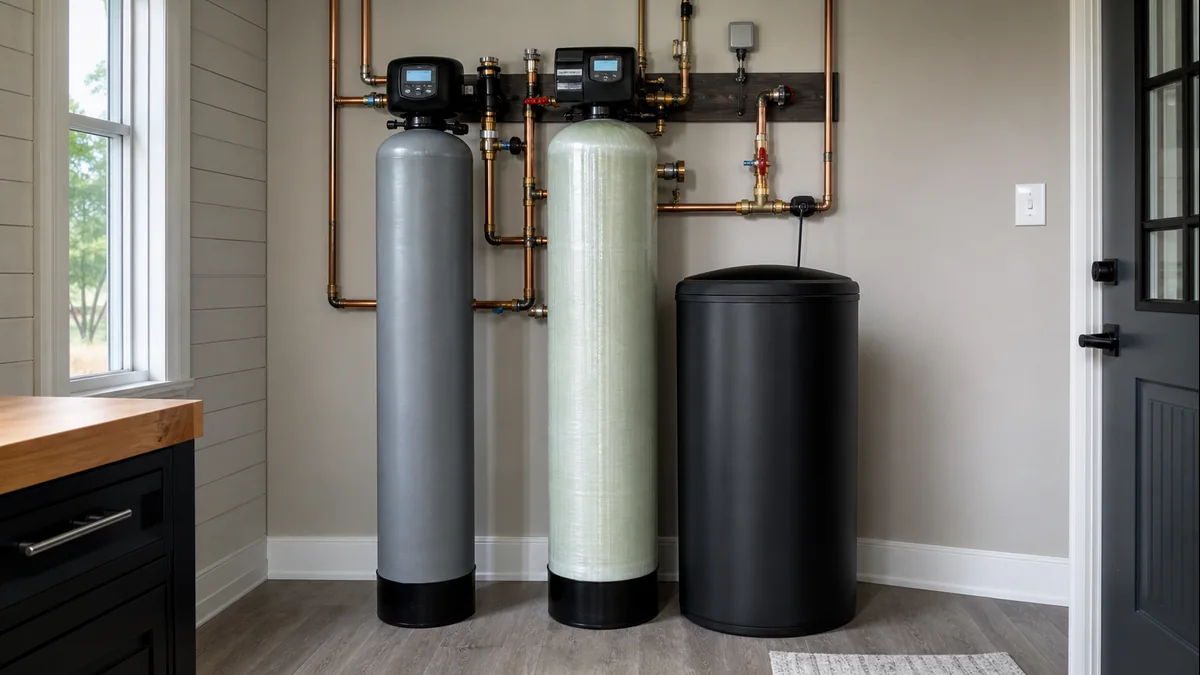
Direct answer: Yes — a whole-home carbon stage removes both chlorine and chloramine from every tap in the house, including the shower, as long as it has enough carbon and enough contact time to do it, which is a design question a whole-home unit is sized for and a small cartridge usually isn't. Cosmetically, that means less of the dry, straw-like, stripped feeling hair can have after a shower in chloraminated water. Softening resin alone does nothing about chlorine or chloramine, which is why the answer in Cary is an all-in-one system that pairs softening resin with a carbon stage.
If you're already looking at whole-home systems for your Cary house, you've probably wondered whether a filter actually deals with both chlorine and chloramine — not just one of them — and whether that has anything to do with how your hair feels and looks after washing it here.
Will a Whole House Filter Remove Both Chlorine and Chloramine?
A properly sized carbon stage removes both, but chloramine takes more work than plain chlorine to remove. Chloramine — chlorine bonded with ammonia — is more persistent in water than free chlorine alone, which is why utilities like Cary use it as a year-round residual disinfectant instead of straight chlorine. Removing it isn't about one magic cartridge; it's about having adequate carbon media and adequate contact time as the water passes through, so the reaction has room to finish before the water reaches your tap. A whole-home system is engineered around that requirement for every fixture in the house. A small in-line or pitcher filter, sized for a trickle of drinking water, is not built to the same standard and can perform very differently on chloramine than it does on chlorine.
Why Does Cary's Water Have Chloramine in the First Place?
Cary's chloramine isn't incidental — it's the intended result of the town's treatment process. Cary, Apex, and Morrisville draw source water from B. Everett Jordan Lake, treated at the Cary/Apex Water Treatment Facility, co-owned by the two towns and operated by Cary as the lead agency, at a capacity of 56 million gallons a day. The treatment train runs raw water through powdered activated carbon at the pump station, then ozonation, alum and polymer coagulation, and filtration through sand and carbon, before fluoride and corrosion-control chemicals are added. At the very end, in the clearwell, chlorine and ammonia are added separately and combine to form chloramines — the residual disinfectant that travels through the distribution system to your house, essentially every day of the year.
Can Chlorine and Chloramine Really Change How My Hair Feels?
The cosmetic effect people describe is about feel and texture, not anything medical — chlorinated and chloraminated water can leave hair feeling drier and less pliable after a shower, sometimes described as dull, straw-like, or prone to tangling, and it can mean color-treated hair loses its color faster with repeated exposure. That's a texture-and-appearance issue tied to what's dissolved in the water hitting your hair every time you shower. A carbon stage that pulls chlorine and chloramine out before the water reaches the fixture addresses the water itself, which is the more direct fix than compensating afterward with more conditioner.
Will a Water Softener by Itself Fix This?
No — a standalone softener does nothing about chlorine or chloramine, because softening and disinfectant removal are two different chemical jobs. Softening resin works by ion exchange, swapping calcium and magnesium out of the water for sodium, which has nothing to do with chlorine, chloramine, disinfection byproducts, or PFAS. A softener can run perfectly and the water coming out of it will still carry the same chloramine it had going in. That asymmetry is exactly why the recommendation for Cary is an all-in-one system: softening resin and a carbon stage in one unit.
What's the Difference Between a Shower Filter Cartridge and a Whole-Home Carbon Stage?
A shower-head cartridge only treats water at that one fixture, and its small size limits how much carbon and contact time it can offer compared with a whole-home unit — a real limitation for chloramine, since chloramine's persistence means it benefits from more carbon and more contact time than a compact cartridge is built to provide. A whole-home carbon stage, installed where the main line enters the house, treats every fixture — kitchen, bathrooms, laundry, and any tap in between — from a single point.
What About PFAS and Other Contaminants While I'm Already Filtering?
Standard activated carbon handles disinfection byproducts well but needs a specific certification to also address PFAS. The EWG Tap Water Database lists Cary's HAA9 at 27.5 ppb and TTHM at 38.2 ppb, along with detectable PFOA (2.86 ppt) and PFOS (3.79 ppt) — 13 contaminants total above EWG's stricter, non-regulatory guidelines, even though Cary's water is legally compliant with EPA limits. Activated carbon removes HAA9 and TTHM effectively. PFAS is separate: it takes carbon certified to NSF/ANSI 53 or P473, or reverse osmosis certified to NSF/ANSI 58 — worth confirming for any system you're evaluating, rather than assuming any carbon filter automatically covers it.
What Happens During Cary's Annual Switch to Free Chlorine?
Cary and Apex normally run on chloramine and switch to free chlorine once a year to flush the distribution system, and that's usually when people notice the smell and feel of their water shift the most. The switch doesn't happen on a fixed calendar date, so check the Town's own announcement for current timing rather than a prior year's dates. During that period the chlorine residual runs higher than normal, which is often when a whole-home carbon stage is doing the most noticeable work at the tap and in the shower.
Softening Resin vs. Carbon Stage vs. Shower-Head Cartridge
| Handles | Softening resin | Whole-home carbon stage | Shower-head cartridge |
|---|---|---|---|
| Chlorine | No | Yes | Limited — small media volume, less contact time |
| Chloramine | No | Yes, with adequate carbon and contact time | Limited — chloramine is harder to remove than chlorine |
| Disinfection byproducts (HAA9/TTHM) | No | Yes | Not designed for this |
| PFAS | No | Only with PFAS-certified carbon (NSF/ANSI 53 or P473) or RO | No |
| Hardness / scale | Yes | No | No |
| Fixtures covered | Whole home | Whole home | One shower only |
The table is the whole case for an all-in-one system in one place: softening resin and a carbon stage each do a job the other one doesn't, and neither a softener alone nor a shower-head cartridge covers the full list.
What About Cary's Water Hardness — Does That Matter Here Too?
It's worth knowing alongside the chlorine and chloramine picture, even though it's a separate issue. The Town of Cary's own FAQ states finished water hardness of 25 to 30 ppm — about 1.5 to 1.75 grains per gallon — and calls that very soft. Our own testing across the service area measures 1.6 to 3.7 grains per gallon depending on ZIP code, which on the Water Quality Association scale spans slightly hard to moderately hard. Both figures are accurate; the Town publishes a plant average for finished water leaving the facility, while what comes out of your specific tap depends on where you are in the distribution system. That's why a free water analysis, not a town-wide average, settles it for your address — and it's also why an all-in-one system, not a carbon-only unit, is worth having on the table if your address tests toward the higher end of that range.
Ready to Find Out What's Actually in Your Water?
The only way to know exactly what your Cary tap needs — chlorine and chloramine removal, PFAS-certified carbon, softening, or some combination — is a free water analysis, not a guess based on a town-wide average. Take the 60-second water quiz to get a sense of what an all-in-one softening-and-carbon system would look like for your household, or read more on whole-home water filtration in Cary, how soft water changes the way skin and hair feel in Apex, carbon filtration versus reverse osmosis, and how a whole-house filter compares with a standalone softener before booking your analysis.
Frequently Asked Questions
I just moved to Cary and my hair feels dry and tangles more than it did before — is that the water? It's a common experience in towns that disinfect with chloramine, since chloramine is present in Cary's water essentially every day of the year, not just occasionally. A whole-home carbon stage removes chlorine and chloramine from every tap, including the shower, which addresses the water itself rather than the hair afterward.
Does a whole-house filter remove chloramine, or only regular chlorine? A properly sized whole-home carbon stage removes both, but chloramine is more persistent than chlorine and needs more carbon and more contact time to fully address — which is a sizing question a whole-home system is built for. A small in-line cartridge sized for drinking water alone may not remove chloramine as completely as it removes chlorine.
I already have a water softener — will that take care of the chlorine and chloramine problem too? No. Softening resin works by ion exchange for calcium and magnesium only, and has no effect on chlorine, chloramine, disinfection byproducts, or PFAS. That's why the recommendation for Cary homes is an all-in-one system that pairs softening resin with a carbon stage, rather than a standalone softener.
Would a shower filter cartridge be enough instead of a whole-home system? A shower filter only treats the one fixture it's attached to, and its small size limits the carbon and contact time it can offer — a real limitation for chloramine specifically. A whole-home carbon stage treats every tap in the house, including the shower, from a single installation point.
Is Cary's water actually unsafe to drink, or is this just a comfort issue? Cary's water is legally compliant with EPA limits. The EWG Tap Water Database lists several contaminants, including disinfection byproducts and detectable PFAS, above its own stricter, non-regulatory guidelines — that gap, plus the day-to-day chlorine and chloramine, is what a whole-home carbon stage addresses, alongside the everyday comfort issue of taste, smell, and feel.
Does removing chlorine and chloramine also take care of PFAS in Cary's water? Not automatically. Standard activated carbon handles disinfection byproducts like HAA9 and TTHM effectively, but PFAS removal specifically requires carbon certified to NSF/ANSI 53 or P473, or reverse osmosis certified to NSF/ANSI 58 — worth confirming as a certification question for any system you're considering.
Answer nine practical questions, then request a written quote or well-water analysis.
Start My Water Analysis