
Whole House Water Filter vs. Reverse Osmosis: Which Do You Need?
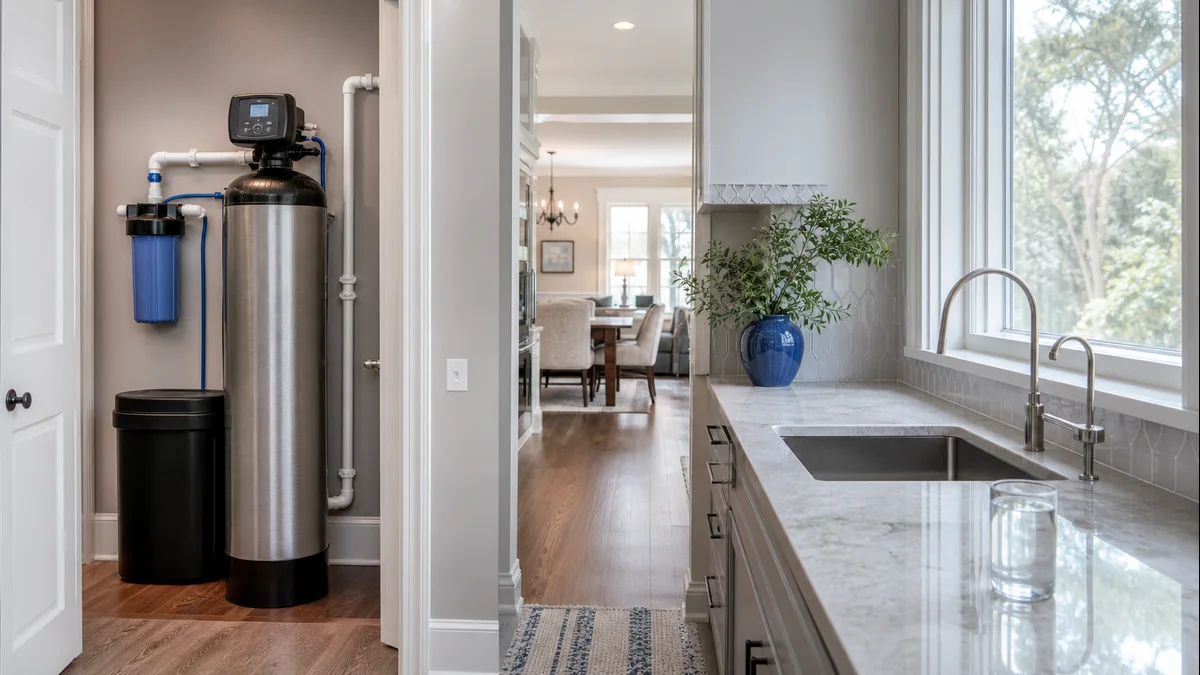
A whole-house filter treats water at the point it enters your home, covering every shower, sink, and washing machine. Reverse osmosis (RO) is installed under one sink and treats only the water you drink and cook with, but removes a finer range of contaminants, including PFAS. They're not competing options — for most Raleigh and Cary homes, the honest answer is both.
What does a whole-house filter actually remove?
A whole-house carbon filter sits on the main line and treats every gallon that enters the home. It's built to reduce chlorine, chlorine byproducts, sediment, and general taste-and-odor issues across every fixture — including the shower, where disinfection byproducts can be inhaled as steam, not just ingested at the tap.
What it doesn't do is remove everything. Standard whole-house carbon isn't engineered to strip out dissolved solids or the smallest contaminants at the molecular level PFAS compounds occupy. It's a broad, first-line defense for the entire house, not a final polish.
What does reverse osmosis remove that a whole-house filter doesn't?
RO forces water through a semi-permeable membrane fine enough to reject dissolved solids, heavy metals, and PFAS compounds that pass through standard carbon media. It's the technology behind NSF/ANSI 58 dissolved-solids reduction certification, and PFAS-specific reduction is covered under the newer NSF/ANSI 53/P473 and 58/P473 protocols.
The tradeoff is coverage: RO is typically installed at a single point of use — almost always the kitchen sink — so it treats your drinking and cooking water, not your shower, laundry, or every other tap in the house.
Why most homes need both, not one or the other
Whole-house filtration and RO solve two different exposure problems. Whole-house carbon handles volume: every gallon, every fixture, chlorine byproducts included, whether you're drinking it or standing under it in the shower. RO handles precision: the smallest, most stubborn contaminants — including PFAS — in the water you actually consume.
Raleigh and Cary tap water carries documented levels of haloacetic acids, trihalomethanes, and PFAS compounds above EWG health guidelines. A whole-house filter addresses the byproducts across the house. RO adds a second layer specifically for what you drink. Running only one leaves a gap the other was built to close.
Cost comparison
| Whole-house filter | Reverse osmosis (under-sink) | |
|---|---|---|
| Coverage | Every tap in the home | One sink (typically kitchen) |
| Primary target | Chlorine, chlorine byproducts, sediment, taste/odor | Dissolved solids, PFAS, heavy metals |
| Certification standard | NSF/ANSI 42, 53 | NSF/ANSI 58, P473 (PFAS) |
| Install location | Main water line | Under one sink |
| Triangle Waterworks pricing | Sized and quoted after a free water analysis | Included with any whole-home install |
| Install time | Most installs: one visit, 2–4 hours | Added same visit |
The bundle question is often what decides it for people: national brands typically price whole-house and RO as two separate purchases, with quotes commonly landing in the $6,000–$12,000 range for whole-home systems alone. Triangle Waterworks includes the under-sink RO with every city whole-home install, so the "should I get both" decision doesn't come with a second invoice.
Local angle: what this means in Raleigh and Cary
Neither Raleigh Water nor the Town of Cary system is out of legal compliance — both meet EPA standards. But "legal" and "everything you'd want out of your water" aren't the same claim. Cary's system shows the more pronounced numbers (HAA9 at 27.5 ppb, 458 times the EWG health guideline of 0.06 ppb; PFOA at 2.86 ppt), largely tied to its Jordan Lake source water. Raleigh's numbers are lower but in the same contaminant classes. A whole-house filter addresses the byproduct load across the home; RO adds PFAS-specific reduction at the tap you drink from most.
FAQ
Do I need reverse osmosis if I already have a whole-house filter? If PFAS or dissolved solids are a concern — and Raleigh/Cary source water data suggests they should be — yes. Whole-house carbon isn't certified for PFAS reduction the way RO is. They cover different parts of the same problem.
Is a whole-house filter enough on its own? It covers chlorine byproducts across every tap, which matters for shower inhalation exposure, not just drinking water. But it won't get you PFAS-specific reduction — that's RO's job.
Does reverse osmosis waste a lot of water? Older RO systems were less efficient than current ones. Ask any installer for the system's actual reject ratio before you buy, and confirm it's a recent design rather than legacy hardware.
Can I install RO without a whole-house filter? Yes, and it's a reasonable choice if you only care about drinking water and don't mind chlorine byproducts in your shower and laundry. Renters and apartment residents often land here since a whole-house system isn't practical.
Do both systems need separate maintenance? Yes — whole-house filters need periodic media or cartridge changes, and RO membranes and pre/post filters have their own replacement schedule. Ask for the specific intervals and costs in writing before installing either.
Not sure which setup fits your home?
Take our 60-second water quiz — it factors in where you live and what's in your local supply, then tells you whether you need whole-house filtration, RO, or both.
Related reading: Whole House Water Filter Cost in Raleigh, NC | Is Reverse Osmosis Water Healthy? | Whole House Filter vs. Water Softener | How to Remove PFAS from Drinking Water
Answer nine practical questions, then request a written quote or well-water analysis.
Start My Water Analysis