
Whole House Water Filter vs. Water Softener: What's the Difference?
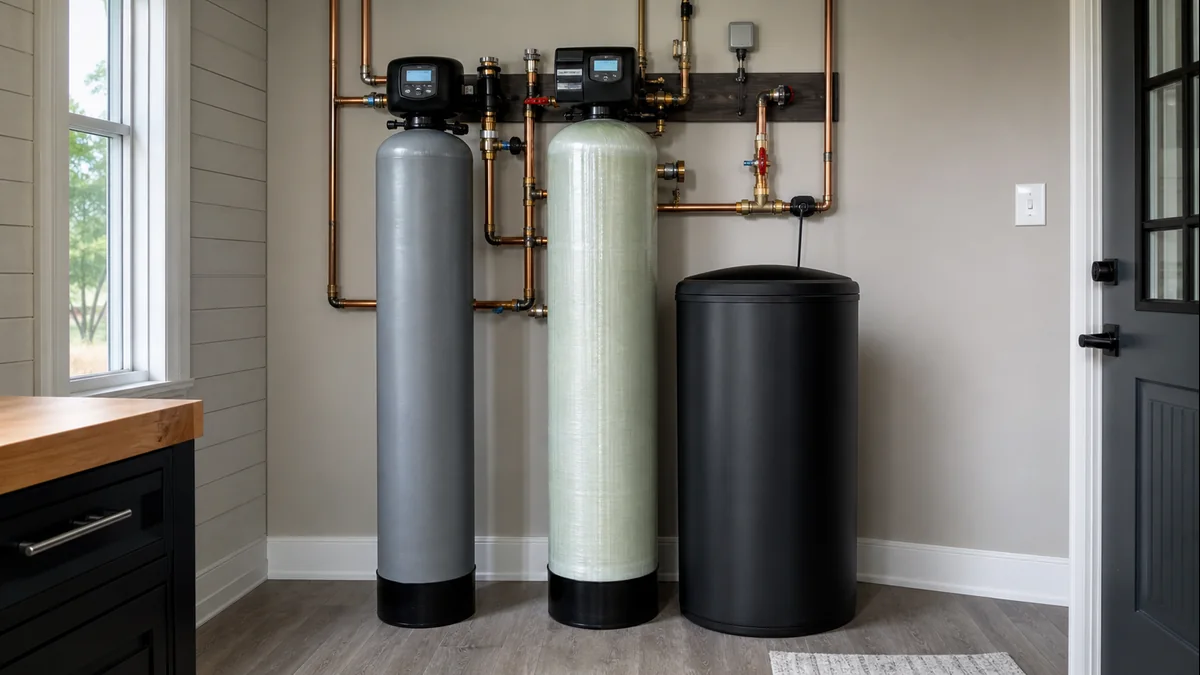
A whole-house filter removes chlorine, chlorine byproducts, and other contaminants from your water. A water softener doesn't clean water — it swaps hardness minerals (calcium and magnesium) for sodium to stop scale buildup. They solve completely different problems. On Raleigh (~1.6 gpg, slightly hard on the WQA scale the Hach test kit uses) and Cary (1.6–3.7 gpg, slightly hard at the low end but moderately hard at the top of the range) city water, the documented disinfection byproducts and PFAS make the filter a must — and the best setup pairs it with a softener sized to whichever end of your local hardness range you fall in.
What's the actual difference between a filter and a softener?
A whole-house filter is a filtration device — water passes through carbon media that adsorbs chlorine, disinfection byproducts, and other dissolved contaminants, and what comes out the other side has less of what was filtered out.
A water softener is a conditioning device, not a filter. It uses ion exchange resin to trade calcium and magnesium ions (the minerals that cause hardness) for sodium ions. Nothing gets "cleaned" in the sense of contaminant removal — hardness gets swapped for softness. That's why a softener doesn't touch chlorine, PFAS, or disinfection byproducts, and a filter doesn't touch hardness.
Does Raleigh or Cary water need softening?
It depends on which system you're on. Raleigh Water — serving Raleigh, Garner, Knightdale, Rolesville, Wake Forest, Wendell, and Zebulon — tests at roughly 1.6 grains per gallon, which is slightly hard on the WQA scale (the same scale the Hach Total Hardness Test Kit uses). The Town of Cary system spans a wider range, from about 1.6 gpg up to 3.7 gpg, and the top of that range crosses into moderately hard — enough to justify softening for Cary/Apex/Morrisville homes, especially at the upper end.
Both systems also carry a documented list of contaminants above EWG health guidelines — haloacetic acids, trihalomethanes, and PFAS among them. That's a filtration problem, separate from hardness, and it's why the strongest setup for city water here is an all-in-one system: carbon filtration for the disinfection byproducts and PFAS, plus softening to handle the minerals that are still present even on Raleigh's slightly hard supply and that push the top of Cary's range into moderately hard territory.
When does a softener actually make sense here?
Mostly on private wells. Roughly 15% of Wake County homes are on private wells, with higher shares in Johnston, Franklin, Chatham, and Granville counties, and well water hardness varies a lot more than municipal supply. If you're on a well and seeing scale buildup, dry skin, or spotty dishes, a water test — not a sales visit — is the right first step to confirm hardness levels before buying a softener.
On city water, the signs people usually associate with hardness (spotting, film, soap not lathering) are worth a second look before assuming a softener is the fix — Raleigh and Cary's numbers don't typically produce those symptoms.
Can you run a filter and a softener together?
Yes — on a well, that's a common setup, with sediment and iron treatment ahead of a softener and carbon filtration handling taste, odor, and chemical contaminants after. On city water, running both is also the best-of-both-worlds approach: carbon handles the disinfection byproducts and PFAS, and softening handles the minerals — which matter most on Cary's system, where the top of its 1.6–3.7 gpg range is moderately hard.
Filter vs. softener at a glance
| Whole-house filter | Water softener | |
|---|---|---|
| What it does | Removes chlorine, byproducts, contaminants | Swaps hardness minerals for sodium |
| Problem it solves | Chemical taste/odor, disinfection byproducts, PFAS (with RO add-on) | Scale, spotting, soap scum |
| Needed on Raleigh/Cary city water | Yes | Yes — especially on Cary's system, where the upper end of its range is moderately hard |
| Needed on Triangle-area wells | Often yes, alongside other stages | Depends on test results — commonly yes |
| Maintenance | Periodic media/cartridge changes | Regular salt refills |
Local angle: city vs. well in the Triangle
If you're inside Raleigh Water or Cary's service area, the water chemistry — slightly hard on Raleigh, slightly-to-moderately-hard on Cary — plus the documented disinfection byproducts and PFAS point toward an all-in-one system: filtration for the contaminants, softening for the minerals. If you're on a well anywhere in Wake, Johnston, Franklin, Chatham, or Granville counties, hardness is a real possibility worth testing for — and the right system might include both a softener and filtration stages, depending on what the test shows.
FAQ
Will a water softener remove chlorine or PFAS from my water? No. A softener only addresses hardness minerals through ion exchange. Chlorine, disinfection byproducts, and PFAS require carbon filtration or reverse osmosis, not softening.
Is Raleigh or Cary water hard enough to need a softener? Raleigh tests around 1.6 grains per gallon, which is slightly hard on the WQA scale. Cary tests at 1.6–3.7 gpg — slightly hard at the low end, but the top of that range is moderately hard, which is enough to make softening worthwhile there alongside filtration.
How do I know if I need a softener instead of (or in addition to) a filter? Test your water. On city water, pull your utility's public water quality report first. On a well, a comprehensive test covering hardness, iron, pH, sulfur, and TDS will tell you definitively rather than guessing from symptoms.
Can I install just a softener without a filter? You can, but on Raleigh or Cary city water that usually means paying for a device that doesn't address the documented contaminants (HAA9, TTHM, PFAS) that are actually in your supply.
Does a whole-house filter fix hard water symptoms like spotting? No — spotting and scale are hardness symptoms, which a filter doesn't touch. If you're seeing those specifically, and you're on a well, that points toward testing for hardness and considering a softener, not a filter.
Not sure what your water actually needs?
Take our 60-second water quiz and get a straight answer based on where you live — filter, softener, both, or neither.
Related reading: Whole House Water Filter Cost in Raleigh, NC | Do I Need a Water Softener in North Carolina? | Raleigh Water Hardness | Whole House Filter vs. Reverse Osmosis
Answer nine practical questions, then request a written quote or well-water analysis.
Start My Water Analysis