
Whole House vs. Point-of-Use Filter — Which One Actually Protects Your Home?
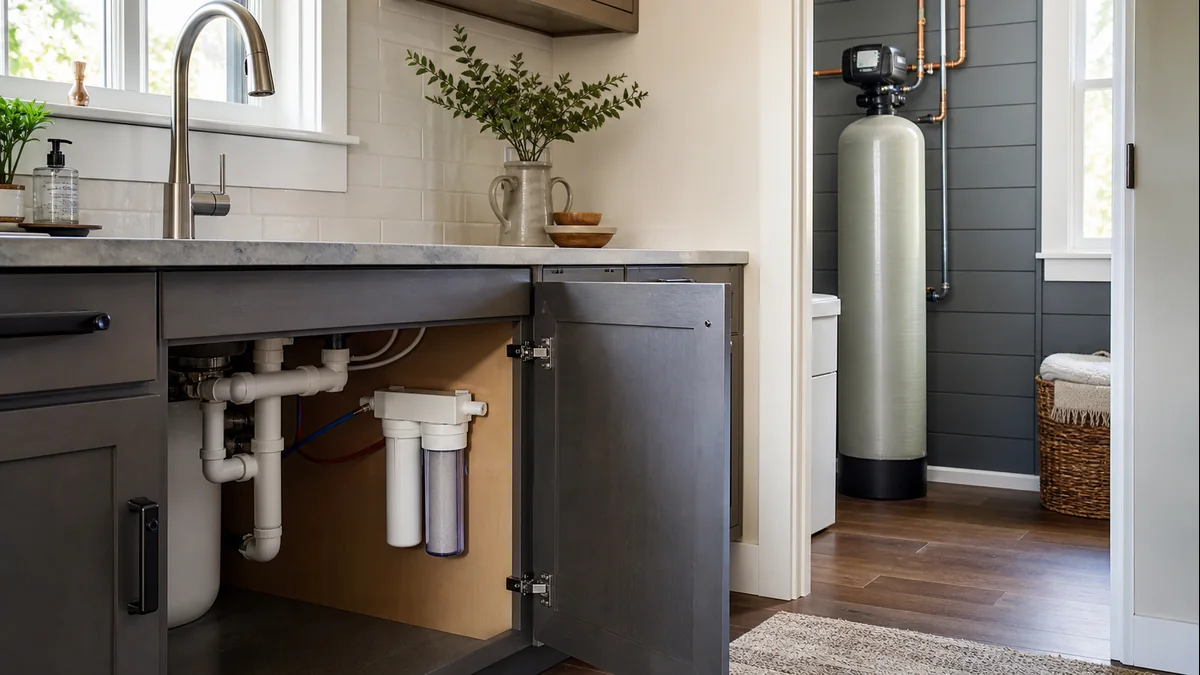
Direct answer: A point-of-use filter — a pitcher, fridge filter, or under-sink unit — treats water at one tap only. A whole-house (point-of-entry) system treats every drop entering the home: every faucet, both showers, the dishwasher, the washer, the ice maker, and the water heater. For a Triangle-area home on city water, an all-in-one whole-home system that pairs softening resin with carbon filtration is the setup that covers taste, disinfection byproducts, and scale protection everywhere at once — a pitcher can't touch any of that outside the kitchen.
What's the difference between whole-house and point-of-use filtration?
The difference is where the water gets treated, not how well it gets treated. A point-of-use (POU) filter sits at or under a single fixture — a pitcher on the counter, a filter clipped into the fridge door, an under-sink cartridge feeding one faucet — and only the water that passes through that one point gets filtered. A point-of-entry (POE) system, which is what "whole-house" means, installs where the main water line enters the home, so every fixture downstream draws from already-treated water. Both approaches can use the same underlying media — activated carbon is common to both — but scope is the entire story. One tap versus the whole house.
Does a pitcher or under-sink filter protect my water heater and appliances?
No — a point-of-use filter is physically incapable of doing that, because it's installed downstream of those appliances, not upstream. A pitcher on your kitchen counter only ever sees the water you pour into it. The water flowing into your water heater, dishwasher, washing machine, and ice maker never passes through that pitcher — it arrives exactly as it left the utility. If scale or mineral buildup is a concern for those appliances, the only place to intercept the water is before it reaches them, at the point of entry.
This matters more than it sounds on paper. DOE/PNNL Building America research found that scale and sediment inside a water heater act as an insulating layer between the burner and the water, reducing heat transfer and letting trapped heat damage the tank's glass lining over time. A 1984 study by Battelle Columbus Laboratories for the Gas Research Institute found water heaters running on untreated hard water accumulated up to 5.8 pounds of scale in the equivalent of one year of typical residential use, while heaters on softened water accumulated an insignificant amount. A point-of-use filter at the kitchen sink has no bearing on any of that — the water heater is filled from a separate line entirely.
What about the shower — does a point-of-use filter help there?
Not unless it's installed at the showerhead specifically, and even then it only covers that one shower. This is one of the most common gaps homeowners run into: they install a pitcher or under-sink filter for drinking water and assume the chlorine or chloramine smell is handled, then still notice it every time they shower. The disinfectant residual utilities maintain for safety travels through every line in the house, and a filter at one kitchen tap never touches the line feeding the bathroom — or a second bathroom, or an outdoor spigot — unless treatment happens before the water splits off to reach them.
Can a point-of-use filter soften my water?
Softening isn't something point-of-use devices are built to do, and it's the clearest way the two categories diverge. Softening works by ion exchange — swapping calcium and magnesium for sodium as water passes through resin — which requires a dedicated resin tank and a regeneration cycle. That's a point-of-entry technology by nature; a small under-sink cartridge doesn't carry the resin volume to soften a household's supply. A pitcher can improve taste at the glass you fill, but it cannot soften the water going into your dishwasher, washer, or water heater. Softening, by definition, has to happen at the point of entry.
What does NSF certification actually tell me about a filter?
It tells you which specific effects a product is certified to reduce — not that "NSF certified" is a blanket guarantee across every claim. NSF/ANSI 42 covers aesthetic effects: chlorine, chloramine, taste, odor, and particulates. NSF/ANSI 53 covers health effects. NSF/ANSI 58 covers reverse osmosis systems specifically. NSF/ANSI 44 covers cation-exchange water softeners. All four standards can apply to either point-of-use or point-of-entry products — certification isn't limited to one category — but the certified reduction claim varies by product, so the specific claim printed on a given system is what matters, not the standard number alone. Learn more about what each standard actually certifies.
Do I need both a whole-home system and an under-sink RO unit?
Many Triangle homeowners run both, and it's a sensible pairing rather than a redundant one. A whole-home all-in-one system handles the two things that touch every fixture: softening (protecting the water heater, dishwasher, washer, and plumbing from scale) and carbon filtration (removing chlorine and chloramine taste, plus disinfection byproducts, at every tap). A reverse osmosis unit at the kitchen sink adds a finishing step specifically for drinking and cooking water, using NSF/ANSI 58-certified membrane filtration. The whole-home system does the heavy lifting across the entire house; the RO unit is a targeted complement at the one faucet where drinking-water polish matters most — not a substitute for house-wide coverage. See how a dedicated RO unit compares to whole-house carbon filtration.
Point-of-use vs. point-of-entry, side by side
| Point-of-use (pitcher, fridge, under-sink) | Point-of-entry (whole-home) | |
|---|---|---|
| Taps covered | One tap or dispenser | Every faucet in the house |
| Showers | Not covered | Covered |
| Dishwasher, washer, ice maker | Not covered | Covered |
| Water heater protection | Not possible — installed downstream | Covered, when softening is included |
| Chlorine/chloramine taste (NSF/ANSI 42) | At that one tap, if certified for it | House-wide |
| Disinfection byproducts (HAA9, TTHM) | Limited, product-dependent | Removed effectively by activated carbon |
| Softening (scale prevention) | Not available | Available via ion-exchange resin |
| Best role | Finishing step for drinking water | Foundation for the whole home |
Why does this matter more in Cary, Apex, and Morrisville than it might elsewhere?
Because there's a genuine hardness case on top of the taste-and-byproduct case. Raleigh Water runs at roughly 1.6 grains per gallon — slightly hard, on the Water Quality Association (WQA) scale, the same one the Hach Total Hardness Test Kit (Model 5-B) uses (soft: <1.0 gpg; slightly hard: 1.0–3.5 gpg; moderately hard: 3.5–7.0 gpg; hard: 7–10.5 gpg; very hard: >10.5 gpg). Cary, Apex, and Morrisville span a wider range, 1.6–3.7 gpg, putting the top of that range into moderately hard territory. "Slightly hard" doesn't mean mineral-free — calcium and magnesium still accumulate on fixtures, pipes, and the water heater over years of daily use, and that buildup is cumulative regardless of where a home falls in the range.
Disinfection byproducts are documented independent of hardness. Raleigh reports HAA9 at 19.9 ppb and TTHM at 21.7 ppb; Cary reports HAA9 at 27.5 ppb and TTHM at 38.2 ppb — both compliant with EPA's legal limits, though EWG's stricter, non-regulatory guidelines flag Cary's water on 13 measures. A point-of-use filter at the kitchen sink changes none of those numbers at the shower, the washer, or the water heater. Only a whole-home carbon stage reaches all of them, and only a system that also includes softening resin handles the scale side. See what a properly sized whole-house filter looks like for Triangle city water.
Frequently Asked Questions
I have a pitcher filter and my water still tastes like chlorine in the shower — why? Because a pitcher filter only treats the water you pour into it, and the shower draws from a completely separate line that never passes through the pitcher. The chlorine or chloramine residual reaching your showerhead is the same water leaving the utility, unchanged. Only a whole-home system installed at the point of entry treats the water before it splits off to every fixture, including the shower.
I just installed an under-sink RO unit — do I still need a whole-home system? An under-sink RO unit is a strong finishing step for the water you drink and cook with, but it doesn't reach the shower, the laundry, the dishwasher, or the water heater. If scale protection and house-wide taste improvement matter to you, an all-in-one whole-home system covers everything the RO unit doesn't, and the two work well together rather than competing for the same job.
Does a whole-house system replace my under-sink RO unit? It replaces the need for a separate whole-house carbon filter, but it isn't built to do what an RO membrane does at the kitchen sink. Many households run a whole-home all-in-one system as the house-wide foundation and keep an RO unit at the kitchen tap as a dedicated drinking-water step.
What's the difference between NSF/ANSI 42, 53, 58, and 44? NSF/ANSI 42 covers aesthetic effects like chlorine, chloramine, taste, and odor. NSF/ANSI 53 covers health effects. NSF/ANSI 58 covers reverse osmosis systems specifically. NSF/ANSI 44 covers cation-exchange water softeners. Any of these can apply to point-of-use or point-of-entry products, so check the specific certified claim on the product itself rather than assuming from the standard number alone.
Will a whole-home system protect my water heater from scale? Yes, when the system includes softening resin. Ion-exchange softening removes the calcium and magnesium that would otherwise accumulate inside the tank over years of use, which point-of-use filters — installed after the water heater, not before it — have no ability to do at all.
Can I install just a whole-house filter without the softening side? A carbon-only whole-house filter improves taste and reduces disinfection byproducts at every tap, but it leaves the scale side unaddressed. An all-in-one system pairs both in a single install, which is why it's the setup we recommend for city-water homes rather than choosing one half or the other.
See which system fits your home
Coverage is the whole story here: a point-of-use filter treats a glass of water, and a whole-home all-in-one system treats a house. Take our 60-second water quiz to see which all-in-one system — softening resin plus carbon filtration — fits your home's water and fixture count.
Related reading: Under-Sink vs. Whole-House Filter | Whole House Filter vs. Reverse Osmosis | Water Softener vs. All-in-One System | NSF Certifications for Water Filters Explained | Best Whole House Filter for City Water
Answer nine practical questions, then request a written quote or well-water analysis.
Start My Water Analysis