
Whole-House Water Filter in Cary, NC: What It Actually Removes
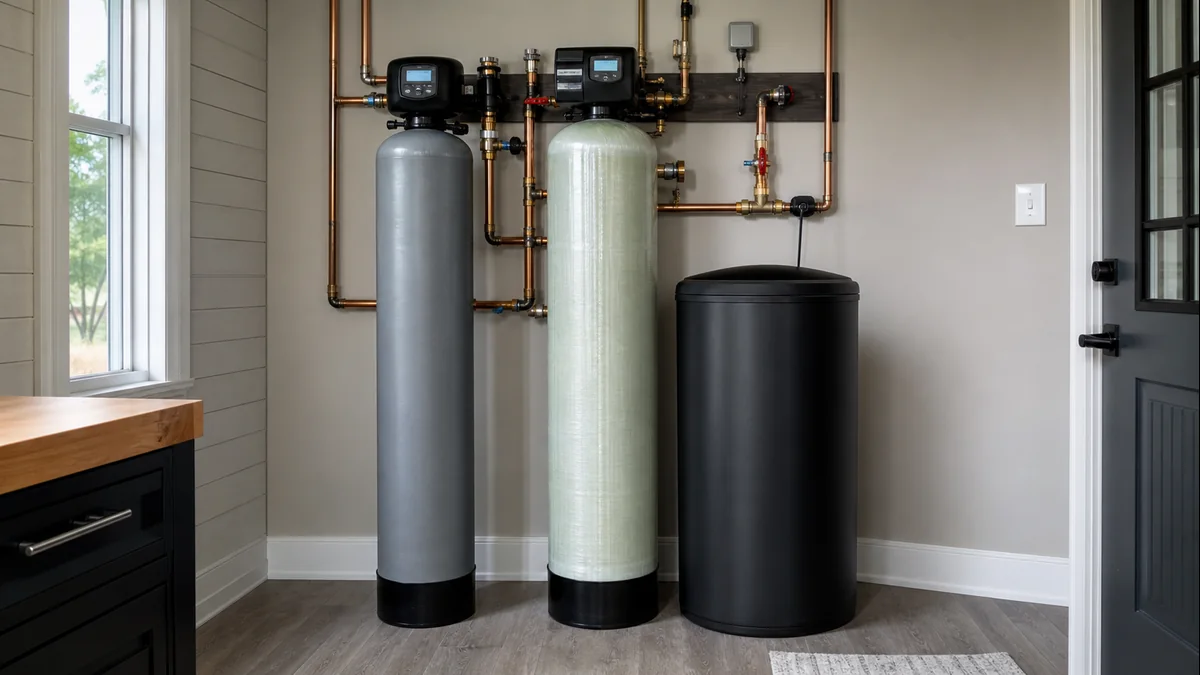
Direct answer: A whole-house water filter in Cary, NC uses activated carbon at your main water line to remove chlorine/chloramine taste and smell, disinfection byproducts (HAA9, TTHM), and — when certified for it — PFAS from every faucet and shower in the home. Cary's own water testing shows 13 contaminants above EWG health guidelines, including PFAS traced back to Jordan Lake. Because Cary also runs 1.6–3.7 gpg (moderately hard at the top of that range), the best-of-both-worlds answer for most Cary homes is an all-in-one system that pairs carbon filtration with softening in a single unit.
What Does a Whole-House Water Filter Remove From Cary Tap Water?
A whole-house carbon filter treats water once, at the point it enters the home, so every tap, shower, and appliance gets filtered water instead of just one sink. For Cary specifically, that means:
- Chlorine and chloramine taste/smell — the "pool water" smell and taste that municipal disinfection leaves behind.
- Disinfection byproducts (DBPs) — specifically HAA9 (haloacetic acids) and TTHM (trihalomethanes), both of which activated carbon removes effectively.
- PFAS ("forever chemicals") — but only if the carbon is certified specifically for PFAS reduction (look for NSF/ANSI 53 or NSF/ANSI P473 certification). Standard carbon isn't automatically rated for PFAS; certified media is.
What a carbon filter does not touch is hardness — calcium and magnesium are minerals, not organic compounds, and carbon filtration doesn't remove them. That's a separate job, handled by ion-exchange softening. More on why that distinction matters for Cary specifically below.
Why Does Cary Water Need Filtration in the First Place?
Cary's water isn't a plant failure — it's a source-water story. Cary, along with Apex and Morrisville, is served by the Cary/Apex Water Treatment Facility, which draws from B. Everett Jordan Lake (Jordan Reservoir). In 2017, Duke University researchers measured combined PFAS levels above 200 parts per trillion (ppt) in Jordan Lake's raw source water — before any treatment. That's a watershed contamination issue upstream of the plant, not evidence the utility is doing anything wrong.
Once treated, Cary's finished tap water is fully compliant with EPA legal limits. But EWG's Tap Water Database — which applies a stricter, non-regulatory health benchmark rather than the legal standard — flags Cary's water for 13 contaminants above its guidelines, including:
- HAA9: 27.5 parts per billion (ppb) — roughly 458 times EWG's 0.06 ppb guideline
- TTHM: 38.2 ppb
- PFOA: 2.86 parts per trillion (ppt)
- PFOS: 3.79 ppt
It's worth stating both bars clearly: legally compliant and "below a stricter voluntary health benchmark" are two different things, and Cary's water is the former while falling short of the latter on several measures. That gap — legal but not squeaky-clean by EWG's standard — is exactly what point-of-entry carbon filtration is designed to close. For the full contaminant breakdown, see is Cary NC water safe to drink.
Does a Whole-House Filter Handle PFAS, or Do I Need Something Else?
A whole-house filter can handle PFAS, but the media matters. Standard activated carbon is excellent at DBPs and chlorine, but PFAS reduction requires carbon specifically certified under NSF/ANSI 53 or NSF/ANSI P473 for PFAS/PFOA/PFOS reduction — that certification is what separates "removes chlorine taste" from "actually reduces PFAS." Reverse osmosis (NSF/ANSI 58) is the other proven path, typically used at a single point of use like a kitchen tap rather than the whole house.
One common myth worth clearing up: boiling water does not remove PFAS. Boiling can concentrate PFAS as water evaporates, since PFAS compounds don't break down or evaporate with the water. If PFAS reduction matters to your household, filtration media rated for it — not a pot on the stove — is the mechanism that actually works.
Filter vs. Softener vs. All-in-One: What's Right for a Cary Home?
Cary's situation is unusual in that it needs both kinds of treatment for different reasons: filtration for what's dissolved in the water (chlorine, DBPs, PFAS), and softening for the mineral hardness that runs 1.6–3.7 gpg — moderately hard at the top of that range. Here's how the three approaches compare:
| Handles this | Whole-House Carbon Filter Only | Water Softener Only | All-in-One System |
|---|---|---|---|
| Chlorine/chloramine taste & smell | Yes | No | Yes |
| Disinfection byproducts (HAA9/TTHM) | Yes | No | Yes |
| PFAS (with certified media) | Yes | No | Yes |
| Scale buildup in water heater/appliances | No | Yes | Yes |
| Spotty dishes & glassware | No | Yes | Yes |
| Softer skin, hair, and laundry | No | Yes | Yes |
A standalone filter leaves scale and mineral buildup unaddressed. A standalone softener does nothing about chlorine, DBPs, or PFAS — it's ion exchange for calcium and magnesium only, and that's all it's built to do. For a Cary home, where both the contaminant profile and the moderately-hard end of the hardness range are real, an all-in-one system that combines a carbon filtration stage with softening resin covers both jobs from one unit — no need to choose which problem to solve first. See whole-house filter vs. water softener for a deeper look at how the two technologies differ, and what to look for in a whole-house filter for city water.
What Does a Whole-House Water Filter Cost in Cary, NC?
A free water analysis confirms what your specific home's water needs first — the analysis is what determines whether you need a filtration-only setup, a softener, or the combined all-in-one system, rather than guessing — and pricing is set after that, typically well under the $6,000–$12,000 national big-brand whole-home quotes commonly run for similar coverage. See is a whole-house water filter worth it for how that cost compares against ongoing bottled water, pitcher filter cartridges, and appliance wear from untreated water.
Frequently Asked Questions
I just moved to Cary from out of state — is the tap water actually safe to drink? Yes. Cary's water meets all EPA legal requirements. Where it falls short is against EWG's stricter, non-regulatory health guideline — 13 contaminants tested above that benchmark, including PFAS tied to the Jordan Lake source. Legally safe and free of everything EWG flags are two different bars, and a whole-house filter is how you close that gap.
My water smells like a swimming pool — will a whole-house filter fix that? Yes, that's exactly what activated carbon is built for. Chlorine and chloramine, used to disinfect municipal water, are what cause that pool-like taste and smell, and carbon filtration removes them at the point the water enters your home — so every faucet and shower runs clear instead of just the one tap you might filter with a pitcher.
I have young kids at home — should I be concerned about PFAS in Cary's water? It's a reasonable thing to want addressed. Cary's tested PFOA (2.86 ppt) and PFOS (3.79 ppt) levels sit above EWG's health guidelines, tracing back to Jordan Lake source water. Carbon media certified for PFAS reduction (NSF/ANSI 53 or P473) is the proven fix — boiling won't help, since PFAS doesn't break down with heat.
Do I still need a whole-house filter if I already use a pitcher or fridge filter? A pitcher or fridge filter only treats water at that one dispensing point. A whole-house filter treats water where it enters your home, so chlorine, DBPs, and PFAS are addressed at every shower, tap, and appliance — not just your drinking glass.
What's actually the difference between a filter and a softener? A filter (activated carbon) removes chlorine, disinfection byproducts, and PFAS — dissolved chemical compounds. A softener uses ion exchange to remove calcium and magnesium — the minerals that cause hardness. Neither one does the other's job, which is why Cary homes, with both a contaminant profile and moderate hardness, typically benefit most from a system that does both.
Is a whole-house filter worth the cost compared to just buying bottled water? For most households, yes — a whole-house system treats every tap continuously, including showers and appliances that bottled water never touches, for less than the ongoing cost of bottled water plus the wear untreated water puts on your water heater and fixtures over time.
See What Your Cary Home Actually Needs
Every Cary home's water runs through the same Jordan Lake source, but your household's usage, plumbing, and priorities are your own. Take our 60-second water quiz to see what fits your home — for most Cary, Apex, and Morrisville households on city water, that means an all-in-one system that filters out chlorine, PFAS, and disinfection byproducts while softening the moderately hard water at the top of Cary's range, all from one unit.
Answer nine practical questions, then request a written quote or well-water analysis.
Start My Water Analysis