
Is a Whole House Water Filter Worth It in Raleigh or Cary?
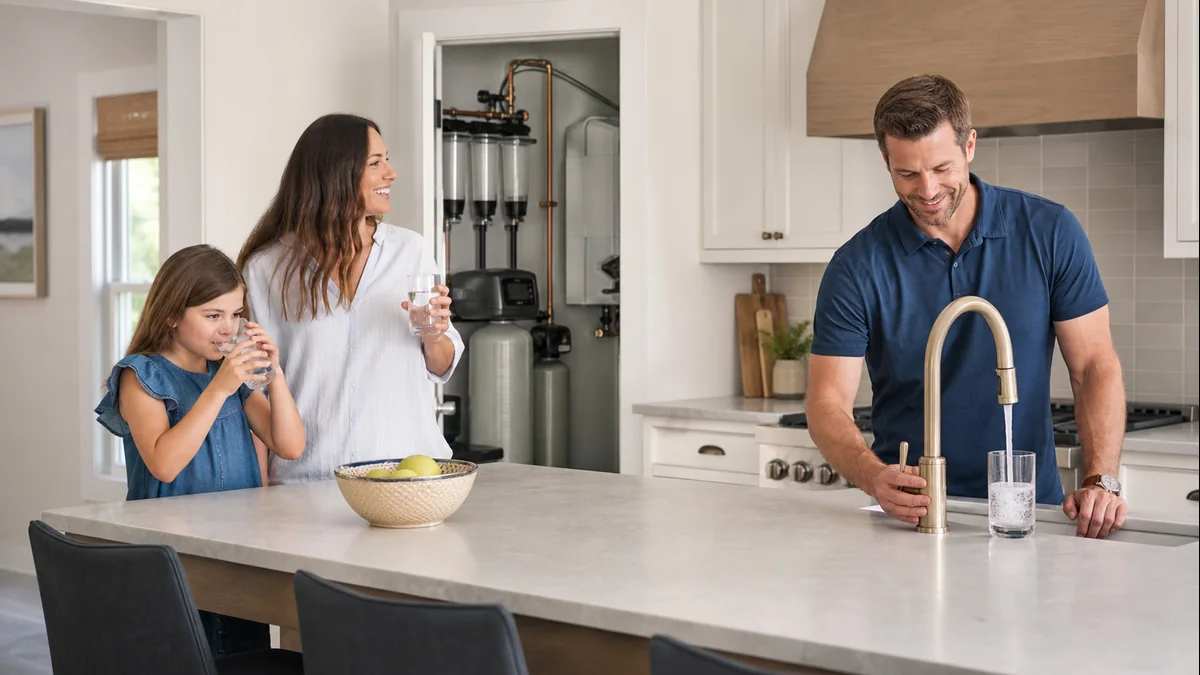
Yes, for most homes on Raleigh or Cary city water — both systems have documented contaminants (haloacetic acids, trihalomethanes, PFAS) above EWG health guidelines, and a whole-house filter is the only option that treats every tap, including shower steam inhalation, not just the water you drink. It's worth skipping only in a few specific situations, covered below.
Is a whole-house water filter worth the cost?
For a Raleigh or Cary homeowner, the case comes down to what's documented in the local water supply, not marketing. Both cities meet EPA legal standards — that's not in question. But EWG's Tap Water Database shows 13 contaminants above health guidelines in the Cary system alone, including HAA9 at 27.5 ppb (458 times the 0.06 ppb guideline) and PFOA at 2.86 ppt (32 times its guideline). Raleigh's numbers are lower — HAA9 at 19.9 ppb, TTHM at 21.7 ppb — but in the same contaminant classes.
"Legal" means the water meets the regulatory floor. Whether that floor is where you want your family's daily exposure to sit is a separate decision, and it's the one a whole-house filter is actually answering.
What's in Raleigh and Cary tap water that a filter addresses?
A standard whole-house carbon filter is built to reduce chlorine, chlorine-based disinfection byproducts (including the HAA9 and TTHM classes above), sediment, and general taste-and-odor issues — across every fixture in the home, not just the kitchen tap. That matters specifically for disinfection byproducts, since they can be inhaled as steam in the shower, not just ingested by drinking.
Where a standard whole-house filter reaches its limit is PFAS — those compounds require reverse osmosis or specialized carbon media rated for PFAS reduction (NSF/ANSI 53 or 58 with the P473 protocol) to meaningfully reduce.
Who should consider skipping it?
A whole-house filter isn't a universal must-have. It's a weaker case if you:
- Rent and can't install permanent plumbing. An under-sink or countertop filter covers drinking water without needing landlord approval or a whole-home install.
- Already have a comparable system installed. No need to duplicate coverage.
- Are on a well with different priorities. Well water problems (iron, sulfur, pH, bacteria) usually need to be diagnosed and treated in a specific order before general carbon filtration is the right next step — start with a test, not a whole-house filter.
- Only care about drinking water, not shower or laundry exposure. An under-sink RO system alone may be a reasonable, lower-cost starting point.
What a whole-house filter costs vs. the alternative
A one-time install is the tradeoff against ongoing spending on bottled water or pitcher filters for years on end — a whole-house system is installed once and then just needs periodic media changes, while bottled water and small filters are a recurring cost for as long as you keep buying them.
| Whole-house filter | National-brand quote | |
|---|---|---|
| Triangle Waterworks pricing | Sized and quoted after a free water analysis | $6,000–$12,000 typical range |
| Under-sink RO | Included | Priced separately |
| Installer | NC-licensed plumber | Varies |
| Warranty | Lifetime, terms in writing | Varies by brand |
| Install time | One visit, 2–4 hours | Varies |
Documented national-brand cases show the gap between an opening quote and what buyers actually negotiate down to — one widely reported Leaf Home case went from a $12,241 quote to $4,825, and the company has 498 BBB complaints on record. That spread is a reason to compare a flat quote built from a real water test before signing anything.
Local angle: Raleigh and Cary specifics
Cary's system draws from Jordan Lake, where 2017 Duke University sampling measured combined PFAS levels above 200 ppt in the source water — which lines up with Cary's higher documented PFAS numbers relative to Raleigh. If you're in Cary or Apex specifically, that source-water context is worth knowing when you're deciding whether whole-house filtration (paired with RO for PFAS specifically) makes sense for your household.
FAQ
Is Raleigh or Cary water actually unsafe to drink? Both systems are legally compliant with EPA standards. The concern is contaminants documented above EWG's stricter health guidelines, not a legal violation — it's a "meets the floor" vs. "what you'd choose for your family" distinction.
Will a whole-house filter remove PFAS? Standard whole-house carbon reduces PFAS to some degree but isn't certified for it the way reverse osmosis or specialized PFAS-rated media are. Pair whole-house filtration with an under-sink RO system for PFAS-specific reduction in your drinking water.
How long does installation take? Most whole-house installs in the Raleigh/Cary area are completed in a single visit, typically 2–4 hours, by an NC-licensed plumber, as required under NCGS §87-21 for any whole-home water treatment installation.
What's the actual maintenance cost after installation? Ongoing cost is mainly periodic filter media changes. Ask any installer for the specific replacement schedule and cost in writing before you commit — "lifetime warranty" and "no maintenance cost, ever" are two different claims.
Do I need a whole-house filter if I'm on a well, not city water? Not as a first step. Well water problems vary household to household — start with a comprehensive test (iron, pH, sulfur, hardness, TDS) to identify what's actually in your water before choosing a filtration approach.
Ready to find out what your specific home needs?
Take our 60-second water quiz for a straight answer based on your address, or request a free water analysis if you're on a well.
Related reading: Is Cary, NC Water Safe to Drink? | Haloacetic Acids in Drinking Water | Whole House Water Filter Cost in Raleigh, NC | Whole House Filter vs. Reverse Osmosis
Answer nine practical questions, then request a written quote or well-water analysis.
Start My Water Analysis