
HOA Rules for Water Softener Installation in Apex, NC
Direct answer: In Apex's HOA-dense subdivisions, a whole-home softening-and-carbon system almost never triggers architectural review, because it installs indoors on the incoming main line — garage, utility closet, or mechanical room — with no exterior change a neighbor could see. Confirm it by reading your community's recorded declaration, then send the ARC a one-line description if you want certainty. Apex's own water quality report is the reason to do this now.
What Does an Apex HOA Architectural Review Committee Actually Look At?
An Apex architectural review committee (ARC) exists to control what's visible from the street or a neighbor's lot — that's the entire purpose of the role. Across most of Apex's newer subdivisions, the list of items an ARC actually reviews stays fairly consistent:
- Exterior paint, siding, and trim colors
- Roofing material, style, and color
- Fences, mailboxes, and accessory structures like sheds
- Satellite dishes, solar panels, and any roof- or wall-mounted equipment
- Driveway, walkway, hardscape, or landscaping changes visible from the street
- Additions or changes to the home's footprint
Every one of those items shares a single trait: a neighbor can identify it without setting foot on your property. That's the actual filter architectural review runs through, and it's a useful test for anything you're wondering whether to submit.
Does a Whole-Home Water System Show Up on That List?
No. A whole-home softening-and-carbon system doesn't touch a single item on the list above — it doesn't get painted, it doesn't sit on the roof, it doesn't attach to siding, and it doesn't change your lot's footprint. That's not a loophole; it's simply outside the category of things architectural review was written to catch in the first place. The equipment lives entirely inside the home's plumbing, on the line that feeds the whole house before it reaches a single fixture.
Where Does the Equipment Actually Go in a Typical Apex Home?
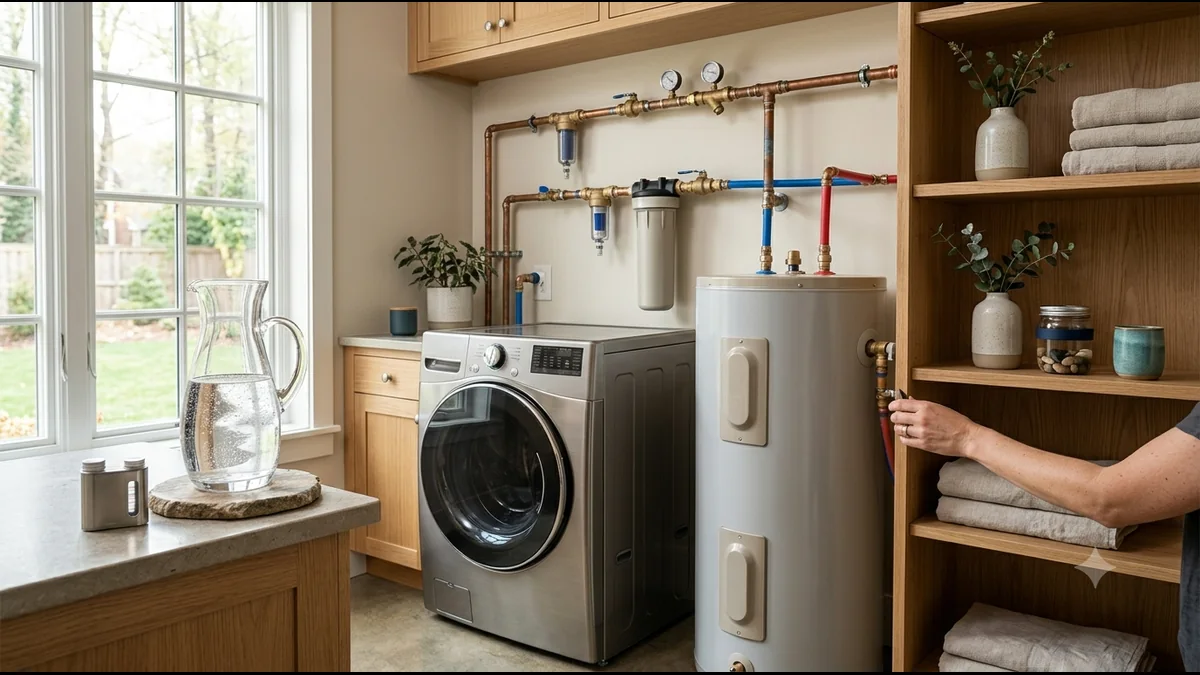
In Apex's newer construction, the system ties into the main water line near where it enters the house — most often a garage corner next to the water heater, a utility closet, or a small mechanical room. The unit needs three things to run: access to that main line, a nearby floor drain, and a standard electrical outlet.
None of those three requirements involves the roof, the siding, the driveway, or the yard, so there's nothing for an ARC to evaluate against its usual checklist.
Chapter 47F or My Declaration — Which One Actually Governs This?
North Carolina homeowners associations are formed and governed under the North Carolina Planned Community Act, N.C.G.S. Chapter 47F. That statute sets up the framework for how an HOA operates and enforces rules — it does not maintain a list of approved or restricted home equipment for every community in Apex. The document that actually controls your lot is your own community's recorded declaration, and declarations vary meaningfully from one Apex subdivision to the next.
| Governing document | What it actually covers | Names water treatment equipment? |
|---|---|---|
| N.C.G.S. Chapter 47F (Planned Community Act) | How associations are formed, structured, and empowered to adopt rules | No — it's a formation framework, not an equipment list |
| Your community's recorded declaration | The specific covenants your ARC enforces on your individual lot | Only your declaration would say — read it directly |
This is general information, not legal advice. If you want a definitive answer for your specific lot, your recorded declaration and your ARC are the only sources that can give one.
What Should the Email to My ARC Actually Say?
If your declaration requires notice for any home improvement, regardless of visibility, a short written description covers it in one message. Keep it factual and specific:
"Installing an interior whole-home water treatment system on the main water line in the garage/utility closet/mechanical room. No exterior work, no change to the home's exterior appearance, no structural changes, no landscaping disturbance."
That single sentence answers the only question an ARC actually needs answered — whether the change affects how the home looks from outside. It doesn't.
What If My Apex HOA Doesn't Have an Architectural Review Committee at All?
Some smaller or newer Apex communities skip a formal ARC and handle approvals through the board directly, or through a simplified self-certification process written into the declaration. The same logic still applies: read the declaration to see whether interior plumbing work needs any notice at all, and if it does, send the same short, factual description. Not having a dedicated committee doesn't change what the equipment is or where it goes.
Why Is Apex's Own Water Worth Treating Right Now?
Apex sits on the Cary/Apex Water Treatment Facility, drawing from B. Everett Jordan Lake and serving Apex, Cary, and Morrisville. The Town of Apex's 2024 Annual Drinking Water Quality Report puts total trihalomethanes at an average of 41 ppb, ranging up to 53 — well within the EPA's 80 ppb limit, but a real, measurable disinfection byproduct in every home on that system.
HAA5 averages 19 ppb against a 60 ppb limit, and the water carries a chloramine residual most of the year.
EPA's National Primary Drinking Water Regulations table lists TTHM's potential health effect from long-term exposure above the MCL as "Liver, kidney or central nervous system problems; increased risk of cancer," and HAA5's as "Increased risk of cancer." Apex's water is legally compliant — every result stays under both limits.
But "compliant" describes a ceiling set by EPA's own risk tolerance, not a guarantee of zero exposure to the exact compounds that ceiling was written around. A carbon stage removes them from the water reaching your fixtures rather than relying on staying under a legal number.
Hardness adds to the case. Apex's own CCR reports average total hardness of 33.3 ppm, about 1.9 gpg, which the Town calls "moderately soft." Our own testing across the service area measures 1.6 to 3.7 gpg by ZIP code — on the Water Quality Association scale the Hach test kit uses, that range reads as slightly hard to moderately hard, not soft. Different scales, same underlying number; the address-level test is what settles it for your home specifically.
Whole-Home System vs. What an Apex ARC Reviews
| What an ARC checklist covers | Does a whole-home water system apply? |
|---|---|
| Exterior color, siding, roofing | No — nothing painted, no roof or siding work |
| Fences, sheds, mailboxes | No — not a structure of any kind |
| Roof- or wall-mounted equipment | No — installed indoors on the main line |
| Driveway, hardscape, landscaping | No — no digging, no exterior plumbing |
| Home footprint or structural changes | No — no addition, no framing work |
| Declaration's general notice requirement (if any) | Sometimes — a one-line email covers it |
None of this is a reason to wait. The HOA question is closed in an afternoon by reading your declaration, and Apex's own water report is the reason not to sit on the other question. Book the 60-second water quiz or a free water analysis, and let a specialist confirm the exact indoor spot for the system while measuring what's actually coming out of your tap.
For the sibling question in a neighboring town, see HOA rules and water softener installation in Clayton, NC. If you're deciding between a softener alone and the combined system, water softener vs. all-in-one system breaks down the difference.
For more on what's actually detected in Apex's supply, see PFAS and forever chemicals in Apex, NC water and why Apex water tastes different after the spring chlorine changeover. For a broader look at Apex water treatment options, start with water softeners in Apex, NC.
FAQ
I just moved into a new-construction home in an Apex HOA and haven't met my ARC yet — is it too early to install a whole-home system? No. The same logic applies whether you've owned the home for years or just closed — the equipment is interior and invisible from outside, so it isn't the kind of change an ARC exists to flag. Read your declaration, send a short description if it calls for notice, and move forward.
My Apex HOA's declaration doesn't mention water treatment equipment anywhere — does that mean I'm automatically fine? Most likely, yes. If your declaration's notice requirements only cover exterior changes and it's silent on interior plumbing equipment, there's typically nothing to submit. If you want it in writing anyway, a short email describing the interior installation and confirming no exterior work creates a paper trail for your own records.
Do I need ARC approval if the unit sits inside my garage where no one but me will ever see it? In most Apex communities, no — garage installations are interior and don't change the home's exterior appearance, which is what architectural review is built to evaluate. Some declarations still require notice for any home improvement regardless of visibility, so check yours before assuming.
Will the installer dig in my yard or attach anything to the outside of my house? No. A standard whole-home installation ties into the main line inside the home and needs access to that line, a nearby drain, and a power outlet — nothing about the job touches the roof, siding, or yard.
Where do I find my Apex community's recorded declaration if I can't locate my closing paperwork? Check with your HOA management company first, or search the Wake County Register of Deeds, where recorded declarations are filed. Your ARC or HOA board can also point you to the current governing documents if the original paperwork isn't handy.
What's actually in Apex's water that makes the carbon side of an all-in-one system worth adding along with the softener? Apex's 2024 water quality report shows measurable TTHM and HAA5, both disinfection byproducts, plus a chloramine residual most of the year — none of which a softener alone addresses, since softening resin only handles calcium and magnesium. The carbon stage in an all-in-one system is what removes taste, odor, and those byproducts before they reach your fixtures.
Sources
- Town of Apex — 2024 Annual Drinking Water Quality Report
- EPA — National Primary Drinking Water Regulations
Answer nine practical questions, then request a written quote or well-water analysis.
Start My Water Analysis