
Does Cary's Water Cause Hot Tub and Spa Scale Buildup?
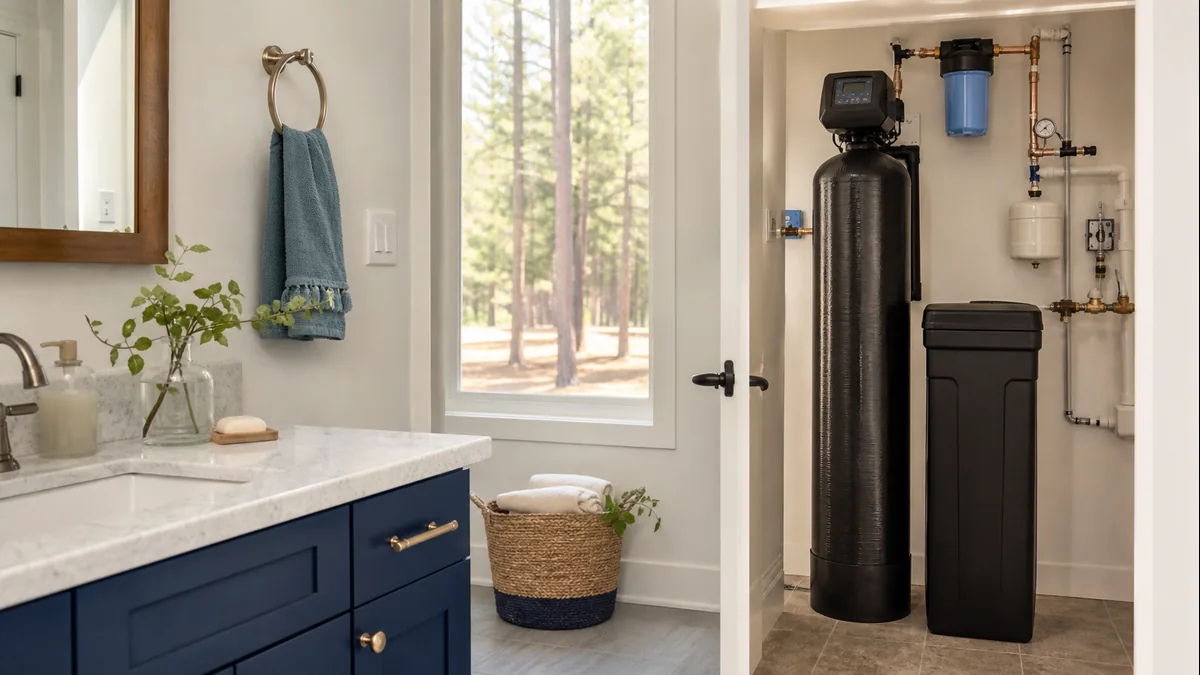
Direct answer: Yes — a spa reheats and evaporates the same fill water for weeks, so whatever calcium and magnesium came in with it concentrates further with each cycle instead of draining away. Cary's own figure is 25–30 ppm, but address-level testing runs up to 3.7 gpg — moderately hard on the Water Quality Association scale. Softened fill water gives the spa far less to concentrate from the start.
Why Does Scale Build Up Inside a Hot Tub or Spa at All?
Scale is calcium and magnesium coming out of solution and depositing on a surface — usually wherever water is heated. As water is heated, minerals that were dissolved evenly become less soluble and settle out onto the heater element, the shell, and the plumbing that circulates water through the jets.
A bathtub drains after one use, so whatever minerals were in that fill water leave with it. A spa doesn't work that way. The same body of water gets reheated for weeks or months between full drains and refills, which gives scale far more opportunity to form than a fixture that empties every time.
Why Do Spas Concentrate Minerals Faster Than a Sink or Bathtub?
A spa loses water two ways between refills: evaporation from the heated surface and small amounts drawn out through normal use and filter maintenance. The water itself evaporates, but the dissolved minerals it carried do not — they stay behind in whatever water remains in the shell.
Top-off water is usually added to replace what's lost, and that new water brings its own load of calcium and magnesium into a system that's already partway concentrated from evaporation. Repeat that pattern over enough refill cycles and the mineral content circulating through the spa climbs well above what came out of the tap on day one.
Is Cary's Water Actually Hard Enough for This to Matter?
Cary's Public Works FAQ states finished-water hardness at 25 to 30 ppm — about 1.5 to 1.75 grains per gallon (gpg) — which the Town describes as very soft. That figure is accurate for water leaving the treatment facility.
Triangle Waterworks' own in-home testing across the service area tells a more variable story: 1.6 to 3.7 gpg depending on ZIP code. On the Water Quality Association (WQA) scale the Hach Total Hardness Test Kit, Model 5-B uses, that range spans slightly hard to moderately hard — with Cary reaching the top of that range in some parts of town.
Neither figure contradicts the other. Cary's is a plant-wide average; ours is measured address by address. See how Cary's own numbers stack up against a WQA classification for the full breakdown. For a spa that concentrates whatever comes out of your specific tap, the address-level number is the one that predicts what actually happens inside the shell.
Where Does Cary's Water Come From, and Why Does Chloramine Matter for a Spa Fill?
Cary's finished water starts at B. Everett Jordan Lake and is treated at the Cary/Apex Water Treatment Facility, which disinfects with chloramine day to day. Once a year the Town switches to free chlorine only, on a schedule it announces itself — the timing shifts year to year, so check the Town's own notice rather than assuming a fixed date.
That disinfection step is also how disinfection byproducts such as TTHM and HAA5 form. EPA's National Primary Drinking Water Regulations table lists TTHM's potential long-term health effect above the legal limit as "Liver, kidney or central nervous system problems; increased risk of cancer," and HAA5's as "Increased risk of cancer." Cary's water is fully compliant with both limits — that compliance is real, but it's a ceiling set at the edge of EPA's own acceptable risk, not a guarantee everything under it is worth ignoring.
For a spa specifically, chloramine residual in the fill water is also the source of the chemical smell some owners notice right after a refill, before spa sanitizer has even been added. A carbon stage removes that residual directly rather than relying on staying under a legal number.
Hard Fill Water vs. Softened Fill Water: What Actually Changes
| Fill Water | What Happens Over Repeated Heating Cycles | What You Notice |
|---|---|---|
| Hard, unsoftened fill water | Calcium and magnesium concentrate further with every evaporation-and-top-off cycle | Scale forming on the heater element and shell, jets losing flow over time |
| Softened fill water | Starts each refill with minerals already removed, so there's far less left to concentrate | Less mineral scale accumulating between drains |
| Fill water with no carbon stage | Chloramine and disinfection byproducts pass into the spa untouched | Chemical smell noticeable right after a refill |
| Fill water with a carbon stage | Chlorine and chloramine are removed before the water goes in | Cleaner-smelling water from the first fill |
How Does a Whole-Home Softening System Help Before Water Ever Reaches the Spa?
A whole-home softener uses ion exchange to remove calcium and magnesium from every line it feeds, including the outdoor spigot most spas fill from. Water arriving at the spa already has the minerals responsible for scale taken out, rather than arriving hard and getting concentrated worse by the spa itself.
Pairing that softening resin with a carbon filtration stage covers the other half of what a spa fill picks up:
- Removes the calcium and magnesium that concentrate into scale as the spa heats and evaporates fill water repeatedly
- Reduces the mineral load reaching the heater element and jet plumbing from every refill going forward
- Pulls chlorine and chloramine taste and smell out of fill water before it goes into the shell
- Gets sized to your home's actual measured water through a free water analysis, not a plant-wide average
See what a whole-home system protects against water heater scale elsewhere in the house — a spa heater and a household water heater scale up through the same basic mechanism.
FAQ
Our spa heater in north Cary keeps crusting up even though we clean it regularly — is this really about our water? It's a strong possibility. A spa reheats and evaporates the same body of water for weeks between refills, so any calcium and magnesium in the fill water has far more chance to deposit on the heater than it would in a fixture that drains after one use. A free water analysis at your address shows exactly what's coming out of your tap.
Cary calls its water very soft — so why would a spa have any scale problem at all? Cary's published figure is a plant-wide average measured at the treatment facility. Triangle Waterworks' own address-level testing runs higher and more variable — 1.6 to 3.7 gpg by ZIP code, reaching moderately hard on the WQA scale in parts of Cary — which is enough hardness for a spa's repeated heating cycles to concentrate into visible scale.
Does softened fill water mean I can use fewer spa chemicals? Softening addresses mineral hardness, not sanitizer chemistry — those are two separate systems. Spa water balance and sanitizer dosing is handled by whatever spa maintenance routine you already follow; a whole-home softener's role is reducing what's dissolved in the water before it ever reaches the shell.
I just filled our new spa with an outdoor hose in Cary, and it already smells faintly like a pool — what's going on? That's typically the chloramine residual in municipal fill water, which is present before any spa sanitizer is even added. A carbon filtration stage removes chlorine and chloramine from the water at the source, so a fresh fill doesn't carry that smell in with it.
Will a whole-home system mean I never have to deal with spa scale again? It removes the minerals responsible for scale before fill water ever reaches the spa, which meaningfully reduces what accumulates over time. Softened fill water starts every refill cycle with far less to concentrate than hard water does.
How do I find out how hard my water actually is before deciding whether this is worth addressing? The Hach Total Hardness Test Kit, Model 5-B, is the at-home GPG test we recommend, reading out on the same WQA scale used throughout this article. A free in-home water analysis from Triangle Waterworks gives you that same address-specific number without any guesswork.
Get a Free Water Analysis for Your Cary Home
A spa that keeps crusting up and smelling faintly of chemicals right after a refill is telling you something about the water feeding it — the fix is a free water analysis away. Take the 60-second water quiz to see how an all-in-one softening-and-carbon system fits your Cary home, or book a free in-home water analysis with Triangle Waterworks.
Sources
- Town of Cary — Public Works FAQ
- Town of Cary — Annual Water Quality Report
- EPA — National Primary Drinking Water Regulations
Related reading: Water Softener Guide for Cary, NC | Is Cary, NC Water Actually Soft? | Does Cary's Water Cause Water Heater Scale Buildup? | What Are TTHM and HAA5 Disinfection Byproducts in Triangle, NC Tap Water?
Answer nine practical questions, then request a written quote or well-water analysis.
Start My Water Analysis