
What Are TTHM and HAA5 Disinfection Byproducts in Triangle, NC Tap Water?
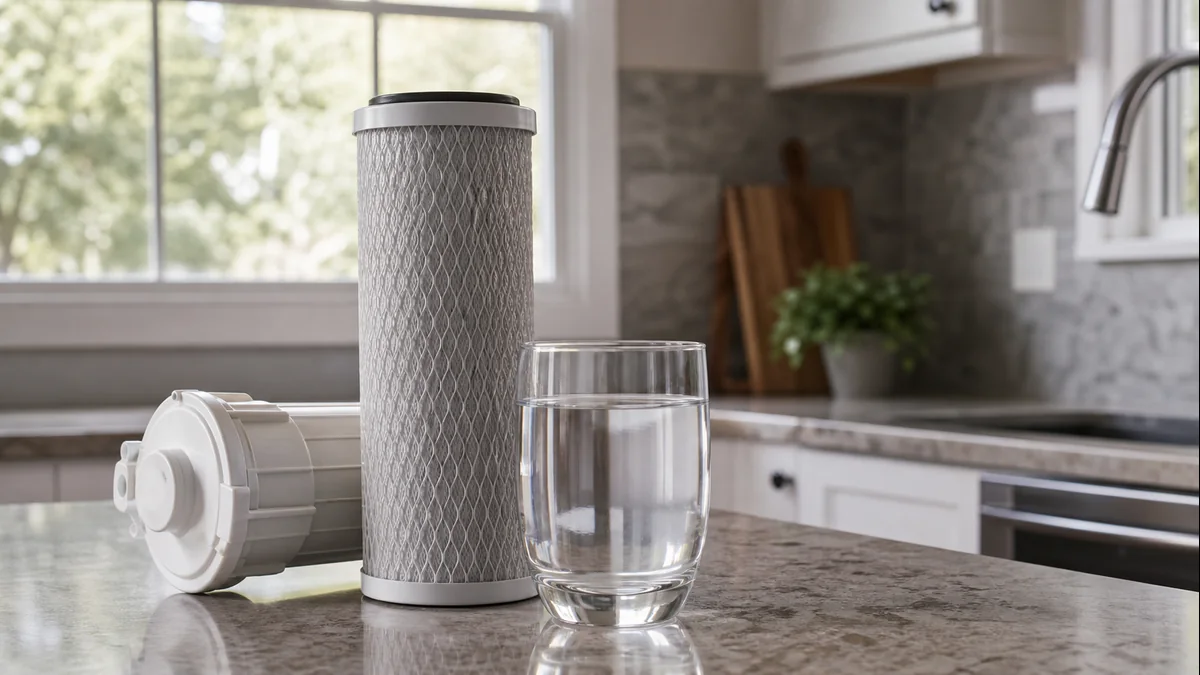
Direct answer: TTHM (total trihalomethanes) and HAA5 (five haloacetic acids) form when the chlorine or chloramine used to disinfect surface water reacts with organic matter naturally present in the source. EPA caps TTHM at 80 parts per billion and HAA5 at 60; every Triangle utility we track stays under both limits. Compliant isn't zero, though — activated carbon removes both compound groups, which is the carbon half of an all-in-one whole-home system.
What are TTHM and HAA5, and where do they come from in Triangle tap water?
TTHM and HAA5 aren't contaminants a utility adds on purpose — they're a byproduct of doing the job correctly. Every surface-water system in the Triangle disinfects with chlorine or chloramine to kill bacteria and other pathogens, which is exactly what keeps tap water safe to drink. The trade-off: the same disinfectant reacts with dissolved organic matter already in lake and river water — decaying leaves, algae, plant material — and that reaction produces a family of compounds.
TTHM is the sum of four related compounds (chloroform among them); HAA5 is the sum of five haloacetic acids. Both are regulated as a combined total, because it's the total exposure EPA set the limit against.
Every utility covered here draws from a lake or reservoir, not a deep well — exactly the setup where this reaction happens. Groundwater systems typically carry far less organic matter to react with.
Why do chloraminated systems form these compounds in the first place?
Because the reaction needs both ingredients — disinfectant and organic matter — and surface-water systems have plenty of both. Raleigh Water, the Cary/Apex Water Treatment Facility, and Durham's plants all treat lake water, using chloramine (chlorine plus ammonia) as their primary, day-to-day disinfectant because it holds a stable residual through long stretches of pipe.
The formation reaction is ongoing, not a one-time event at the plant. TTHM and HAA5 can keep building as water moves through the distribution system, which is part of why a utility's numbers are reported as a running average across multiple points, not one reading at the plant gate.
None of this means the water is being treated wrong. It means disinfection has a chemical cost — one EPA regulates and a home filtration stage is built to remove.
What are the EPA limits for TTHM and HAA5, and what health effects do they list?
EPA's Maximum Contaminant Level for TTHM is 80 parts per billion (ppb); for HAA5 it's 60 ppb. Utilities test on a running-average basis and report the results in their annual Consumer Confidence Report. Every utility in this article stays under both limits.
EPA's own National Primary Drinking Water Regulations table lists the potential health effects from long-term exposure above the MCL: for TTHMs, "Liver, kidney or central nervous system problems; increased risk of cancer." For HAA5, "Increased risk of cancer."
That's a real health basis, not a taste-and-odor footnote — and it's worth being precise about what it does and doesn't mean. Every utility named in this article reports levels under the MCL, so none of these effects apply to their current, compliant water. But "legally compliant" is a ceiling EPA itself set based on its own risk tolerance, not a guarantee of zero risk. These are the exact compounds and the exact effects EPA had in mind when it drew that line. A carbon filtration stage removes them at the tap rather than relying on staying under a legal limit.
How do Raleigh, Apex, Cary, and Durham's disinfection byproduct levels compare?
All four are legally compliant, and all four report real, detectable TTHM and HAA5. Here's what each utility's own current report shows:
| Utility (source report) | TTHM | HAA5 | MCL |
|---|---|---|---|
| Raleigh Water (2025 CCR) | 34.2 ppb avg, up to 42.8 | 22.0 ppb avg, up to 33.6 | 80 / 60 ppb |
| Town of Apex (2024 CCR) | 41 ppb, range 20–53 | 19 ppb, range 8–19 | 80 / 60 ppb |
| Town of Cary (2025 CCR) | 37 ppb, range 17–43 | 17 ppb, range 9–17 | 80 / 60 ppb |
| Durham (2025 report) | 56 ppb, highest LRAA | 49 ppb, highest LRAA | 80 / 60 ppb |
Durham's 56 ppb is the highest verified TTHM reading in this comparison — worth knowing if you're in Durham, and still under Durham's own 80 ppb limit.
One honest caveat on reading this table as a ranking: Durham reports a locational running annual average (LRAA) — the highest of several individual monitoring points — while Raleigh, Apex, and Cary report a system-wide average with a stated range. Those aren't identical measurements of identical things, so treat this table as indicative of where each utility sits relative to its own limit, not a precise, apples-to-apples league table across systems.
Cary and Apex share the same source and the same treatment plant — the Cary/Apex Water Treatment Facility on Jordan Lake, which Cary operates and co-owns with Apex — so their numbers sit close together. Morrisville has been on Cary's utility since April 2006 and receives Cary's finished water; it publishes no figure of its own.
Why do TTHM, HAA5, and chlorine taste all spike in late winter and spring?
Because most Triangle utilities run chloramine most of the year, then switch to free chlorine for a few weeks. Raleigh Water normally disinfects with chloramine — which the City describes as carrying no taste or odor of its own — and converts to free chlorine only once a year, on the N.C. Department of Environmental Quality's recommendation, while flushing the distribution system to speed the changeover.
Chlorine residual runs higher system-wide during that period, which is exactly when taste and odor complaints climb. The window has historically fallen in the last week of February through the first week of April; Raleigh's 2026 conversion ran February 26 through April 2. Dates shift year to year, so check the utility's own current announcement rather than assuming a fixed calendar.
The conversion is a planned maintenance step, not a sign anything went wrong — free chlorine is more reactive and helps scour biofilm and sediment out of distribution pipes. Read the full mechanics in why Raleigh water tastes different in spring.
What's the difference between HAA5 and HAA9?
This is a common mix-up worth getting right. HAA5 is the federally regulated figure — the sum of five haloacetic acids, capped at 60 ppb by EPA's own MCL, and the number used in every utility's official Consumer Confidence Report.
HAA9 has no EPA limit at all. It's a broader nine-compound sum some independent databases track for a fuller occurrence picture, but there's no regulatory ceiling for it to comply with. An HAA9 number can be useful context, but it's never accurate to describe it as "under the legal limit" — there isn't one. Every HAA5 figure in this article, by contrast, is compared against the actual regulated 60 ppb MCL.
Does activated carbon actually remove TTHM and HAA5?
Yes — activated carbon removes disinfection byproducts effectively. It's the standard, well-established method for pulling TTHM and HAA5 out of tap water at the point of use, working on the same principle it uses to remove chlorine and chloramine taste: the compounds adsorb onto the carbon media as water passes through.
A water softener doesn't touch any of this. Softening is ion exchange built specifically for calcium and magnesium — it has no mechanism for organic disinfection byproducts. That's exactly why an all-in-one whole-home system pairs a carbon stage with softening resin: the carbon side handles TTHM, HAA5, and chlorine/chloramine taste, while the softening side protects your water heater, dishwasher, and plumbing from mineral buildup. One install, both problems solved.
For the well-documented, non-geo mechanics of each compound family, see our guides on trihalomethanes in tap water and haloacetic acids in drinking water.
See your own utility's numbers, then fix what a compliant report still leaves in your water
Raleigh, Apex, Cary, and Durham all report real, detectable TTHM and HAA5, and all four stay under EPA's limits. Compliant is a floor everyone should expect — it isn't a reason to skip filtering the compounds EPA regulates precisely because of their long-term health effects. Take the 60-second water quiz to see which all-in-one system fits your home, or book a free water analysis for the reading at your own address. See detailed local numbers for Apex, Cary, Durham, and Raleigh.
FAQ
I just moved to the Triangle and saw "TTHM" on my new utility's report — is that something to worry about? It's worth understanding, not panicking over. TTHM is a normal byproduct of disinfecting surface water, and every utility in the Triangle reports levels under EPA's 80 ppb limit. It's still a real compound with a documented long-term health basis, which is exactly why a carbon filtration stage exists — to remove it rather than just track it.
My water utility says it's "in compliance" — does that mean the TTHM and HAA5 levels are basically zero? No. Compliance means the utility's reported average stays under EPA's limit — 80 ppb for TTHM, 60 ppb for HAA5 — not that the compounds are absent. Raleigh's own 2025 report shows TTHM running up to 42.8 ppb and HAA5 up to 33.6 ppb at points in the system, both real, detectable, and both compliant at the same time.
Why does Durham's number look higher than Raleigh's or Cary's in your table? Durham's 2025 report shows the highest verified TTHM and HAA5 readings in this comparison — 56 and 49 ppb, both still under Durham's own 80 and 60 ppb limits. Keep in mind Durham reports its highest single monitoring point (an LRAA), while Raleigh, Apex, and Cary report a system-wide average, so it's a real but not perfectly apples-to-apples comparison.
Does boiling my water get rid of TTHM or HAA5? No, and boiling can actually push volatile compounds like TTHM into the air rather than removing them from what you drink in a controlled, reliable way. Boiling is a fix for biological contamination, not a filtration method for disinfection byproducts.
Is HAA9 the same thing as the HAA5 my utility reports? No — and this is worth getting right. HAA5 is the federally regulated figure with a 60 ppb EPA limit; HAA9 is a broader nine-compound sum with no EPA limit at all. If you see an HAA9 number somewhere, it isn't being measured against a legal ceiling the way HAA5 is.
Will a water softener reduce the TTHM or HAA5 in my Triangle home's water? No. A softener is ion exchange built for calcium and magnesium and has no mechanism for organic compounds like TTHM or HAA5. Removing them takes an activated carbon stage, which is why an all-in-one system pairs carbon with softening resin in a single install.
Sources
- EPA — National Primary Drinking Water Regulations
- City of Raleigh Water — 2025 Consumer Confidence Report
- Town of Apex — 2024 Annual Drinking Water Quality Report
- Town of Cary — Water Quality Report
- City of Durham — 2025 Annual Drinking Water Quality Report
Related reading: Trihalomethanes in Tap Water | Haloacetic Acids in Drinking Water | Why Does Raleigh Water Taste Different in Spring? | What Are PFAS Forever Chemicals in Triangle, NC Tap Water?
Answer nine practical questions, then request a written quote or well-water analysis.
Start My Water Analysis