
Trihalomethanes and Haloacetic Acids in Apex, NC Tap Water
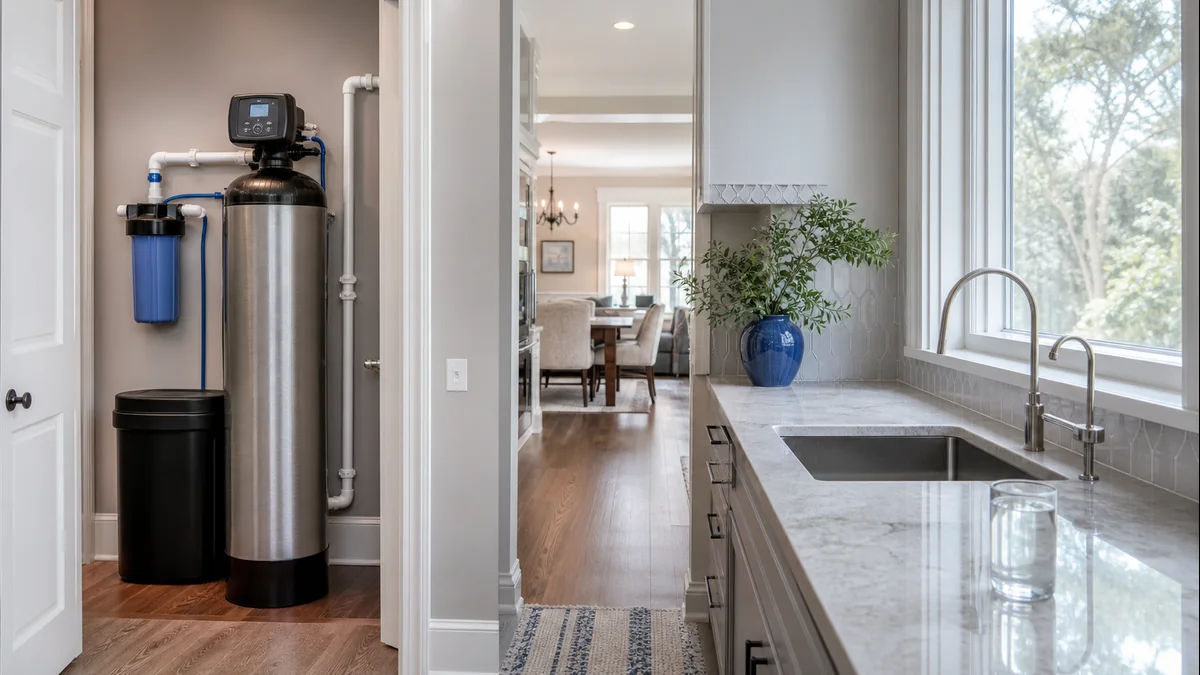
Direct answer: Yes — Apex's own 2024 water quality report measured trihalomethanes as high as 53 ppb and haloacetic acids up to 19 ppb, both legally compliant with EPA limits of 80 and 60 ppb. These byproducts form when the chloramine used to disinfect Jordan Lake water reacts with organic matter. A carbon filtration stage removes them; the all-in-one whole-home system pairs that carbon with softening resin.
What are trihalomethanes and haloacetic acids in Apex's tap water?
Trihalomethanes (TTHM) and haloacetic acids (HAA5) are disinfection byproducts — compounds that form when the chloramine Apex uses to treat its water reacts with organic matter carried in from B. Everett Jordan Lake, the town's source. They aren't outside contamination; they're a byproduct of the disinfection step itself, present to some degree in every chlorinated or chloraminated water system in the country.
EPA regulates both under the Safe Drinking Water Act, with a Maximum Contaminant Level of 80 ppb for TTHM and 60 ppb for HAA5, each measured as a running annual average across a system's testing sites.
How high are TTHM and HAA5 levels in Apex, NC tap water?
Apex's 2024 Annual Drinking Water Quality Report put TTHM at a system average of 41 ppb, with individual site readings ranging up to 53 ppb. HAA5 averaged 19 ppb, with a range of 8 to 19 ppb. Both numbers sit under their respective limits — 80 ppb for TTHM, 60 ppb for HAA5 — so Apex is in full compliance.
The average tells only part of the story. Site-level testing varies across a distribution system, and 53 ppb, the top of Apex's own reported TTHM range, is what some households in town are actually getting, not the blended average for the whole system.
| Parameter | Apex 2024 average | Range | EPA limit |
|---|---|---|---|
| TTHM | 41 ppb | 20–53 ppb | 80 ppb (MCL) |
| HAA5 | 19 ppb | 8–19 ppb | 60 ppb (MCL) |
| Chloramines (RAA) | 3.23 ppm | 1.04–3.98 ppm | 4.0 ppm (MRDL) |
| Chlorine (RAA) | 2.20 ppm | 0.8–3.6 ppm | 4.0 ppm (MRDL) |
Where do Apex's TTHM and HAA5 come from?
Apex's water starts as surface water pulled from B. Everett Jordan Lake, part of the Cape Fear River basin. It's treated at the Cary/Apex Water Treatment Facility, a 56-million-gallon-per-day plant Apex co-owns with Cary — Cary is the lead agency and runs day-to-day operations, and the same plant also supplies RDU and RTP South.
The raw lake water first gets a dose of powdered activated carbon, then goes through ozonation to break down organics and control taste and odor, then coagulation with alum and polymer, then filtration through sand and carbon media, plus fluoride and corrosion-control chemicals. The last step happens in the clearwell: chlorine and ammonia are added there, separately, to combine into chloramine — the residual disinfectant that travels with the water into Apex's distribution system.
That chloramine residual keeps reacting with whatever organic matter is still present as water moves through miles of pipe, and that ongoing reaction is where Apex's measured TTHM and HAA5 numbers come from. It's a function of treating surface water from a lake, not a sign anything in Apex's process is off.
Is Apex's water higher in these compounds than nearby Triangle towns?
Higher than Raleigh's, yes — not the highest in the region. Raleigh Water's 2025 report put its own TTHM at an average of 34.2 ppb, with a high of 42.8 ppb; Apex's 53 ppb top reading runs higher, roughly 1.2 times Raleigh's high mark. That's a real difference, but a modest one, not double.
Durham's water carries more. Durham's 2025 report shows a highest TTHM running annual average of 56 ppb, ahead of Apex's 53. Raleigh, Apex, and Durham all remain compliant with the 80 ppb limit — the point isn't that any one town is failing, it's that surface-water systems across this region all produce measurable disinfection byproducts, at levels that differ town to town.
What health effects does EPA link to TTHM and HAA5?
EPA's own National Primary Drinking Water Regulations table lists the potential health effects from long-term exposure above the MCL for TTHM as "liver, kidney or central nervous system problems; increased risk of cancer." For HAA5, EPA's listed effect is "increased risk of cancer."
Those effects apply to exposure above the legal limit, over a long period — not to Apex's current, compliant water. Apex's readings sit under both MCLs. But "legally compliant" is a ceiling EPA set based on its own risk tolerance, not a guarantee of zero risk. TTHM and HAA5 are the exact compounds EPA had in mind when it set that ceiling, which is why a carbon filtration stage that removes them outright is a stronger answer than simply staying under the number.
Does Apex's water hardness add to the case for treatment?
It's a secondary factor here — the bigger story in Apex is disinfection byproducts, not scale. Apex's own 2024 report lists average hardness at 33.3 ppm, about 1.9 grains per gallon, which the town calls "moderately soft."
Triangle Waterworks measures a broader range across the homes we test in the area — 1.6 to 3.7 grains per gallon depending on ZIP code. On the WQA/Hach scale, the scale used by the Hach Total Hardness Test Kit Model 5-B, that range spans slightly hard to moderately hard. The gap between the town's plant average and what we measure at individual addresses is exactly why a free, address-level test settles it better than either published number alone.
How do I get TTHM and HAA5 out of my Apex tap water?
Activated carbon removes disinfection byproducts effectively, adsorbing the compounds as water passes through the media. That's the carbon half of the all-in-one whole-home system — the same install pairs a carbon filtration stage with softening resin, so the water heater, dishwasher, and plumbing get scale protection while the carbon stage handles TTHM, HAA5, chlorine taste, and PFAS in the same pass.
Because DBP levels and hardness both vary by address and by season, a free in-home water analysis is the way to size a system to what's actually coming out of your own tap rather than the town-wide average.
Take the 60-second water quiz to see which all-in-one system fits your Apex home, or book a free water analysis to get your own address's numbers. For more on what Apex's chloramine can do to taste, see why Apex water tastes like chemicals, and for local install info, see water treatment near you in Apex, NC.
FAQ
Is Apex's tap water safe to drink even with detectable TTHM and HAA5? Yes — Apex's 2024 report shows both compounds under their EPA limits, so the town is in full compliance. Compliance is a legal ceiling, not a claim of zero risk, which is why removing the compounds with a carbon stage is worth doing even on compliant water.
I just moved to Apex and noticed a chemical taste in my tap water — is that related to TTHM and HAA5? Possibly, but not usually directly. Apex disinfects primarily with chloramine and switches to free chlorine once a year to flush the system, and either disinfectant can carry a noticeable taste. TTHM and HAA5 themselves are generally not what you're tasting — a free water analysis can identify what's actually behind the taste at your address.
My neighbor's water tastes different from mine even though we're both in Apex — why? Site-level DBP readings vary across a distribution system, and Apex's own reported TTHM range runs from 20 to 53 ppb depending on location. Distance from the treatment plant, pipe age, and how long water sits in that section of the system all play a role.
Does Apex's HAA5 level count against the HAA9 guideline I've seen online? No — HAA9 is a nine-compound composite tracked by groups like EWG with no EPA limit attached to it. Apex's official compliance figure is HAA5, the five-compound group EPA regulates with a 60 ppb MCL, and Apex's 19 ppb sits well under that.
Will boiling my water remove TTHM or HAA5 before I drink it? No — boiling isn't a reliable way to remove disinfection byproducts, and it can drive off some volatile compounds while concentrating others left behind. Activated carbon filtration is the mechanism that actually removes TTHM and HAA5, not heat.
I'm on a well outside Apex city limits — does any of this apply to me? No — TTHM and HAA5 are disinfection byproducts specific to treated, chlorinated or chloraminated municipal water. Private wells aren't disinfected the same way and carry a different set of concerns, like iron, sulfur, or low pH, addressed with a different kind of system.
Sources
- Town of Apex — 2024 Annual Drinking Water Quality Report
- City of Raleigh — 2025 Water Consumer Confidence Report
- City of Durham — 2025 Annual Drinking Water Quality Report
- EPA — National Primary Drinking Water Regulations
Related reading: Triangle NC Disinfection Byproducts Explainer | Trihalomethanes in Tap Water | Haloacetic Acids in Drinking Water
Answer nine practical questions, then request a written quote or well-water analysis.
Start My Water Analysis