
Does Cary NC Tap Water Have Pesticides or Atrazine?
Direct answer: No — Cary's 2025 Annual Water Quality Report lists no detected atrazine, simazine, or other pesticide/herbicide result anywhere in its contaminant tables. Cary draws from Jordan Lake, an agricultural watershed the state rates "Higher" susceptibility for exactly these compounds, so the clean reading is genuinely reassuring. It doesn't cover chlorine, chloramine byproducts, or PFAS, which the same report does show — and which a whole-home carbon system handles.
Does Cary NC tap water have pesticides or atrazine in it?
No, based on Cary's own current testing. Cary's 2025 Annual Water Quality Report — the town's federally mandated Consumer Confidence Report — states plainly that its tables "show only those substances that were detected in the water" during the year's testing, and no line for atrazine, simazine, or any other pesticide or herbicide appears anywhere in the report.
That's not a gap in monitoring. Cary tested drinking water roughly 90,000 times in 2025 across radioactive, biological, inorganic, and synthetic organic substance categories, which is the group atrazine and simazine fall under. A clean result from that volume of testing is a genuine non-detect, not an untested blind spot.
Why would Cary's water even be tested for atrazine in the first place?
Because Cary's source is Jordan Lake, a surface-water reservoir on the Cape Fear River Basin that the North Carolina Division of Environmental Quality's Source Water Assessment Program rates "Higher" susceptibility to potential contaminant sources, including agricultural runoff. That rating is exactly why atrazine and simazine testing is part of Cary's routine monitoring — not a sign that the town's water is currently compromised.
Cary's report explains where these compounds could come from in general: "pesticides and herbicides, which may come from a variety of sources, such as agriculture, urban stormwater runoff, and residential uses." Jordan Lake's watershed includes farmland, so testing for herbicides used on crops is a standard, expected part of Cary's compliance program — one it has passed for atrazine and simazine in the current report.
What does Cary's own 2025 water quality report actually show?
Cary tested extensively and reported clean results across the synthetic organic contaminant category, alongside real, quantified numbers for other compounds that softening alone does nothing about.
| Substance | Cary's 2025 result | Federal limit | What removes it |
|---|---|---|---|
| Atrazine / simazine | Not detected (no line in report) | 3 ppb / 4 ppb | Activated carbon |
| Trihalomethanes (TTHM) | 37 ppb (range 17–43) | 80 ppb | Activated carbon |
| Haloacetic acids (HAA5) | 17 ppb (range 9–17) | 60 ppb | Activated carbon |
| PFOA | 1.3 ppt average (ND–3.9) | 4 ppt | PFAS-certified carbon or RO |
| Chloramines | 2.96 ppm running annual average | 4.0 ppm | Activated carbon (taste/odor) |
Cary's report also states 1,4-dioxane was tested 12 times in 2025 with none detected — another clean synthetic organic result. The pattern is consistent: pesticides and 1,4-dioxane are absent, but chlorine byproducts and trace PFAS are present and quantified.
If atrazine isn't detected, why does Cary's water still need to be filtered?
Because a non-detect pesticide result answers one specific question and leaves several others untouched. Cary's own report shows total trihalomethanes at 37 ppb and haloacetic acids at 17 ppb — both legally compliant, and both compounds EPA regulates for a reason.
EPA's National Primary Drinking Water Regulations table lists the potential health effect from long-term exposure above the MCL as "liver, kidney or central nervous system problems; increased risk of cancer" for TTHM, and "increased risk of cancer" for HAA5. A compliant result is a ceiling EPA set using its own risk tolerance, not a promise of zero exposure — a carbon stage removes these compounds rather than relying on staying under the legal limit.
Hardness is the other piece pesticide testing says nothing about. Triangle Waterworks measures 1.6 to 3.7 grains per gallon across the service area, slightly hard to moderately hard on the WQA/Hach scale, with Cary's own area running toward the higher end of that range in our testing. That buildup is cumulative on fixtures, glassware, and inside water heaters over years, regardless of what any single contaminant test shows.
What is Cary doing about PFAS and other contaminants in the same report?
Cary treats its water with powdered activated carbon specifically to reduce PFAS, and its 2025 report shows the results: PFOA averaging 1.3 ppt (range ND–3.9), under the EPA's 4 ppt limit, and PFOS non-detect (range ND–1.7), also under its 4 ppt limit. Cary's report describes this treatment as consistent over several years, since it began its proactive PFAS monitoring and testing plan.
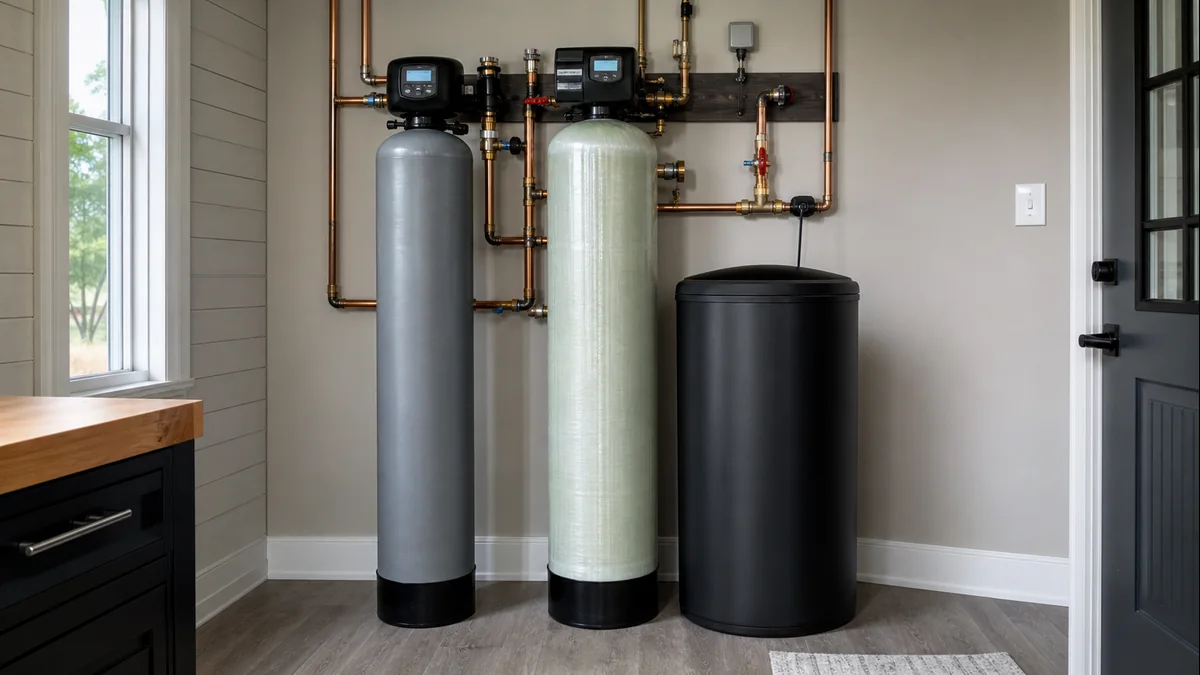
That's the same principle behind a whole-home carbon stage at your own tap — activated carbon works on PFAS, chlorine taste, and disinfection byproducts, and it would work on atrazine or simazine too if either ever showed up in a future report. A carbon stage isn't a response to one bad test result; it's coverage for the whole category of compounds treatment plants and home systems both rely on carbon to handle.
How do I get a copy of Cary's water quality report myself?
Cary publishes its current Annual Water Quality Report at carync.gov/waterreport every year, typically in the spring, covering the prior calendar year's testing. It is the primary-source document for anything you want to check yourself, and it beats any third-party aggregator repeating older figures.
Reading the town-wide report is a good first step, but it reflects an average across the whole system. Testing your own address — through a free water analysis — is the only way to know what's actually coming out of your specific tap, including the ZIP-code hardness variation Cary's own report doesn't track.
Ready to find out what's in your Cary tap water?
Cary's pesticide results are clean, and the same report shows real disinfection byproducts and PFAS worth addressing now rather than living with. Take our 60-second water quiz to see which all-in-one system fits your home, or book a free water analysis to see your own address's numbers.
FAQ
I just moved to Cary and saw people online worried about "Jordan Lake chemicals" — should I be concerned about pesticides specifically? Cary's current report shows no detected atrazine, simazine, or other pesticide, so that specific concern doesn't hold up against the town's own testing. Jordan Lake is an agricultural watershed that gets monitored closely for exactly this reason, and the 2025 data came back clean for that category.
Does Cary test for atrazine every single year, or only sometimes? Synthetic organic contaminants like atrazine are part of Cary's required annual testing program, though EPA allows some substances to be tested less than once a year when levels aren't expected to vary much. Cary's report discloses this explicitly, so a given year's report can include recent data for the compounds most likely to change and slightly older data for the most stable ones.
If pesticides aren't detected, is Cary's water basically clean across the board? Not entirely — Cary's own report shows trihalomethanes at 37 ppb and haloacetic acids at 17 ppb, both legally compliant but both compounds tied to real EPA-listed health effects at levels above the limit. Softening doesn't touch either one; a carbon stage does.
How does Cary's water compare to Apex's, since they share a treatment plant? Cary and Apex draw from the same Jordan Lake source and the jointly owned Cary/Apex Water Treatment Facility, but each town publishes its own separate annual report with its own sampling results. Cary's 2025 report and Apex's 2024 report both show clean pesticide results and real, quantified disinfection byproducts — check each town's own numbers rather than assuming they're identical.
I have well water outside Cary's service area — does the town's pesticide result tell me anything about my well? No — Cary's report only covers water tested at its own treatment facility and distribution system, and North Carolina doesn't regulate private well water after construction. A free water analysis is the only way to know what's actually in a specific well.
Is Cary's water hard, and does that have anything to do with pesticides? They're unrelated — hardness comes from calcium and magnesium, not agricultural chemicals. Triangle Waterworks measures 1.6 to 3.7 grains per gallon across the service area, and Cary's own testing runs toward the higher end of that range, which is a genuine reason to address hardness even with a clean pesticide result.
Sources
Related reading: Do Triangle NC Tap Water Systems Have Pesticides or Herbicides? | Does Apex NC Tap Water Have Pesticides? | Water Softener in Cary, NC | Whole House Water Filter in Cary, NC | Best Whole-Home System for Cary, Apex, and Morrisville
Answer nine practical questions, then request a written quote or well-water analysis.
Start My Water Analysis