
Does Clayton, NC Tap Water Have Pesticides in It?
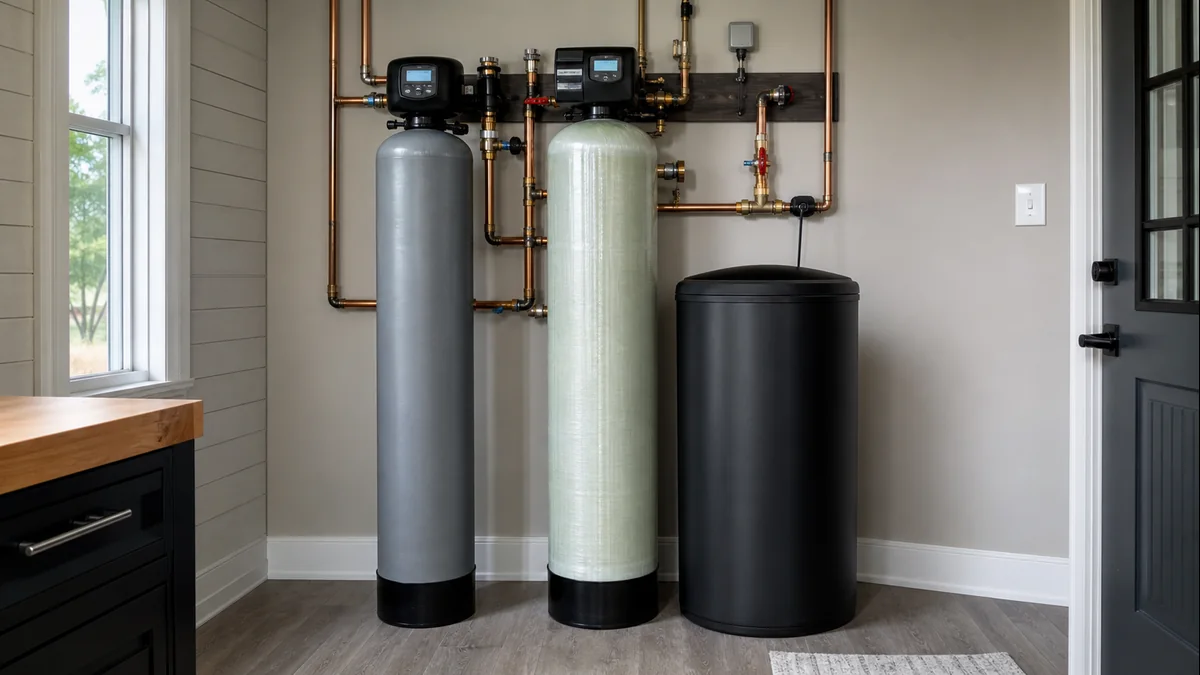
Direct answer: No — Clayton's 2025 Annual Drinking Water Quality Report lists no pesticide or herbicide anywhere in its tables, a genuine non-detect under the town's own disclosure rule. The same report shows real disinfection byproducts (TTHM 52 ppb, HAA5 30.49 ppb) and slightly hard water. A clean pesticide result doesn't mean nothing's worth filtering — an all-in-one carbon-and-softening system handles what's actually there.
Does Clayton, NC tap water have pesticides in it?
No, based on Clayton's own testing. The Town of Clayton's 2025 Annual Drinking Water Quality Report, covering the "Town of Clayton - North" system (NC 40-51-019), contains no atrazine, simazine, or any other pesticide or herbicide line anywhere in its tables.
That's a real answer, not an absence of testing. Clayton's report states, verbatim: "We routinely monitor for over 150 contaminants in your drinking water according to Federal and State laws. The tables below list all the drinking water contaminants that we detected in the last round of sampling for each particular contaminant group."
A substance only earns a row once it's been found. A missing pesticide row means it was tested for and not found, not that it went unchecked.
How does a missing row prove a non-detect instead of "untested"?
Because of how the report's own disclosure rule works. Clayton's report lists what it detected in the most recent sampling round for each contaminant group; it doesn't publish a blank line for a substance that was tested and came back clean. So the total absence of a pesticide or herbicide row — no atrazine, no simazine, nothing under that category — is the report's built-in way of showing a clean result.
That's a meaningfully different situation from a topic the report simply never covers. Pesticides and herbicides are tested as part of Clayton's routine synthetic-organic-chemical monitoring; the empty result is the finding.
Where does Clayton get its drinking water?
From purchased surface water sourced at the Neuse River, treated before it reaches Clayton addresses. That's a different watershed than the Jordan Lake source shared by Cary, Apex, and Morrisville — so Clayton's pesticide result reflects its own river and its own treatment process, not a shared regional plant.
That distinction matters for how much weight to put on the non-detect. It's Clayton's own water, tested at Clayton's own entry point, not a number borrowed from a neighboring town's report.
Does a clean pesticide result mean Clayton's water doesn't need any treatment?
No — the same report that shows no pesticides also shows measurable disinfection byproducts and hardness, neither of which pesticide testing touches. Total trihalomethanes (TTHM) came in at 52 ppb, ranging as high as 64.20, against an EPA limit of 80 ppb. Haloacetic acids (HAA5) came in at 30.49 ppb, ranging to 44.30, against a limit of 60 ppb.
Both are legally compliant. Both are also the second-highest verified disinfection-byproduct readings in this whole service area, behind only Durham's.
EPA's National Primary Drinking Water Regulations table lists TTHM's potential health effect from long-term exposure above the legal limit as "Liver, kidney or central nervous system problems; increased risk of cancer," and HAA5's as "Increased risk of cancer."
"Legally compliant" is a ceiling EPA set at the edge of its own risk tolerance, not a guarantee of zero risk — these are the exact compounds and effects EPA had in mind when it drew that line, and a carbon filtration stage removes them directly rather than relying on staying under a legal number.
What does Clayton's report show for chlorine and chloramine?
A running annual average chloramine residual of 1.34 ppm, ranging from 0.05 to 3.02, against an EPA maximum residual disinfectant level of 4.0 ppm. Chloramine is what most Clayton addresses taste and smell day to day; it's added deliberately to keep the water disinfected as it travels through the distribution system, and it's the same category of compound that carbon filtration is built to strip out along with TTHM and HAA5.
Is Clayton's water hard?
Slightly hard, on the town's own numbers. Clayton's Drinking Water page states the typical hardness level is 30 milligrams per liter, which works out to roughly 1.75 grains per gallon (gpg) on the Water Quality Association scale the Hach Total Hardness Test Kit uses — the "slightly hard" band, not "hard," which starts at 7 gpg.
Slightly hard isn't mineral-free. Calcium and magnesium are present at that level and accumulate on fixtures, glassware, and inside a water heater over years of daily use — buildup is cumulative even at the low end, and a softening stage sized to that reading runs cheaply and regenerates rarely.
| What Clayton's 2025 report shows | Reading | Removed by carbon? | Removed by softening? |
|---|---|---|---|
| Pesticides/herbicides (SOC) | No row in any table — non-detect | Yes, if ever detected | No |
| TTHM | 52 ppb (range 26.20–64.20, limit 80) | Yes | No |
| HAA5 | 30.49 ppb (range 20.20–44.30, limit 60) | Yes | No |
| Chloramines | 1.34 ppm RAA (0.05–3.02, MRDL 4.0) | Yes — taste and odor | No |
| Hardness | ≈1.75 gpg — slightly hard | No | Yes |
What should a Clayton homeowner actually do with this?
Treat the pesticide question as settled and look at what's left. Clayton's own report already answers it cleanly — a real non-detect, not a gap in testing. What's left is the disinfection byproducts, the chloramine residual, and the slightly hard water that pesticide testing never touches, exactly what an all-in-one system's carbon and softening stages are built to cover together.
See the fuller regional picture in our Triangle NC pesticides & herbicides explainer, or check new construction water treatment in Clayton, NC if you're building.
See what's actually coming out of your Clayton tap
Clayton's report clears pesticides but shows real TTHM, HAA5, and slightly hard water that a filter search shouldn't skip past. Take the 60-second water quiz to see which all-in-one system fits your Clayton home, or book a free water analysis for your own address's numbers.
FAQ
I just moved to Clayton from a town where pesticides were an issue — should I still worry here? Clayton's own 2025 report shows no pesticide or herbicide detected in any sampling round, which is a real, tested result under the town's disclosure rule, not a gap. The water still carries measurable disinfection byproducts and slightly hard minerals, which is where an all-in-one system's carbon and softening stages actually earn their keep.
I'm about to close on a house in Clayton and the inspection didn't mention water quality — is that something I should test myself? Yes. Clayton's town-wide report is a good starting point, but it reflects a sampling point in the distribution system, not your specific address after your home's own plumbing. A free water analysis before or right after closing gives you your own numbers.
Does "no pesticides detected" mean Clayton's water source is cleaner than towns on Jordan Lake? Not necessarily — it means Clayton's own testing, on its own Neuse River source, came back clean for that contaminant category. Jordan Lake towns like Cary and Apex also show no pesticide row in their own reports, so a clean result on either watershed doesn't say one source is inherently cleaner than the other.
Why does Clayton's chloramine level bounce around so much, from 0.05 to 3.02 ppm? That range reflects normal variation across sampling points and times of year within the distribution system, all still under the 4.0 ppm federal limit. It's part of why an in-home carbon stage is useful — it treats the water at your tap regardless of where in that range the system happens to be running.
Is Clayton's water hard enough to actually need a softener? At roughly 1.75 gpg, Clayton's water is slightly hard on the Water Quality Association scale — real, measurable hardness, just not the highest band. Minerals at that level still build up on fixtures, glassware, and inside a water heater over years, and a softening stage sized to that reading is inexpensive to run.
How do I find out exactly what's coming out of my own Clayton tap? A free water analysis is the direct way — it tests your actual address rather than relying on the town-wide report, and it's what determines how an all-in-one system should be sized for your home.
Sources
- Town of Clayton — 2025 Annual Drinking Water Quality Report
- Town of Clayton — Drinking Water
- EPA — National Primary Drinking Water Regulations
Related reading: Do Triangle NC Tap Water Systems Have Pesticides or Herbicides? | Who Installs Water Softeners in Clayton, NC | Does Durham, NC Tap Water Have Pesticides? | New Construction Water Treatment in Clayton, NC
Answer nine practical questions, then request a written quote or well-water analysis.
Start My Water Analysis