
Does Morrisville, NC Tap Water Have Pesticides in It?
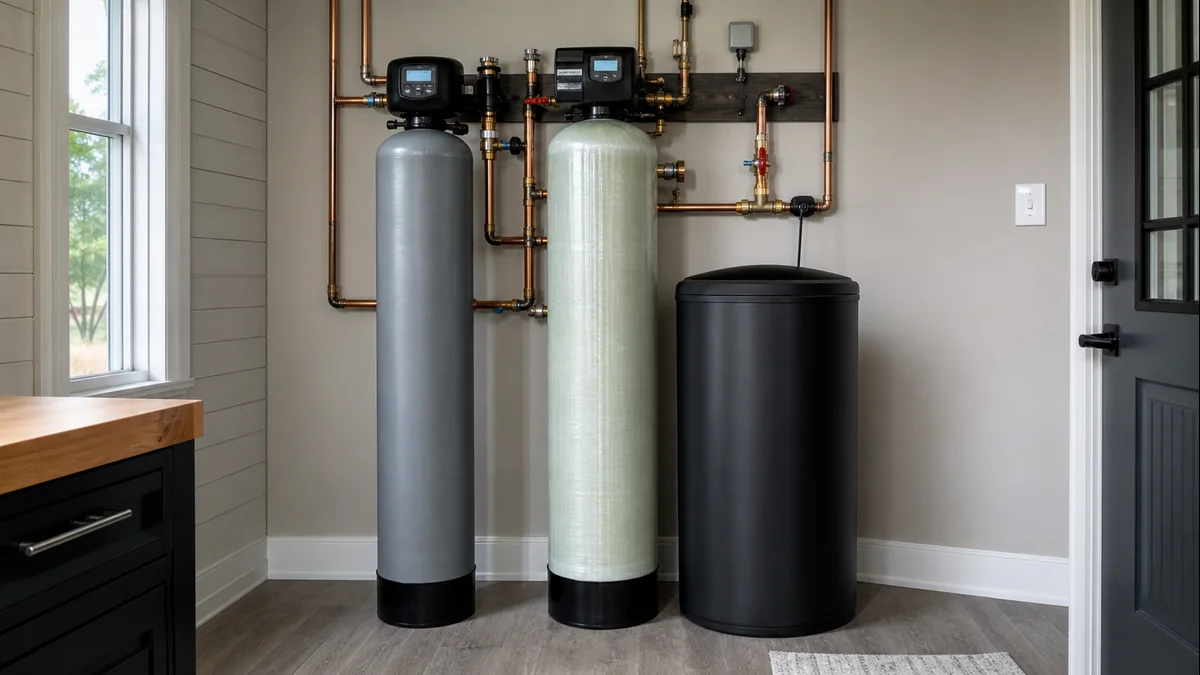
Direct answer: Morrisville has no water report of its own — the Town of Cary has operated Morrisville's water utility since 2006, so Morrisville customers receive Cary's finished water. Cary's 2025 report lists no atrazine, simazine, or other pesticide anywhere — a genuine non-detect the neighboring Apex report backs up. The same water carries real disinfection byproducts, PFAS, and slightly-to-moderately-hard minerals an all-in-one system handles.
Does Morrisville, NC Tap Water Have Pesticides in It?
No, based on the report that actually covers a Morrisville tap. The Town of Cary has operated Morrisville's water and sewer utility since April 2006, which means Morrisville customers are drinking Cary's finished water, treated at Cary's plant and tested under Cary's monitoring program — not a separate Morrisville system. Cary's 2025 Annual Water Quality Report contains no atrazine, simazine, or other pesticide or herbicide line anywhere in its detected-substances tables.
Why Doesn't Morrisville Publish Its Own Water Report?
Because Morrisville doesn't run its own treatment plant. Since the Town of Cary took over Morrisville's water and sewer utility in April 2006, the water reaching Morrisville addresses has been Cary's finished product, and Cary's annual Consumer Confidence Report is the document that governs it. Searching for a "Morrisville water quality report" by name turns up nothing, because the report that actually applies is published under Cary's name at carync.gov/waterreport.
Does a Missing Pesticide Row Mean It Wasn't Tested?
No — it means the opposite. A Consumer Confidence Report only lists a substance that was actually detected during sampling; anything tested for and never found doesn't get a line at all. So the complete absence of an atrazine, simazine, or other synthetic-organic pesticide row in Cary's 2025 tables is the report's built-in way of showing a clean result, not a blank spot in the monitoring.
The neighboring Town of Apex, which shares the same Jordan Lake source and the same Cary/Apex Water Treatment Facility, shows the identical pattern in its own 2024 report — no pesticide or herbicide row in its tables either. Two separate reports on the same source water agreeing is a stronger result than either one alone.
Where Does Morrisville's Water Actually Come From?
From B. Everett Jordan Lake, part of the Cape Fear River Basin, treated at the Cary/Apex Water Treatment Facility. That plant is co-owned by Apex and Cary, with Cary as the lead agency operating it, and it has a capacity of 56 million gallons a day — serving Cary, Apex, Morrisville, and parts of RDU and RTP South from one shared treatment train.
Because Morrisville buys finished water from Cary rather than treating its own, the plant's testing record is Morrisville's testing record too.
What Else Shows Up in Cary's Report That Pesticide Testing Doesn't Cover?
A clean pesticide result leaves other categories untouched. Cary's 2025 report shows total trihalomethanes (TTHM) at 37 parts per billion, ranging 17 to 43 ppb against an 80 ppb legal limit, and haloacetic acids (HAA5) at 17 ppb, ranging 9 to 17 ppb against a 60 ppb limit.
It also shows PFOA averaging 1.3 parts per trillion. All three figures are legally compliant, and none of them is a pesticide — they're disinfection byproducts and a detectable forever chemical, a different category entirely.
EPA's National Primary Drinking Water Regulations table lists TTHM's potential health effect from long-term exposure above the MCL as "Liver, kidney or central nervous system problems; increased risk of cancer," and HAA5's as "Increased risk of cancer."
Compliance is real here and shouldn't be waved away — Cary isn't violating anything. But the legal limit is a ceiling EPA set at the edge of its own acceptable risk, not a promise that everything under it deserves no attention. A carbon filtration stage removes these exact compounds directly, rather than relying on staying under a legal number.
Is Morrisville's Water Hard?
That depends on which source you check, and both are worth knowing. Morrisville itself publishes no hardness figure — it's on Cary's system and doesn't run separate testing. The Town of Cary publishes finished-water hardness of 25 to 30 parts per million, roughly 1.5 to 1.75 grains per gallon (gpg).
Our own in-home testing across the service area, done address by address rather than as one plant figure, measures 1.6 to 3.7 gpg by ZIP code — slightly hard to moderately hard on the WQA/Hach scale.
Both figures are accurate; they're just measuring different things. Cary's number is a treatment-plant average, and ours reflects what actually shows up at individual taps across the wider area, which is why an address-level test is the number that settles it for any given Morrisville home.
Why Does the Water Taste Different for a Few Weeks Sometimes?
Because of a normal annual maintenance step, not a problem with your line. Cary and Apex normally disinfect with chloramine, and once a year switch to free chlorine only to flush the distribution system, a step North Carolina encourages for chloramine systems generally. Free chlorine tends to have a stronger, more noticeable smell and taste than chloramine while the switch is in effect.
The exact dates move every year, so don't plan around a fixed window — check the Town of Cary's own current-year announcement rather than relying on a date from a prior season.
What Cary's Report Shows vs. What Softening Handles
| Substance | What Cary's 2025 report shows | Removed by carbon stage? | Removed by softening resin? |
|---|---|---|---|
| Atrazine, simazine (pesticides/herbicides) | No row in any table — non-detect | Yes, if ever detected | No |
| TTHM | 37 ppb (range 17–43, limit 80) | Yes | No |
| HAA5 | 17 ppb (range 9–17, limit 60) | Yes | No |
| PFOA | 1.3 ppt average | Yes, with PFAS-rated carbon | No |
| Hardness | 25–30 ppm (Cary avg); 1.6–3.7 gpg (our testing) | No | Yes |
What Should a Morrisville Homeowner Actually Do With This?
Treat the pesticide question as answered and move on to what's left. Cary's own report, backed up by Apex's separate report on the same source water, already settles the pesticide question cleanly. What's left is the disinfection byproducts, detectable PFAS, and hardness that a pesticide search never touches — exactly what an all-in-one system's carbon and softening stages are built to cover together. A free water analysis turns Cary's plant-wide averages into your own Morrisville address's actual number.
FAQ
I just moved to Morrisville and can't find a "Morrisville water quality report" — where do I actually look? Look for the Town of Cary's Annual Water Quality Report instead. Cary has operated Morrisville's water utility since 2006, so Cary's report, published at carync.gov/waterreport, is the document that covers a Morrisville address.
My neighbor in Apex says their report shows no pesticides either — is that a coincidence? No — Morrisville, Cary, and Apex all draw from the same Jordan Lake source through the shared Cary/Apex Water Treatment Facility, so a clean pesticide result on one town's report is a genuinely useful cross-check on the others, not a coincidence.
Does a clean pesticide result mean Morrisville's water doesn't need any treatment at all? No — the same report that shows no pesticides also shows measurable TTHM, HAA5, and detectable PFAS, none of which pesticide testing addresses. Those are the items worth acting on, and an all-in-one carbon-and-softening system is built to cover all of them together.
Why does my water feel harder than the 25–30 ppm Cary publishes? Cary's figure is a plant-wide average, while our own address-by-address testing across the service area measures up to 3.7 grains per gallon depending on ZIP code — a free water analysis at your specific address is the only way to know where your home falls in that range.
Is the occasional stronger chlorine smell in my Morrisville tap water a sign something's wrong? No — it's the documented annual switch from chloramine to free chlorine that Cary and Apex run each year to flush the distribution system. Exact dates shift year to year, so check the current announcement rather than a prior year's schedule.
How do I actually read the report that covers my Morrisville address? Pull up the Town of Cary's current Annual Water Quality Report at carync.gov/waterreport rather than searching for a Morrisville-specific one, and check the tables for hardness, TTHM, and HAA5 first — those are the rows that tell you the most.
See What's Actually Coming Out of Your Morrisville Tap
Cary's report settles the pesticide question for Morrisville — the disinfection byproducts, PFAS, and hardness rows are what's actually worth addressing, and none of them improve by waiting. Take the 60-second water quiz to see which all-in-one system fits your Morrisville home, or book a free water analysis for your own address's numbers.
Sources
Related reading: Do Triangle NC Tap Water Systems Have Pesticides or Herbicides? | Does Cary, NC Tap Water Have Pesticides or Atrazine? | Is Morrisville, NC Water Hard? | Water Softener in Morrisville, NC | Best Whole-Home System for Cary, Apex, and Morrisville
Answer nine practical questions, then request a written quote or well-water analysis.
Start My Water Analysis