
Does Rolesville, NC Tap Water Have Pesticides or Atrazine in It?
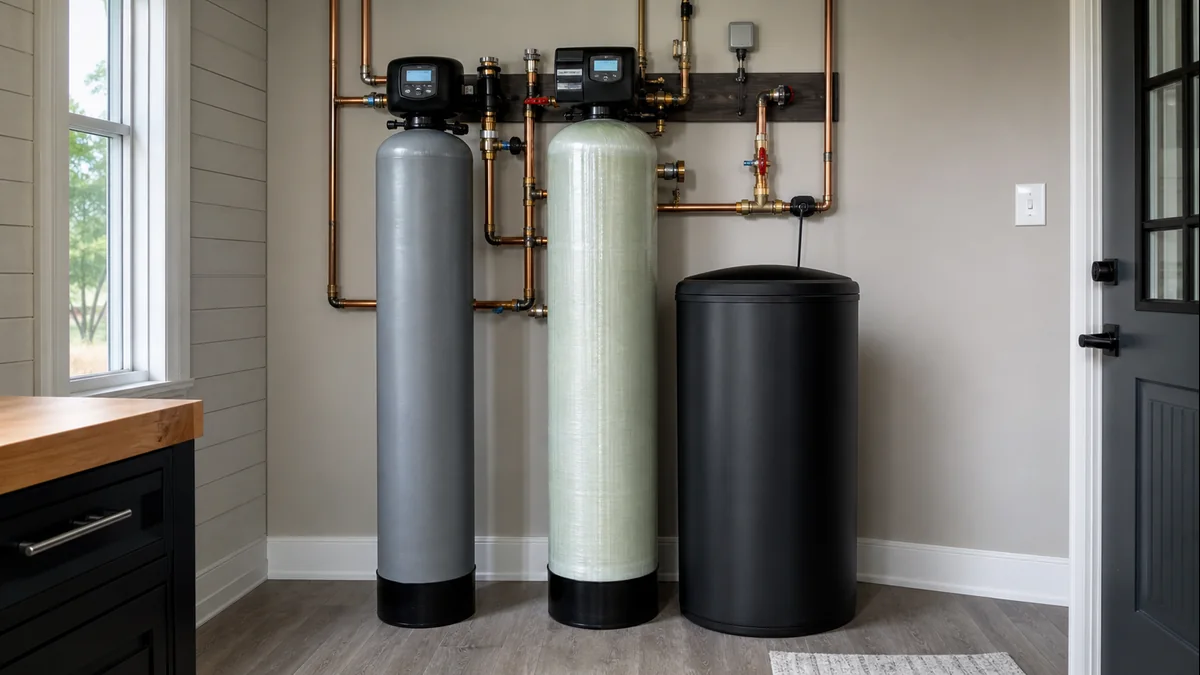
Direct answer: No — Raleigh Water's 2025 Consumer Confidence Report, which supplies Rolesville, lists no atrazine, simazine, or any pesticide in any table, a genuine non-detect under the report's own disclosure rule. The same report shows real disinfection byproducts and slightly hard water an all-in-one system is built to handle.
Does Rolesville, NC tap water have pesticides or atrazine in it?
No, based on Raleigh Water's own current testing. Rolesville is one of seven communities on the Raleigh Water system — with Raleigh, Garner, Knightdale, Wake Forest, Wendell, and Zebulon — and its 2025 Consumer Confidence Report contains no atrazine, simazine, or any other pesticide or herbicide line anywhere in its tables.
That's a real, local answer, not a guess. Under the CCR disclosure rule, only substances actually detected during testing get a row in the report. A missing row means Raleigh Water's most recent sampling round found nothing at a detectable level for that entire category.
Why does general atrazine news not automatically apply to Rolesville?
Because the only evidence that actually answers this question is a specific test of the water supply serving Rolesville, not a description of farming somewhere else. Atrazine detection depends on how much cropland actually drains into a particular water source, and that varies by location — which is why a local, tested result carries more weight than a general worry.
The only number that actually answers the question for a Rolesville address is the local one: Raleigh Water's own report, which shows no detectable pesticide or herbicide this round.
What does a real, tested atrazine row look like when a utility does find something?
Worth seeing for comparison. Durham's 2025 Annual Drinking Water Quality Report — a different Triangle utility, on a different watershed — carries an explicit table naming both atrazine and simazine as sampled compounds. Durham tested for them quarterly through 2025 and both came back non-detect, under 0.1 ppb, against regulatory limits of 3 ppb and 4 ppb respectively.
That's the difference between "tested and clean, shown explicitly" and Raleigh Water's approach of "tested and clean, shown by leaving the row out." Both are genuine non-detects; they're just presented differently. Neither utility is hiding anything — Durham's report happens to name the compounds it tests, and Raleigh Water's report only names what it finds.
| How two Triangle utilities report atrazine and simazine | What the report shows | What it means |
|---|---|---|
| Raleigh Water 2025 CCR (serves Rolesville) | No atrazine/simazine row in any table | Non-detect, shown by omission per disclosure rule |
| Durham 2025 Annual Water Quality Report | Explicit SOC table: both compounds, quarterly, <0.1 ppb | Non-detect, shown by naming the tested result |
If pesticides aren't the issue in Rolesville, what actually is?
Disinfection byproducts and hardness, both documented with real numbers in the same 2025 report. Total trihalomethanes (TTHM) average 34.2 ppb, ranging as high as 42.8, against an EPA limit of 80 ppb. Haloacetic acids (HAA5) average 22.0 ppb, ranging as high as 33.6, against a limit of 60 ppb. Both are legally compliant and both are byproducts of the chlorine-based disinfection that keeps the water safe on its way to Rolesville.
EPA's National Primary Drinking Water Regulations table lists TTHM's potential health effect from long-term exposure above the legal limit as "Liver, kidney or central nervous system problems; increased risk of cancer," and HAA5's as "Increased risk of cancer."
"Legally compliant" is a ceiling EPA set at its own risk tolerance, not a guarantee of zero risk — these are the exact compounds and effects EPA had in mind when it drew that line, and a carbon filtration stage removes them directly instead of relying on staying under a legal number.
Raleigh Water also runs chloramine most of the year and switches to free chlorine for several weeks annually to flush the system, on the state's recommendation — the 2026 window ran February 26 through April 2. See how that annual chlorine conversion works rather than assuming a fixed date next year.
Is Rolesville's water hard?
Slightly hard, on Raleigh Water's own reported figures. Average total hardness across the system reads 25.2 ppm, ranging 21.9 to 35.3 ppm — roughly 1.3 to 2.1 grains per gallon (gpg) on the Water Quality Association scale the Hach Total Hardness Test Kit uses. That's the "slightly hard" band, 1.0–3.5 gpg, well under "hard," which starts at 7 gpg.
Calcium and magnesium at that level don't disappear just because pesticide levels are clean — they're a separate category entirely, and they accumulate gradually on fixtures, glassware, and inside a water heater over years of daily use. A softening stage sized for slightly hard water runs cheaply and doesn't regenerate often.
What should a Rolesville homeowner take away from all this?
That the atrazine worry is answered locally, and the real work is elsewhere. Raleigh Water's 2025 report settles the pesticide question with a genuine non-detect specific to Rolesville, not a generic assumption. What's left — measurable TTHM and HAA5, a seasonal chlorine switch, and slightly hard water — is exactly what an all-in-one carbon-and-softening system is built to handle.
Read the Triangle NC pesticides and herbicides explainer for how this compares across the region, or check water treatment options near Rolesville for local next steps. If you're also curious about PFAS, see how to test your own tap water for it, or check who installs water softeners in Rolesville.
See what's actually in your Rolesville tap water
Raleigh Water's report clears the atrazine question, but real TTHM, HAA5, and slightly hard water are still there. Take the 60-second water quiz to see which all-in-one system fits your Rolesville home, or book a free water analysis for your own address's numbers.
FAQ
I read an article about atrazine contamination in farm states and got worried about my own tap — does that apply to Rolesville? Not based on Raleigh Water's own testing. What matters is the tested result for the specific system that supplies Rolesville, not a description of a different watershed. Raleigh Water's 2025 report shows no atrazine or any other pesticide detected in the most recent sampling round.
How do I know Raleigh Water actually tests for atrazine and isn't just skipping it? Raleigh Water's report doesn't show a row for atrazine because nothing was found — under the CCR disclosure rule, only substances actually detected get listed. Durham's report, on a different watershed, shows the same non-detect result but names the compound directly, which is a useful side-by-side if you want to see both formats.
My well-water friends in a different county say they test for atrazine every year — should I be doing that too on municipal water? Private wells are a different situation: NC doesn't regulate private well water after construction, so well owners are usually advised to test their own water periodically, including for pesticides if they're near farmland. Rolesville's municipal supply is already tested and reported by Raleigh Water on a regulatory schedule, so that ongoing burden isn't on you the same way.
If atrazine isn't in Rolesville's water, why would I still need any kind of filtration system? Because pesticides are only one category among several the report covers. The same 2025 report shows real disinfection byproducts (TTHM and HAA5) from the chlorine-based treatment process and slightly hard water from natural calcium and magnesium — neither related to pesticides, both handled by an all-in-one system.
Is Rolesville's water hard enough to actually notice? At roughly 1.3 to 2.1 grains per gallon average, it's slightly hard — real, measurable buildup on fixtures and inside a water heater over time, even though it's not in the highest hardness bands. A softening stage sized to that reading is inexpensive to run.
How do I find out what's actually coming out of my own Rolesville tap instead of relying on the town-wide average? A free water analysis tests your specific address rather than a system-wide report, and it's what determines how an all-in-one system should be sized for your home.
Sources
- Raleigh Water — 2025 Consumer Confidence Report
- Durham — 2025 Annual Drinking Water Quality Report
- EPA — National Primary Drinking Water Regulations
Answer nine practical questions, then request a written quote or well-water analysis.
Start My Water Analysis