
Why Garner, NC Water Tastes Different Each Spring — And What TTHM and HAA5 Have to Do With It
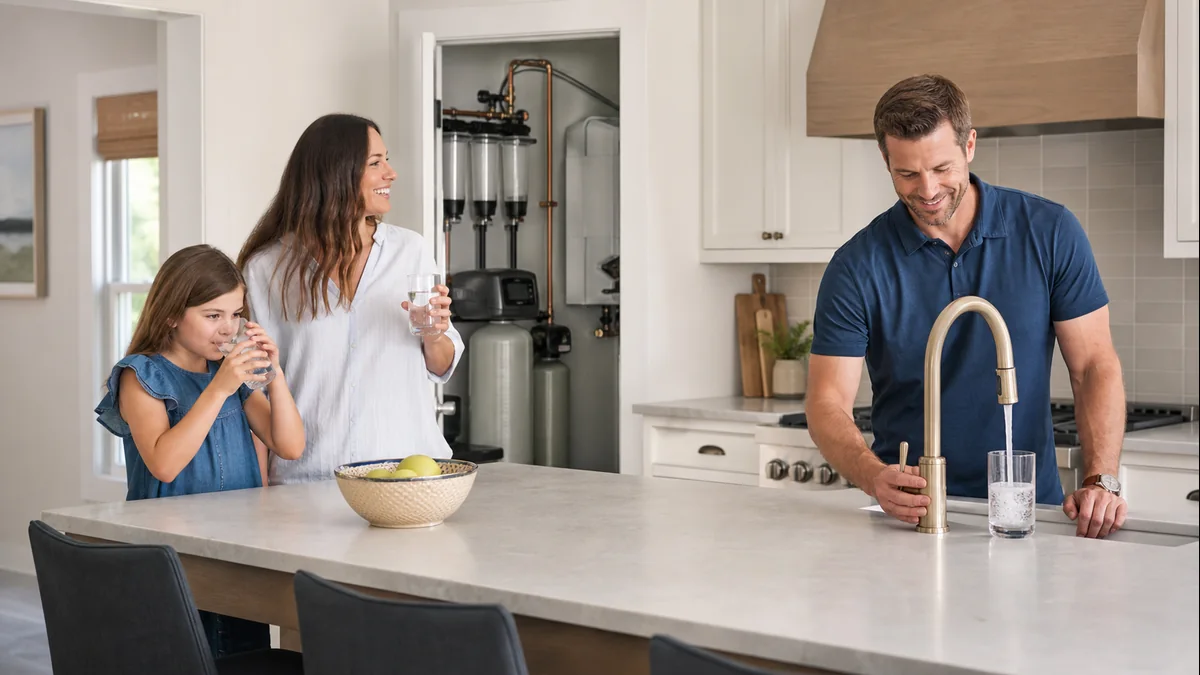
Direct answer: Garner runs on Raleigh Water, which disinfects with chloramine most of the year and switches briefly to free chlorine, on state guidance, to flush the system — a change many households notice in taste and smell. Garner's TTHM and HAA5 levels are reported as a year-round range (up to 42.8 and 33.6 ppb), not a seasonal spike. A carbon stage handles both, taste and byproducts together.
Why does my Garner tap water smell stronger of chlorine some weeks and not others?
Garner households are served by Raleigh Water, and Raleigh Water disinfects with chloramine for most of the year — a compound the utility describes as carrying little taste or smell of its own. Once annually, on the N.C. Department of Environmental Quality's recommendation, the system switches to free chlorine only and flushes the distribution network to speed the changeover.
That switch is what produces the noticeably stronger chlorine smell some households report for a few weeks. It's a planned maintenance event with a real chemical cause, not a sign that something's gone wrong with the water.
When does this happen, and how long does it last?
The window shifts year to year, so it's worth checking Raleigh Water's own current announcement rather than counting on a fixed date. The 2026 conversion ran February 26 through April 2; historically the period has fallen somewhere in late winter through early spring.
During the free-chlorine window, the chlorine residual runs higher system-wide, and flushing crews open hydrants block by block, which can also cause brief discoloration. Garner households near the flushing routes are often the first to notice the taste change.
Does the disinfectant switch mean TTHM or HAA5 levels spike in Garner?
There's no verified Garner-specific or seasonal data showing a spike, and it isn't something to claim without a source. What is verified is that Raleigh Water reports TTHM and HAA5 as a range across its 2025 Consumer Confidence Report — not a single moment-in-time reading — and that range already accounts for variation across the distribution system and across the year.
TTHM averages 34.2 parts per billion, reaching 42.8 ppb at some sampling points; HAA5 averages 22.0 ppb, reaching 33.6 ppb. Both stay under EPA's limits of 80 and 60 ppb. The honest statement is this: the disinfectant itself changes, and taste changes with it. The reported byproduct range is what it is regardless of which week you happen to test.
Why is a range reported instead of one fixed number?
Because water sits in pipes for different lengths of time depending on where a household is in the distribution system, and TTHM/HAA5 levels build the longer disinfectant reacts with organic matter along the way. A household near the far edge of the network can see a different reading than one close to the treatment plant.
Reporting a range — rather than a single average — is the more honest way to represent that spread. It's also why the standing approach here is to lead with the top of the range: 42.8 ppb for TTHM and 33.6 ppb for HAA5 are the numbers a Garner household near the higher end of the system should actually plan around.
What are TTHM and HAA5, and why does EPA regulate them at all?
TTHM (total trihalomethanes) and HAA5 (five regulated haloacetic acids) are two families of compounds that form when chlorine-based disinfectant reacts with organic material in source water — the same disinfection process that keeps the supply free of pathogens also produces these as a byproduct.
EPA's National Primary Drinking Water Regulations table lists the potential health effects from long-term exposure above the legal limit. For TTHMs: "liver, kidney or central nervous system problems; increased risk of cancer." For HAA5: "increased risk of cancer." Those effects apply above the MCL, over years of exposure — not to a single compliant reading from Garner's current supply.
Staying under those limits is a real, verified fact about Garner's water — and it's a separate fact from the compounds being gone. EPA drew that line based on its own judgment of acceptable long-term risk; a reading under it is not the same as a reading of nothing. They're real, measured, and exactly what a whole-home carbon stage is built to remove rather than track. For the underlying chemistry across the whole region, see what TTHM and HAA5 disinfection byproducts are in Triangle NC water.
The seasonal switch and the byproduct range, side by side
| What changes | Timing | What it affects | What it doesn't affect |
|---|---|---|---|
| Chloramine → free chlorine | Once a year, dates vary (2026: Feb 26–Apr 2) | Taste, smell, chlorine residual | The reported TTHM/HAA5 range itself |
| TTHM range | Reported annually in the CCR | Up to 42.8 ppb (avg 34.2) | Not tied to a specific week |
| HAA5 range | Reported annually in the CCR | Up to 33.6 ppb (avg 22.0) | Not tied to a specific week |
Two different things, on two different timelines, both traceable to the same disinfection process. A carbon filtration stage addresses both the taste swing and the year-round byproduct range in one pass.
Where can I check on Garner's own water numbers?
Garner draws its water and its Consumer Confidence Report from Raleigh Water, the same system serving Knightdale, Rolesville, Wake Forest, Wendell, and Zebulon. For a full walkthrough of every line on that report, see how to read your water quality report in Garner. For the mechanics of the spring conversion itself, Raleigh Water's own explanation of the seasonal taste change applies directly to Garner too, since it's the same distribution system. For the fuller picture of what a Garner home's water needs year-round, see water treatment in Garner, NC.
Get a reading from your own Garner tap, not the system range
A yearly disinfectant switch and a published byproduct range both describe the whole Raleigh Water system — neither tells you what's specifically coming out of a tap in your Garner neighborhood. Take the 60-second water quiz to see which all-in-one system fits your home, or book a free water analysis for your own numbers.
FAQ
My water in Garner started smelling like a swimming pool a couple weeks ago — is that dangerous? Not dangerous, and it's a known event: Raleigh Water switches from chloramine to free chlorine once a year on state guidance, and that produces a stronger chlorine smell system-wide for a few weeks. It's a planned maintenance step, not a contamination signal.
I heard the TTHM and HAA5 levels go up during the spring flush — is that true for Garner? There's no verified data showing a seasonal spike, so that claim shouldn't be treated as fact. What's verified is a year-round reported range — TTHM up to 42.8 ppb, HAA5 up to 33.6 ppb — that already reflects variation across the system rather than a single moment.
Why does my report list a range for TTHM and HAA5 instead of just one number? Because levels vary depending on how far water has traveled through the distribution system before it reaches your tap. A single average would hide that spread, so Raleigh Water — the system Garner draws from — publishes both the average and the range.
Is Garner's water actually tested separately, or is this all Raleigh's numbers? It's Raleigh Water's testing. Garner doesn't operate its own separate treatment plant for these figures — it's part of the same distribution system as Raleigh, Knightdale, Rolesville, Wake Forest, Wendell, and Zebulon, so the CCR figures apply directly.
Does a whole-home softener fix the chlorine smell during the spring switch? No — a softener is ion exchange built for calcium and magnesium; it has no effect on chlorine, chloramine, TTHM, or HAA5. Only a carbon filtration stage removes taste, smell, and disinfection byproducts, which is why the all-in-one system pairs both in a single install.
Should I wait until after the spring conversion to test my water? No need to wait — the reported TTHM and HAA5 range already covers the full year, and a free water analysis reads your specific tap regardless of the season. Timing your test around the conversion window won't change what a carbon stage would remove.
Sources
- City of Raleigh Water — 2025 Consumer Confidence Report
- EPA — National Primary Drinking Water Regulations
Answer nine practical questions, then request a written quote or well-water analysis.
Start My Water Analysis