
Raleigh, NC Trihalomethanes and Haloacetic Acids — What the CCR Shows
Direct answer: Raleigh Water's 2025 Consumer Confidence Report shows TTHM reaching 42.8 parts per billion at points in the system (average 34.2) and HAA5 reaching 33.6 (average 22.0) — both compliant with EPA's 80 and 60 ppb limits. Raleigh runs chloramine, converting briefly each year to free chlorine. Activated carbon removes both compound groups — the carbon half of an all-in-one whole-home system built for Raleigh's water.
What do Raleigh Water's TTHM and HAA5 numbers actually show?
Raleigh Water's 2025 Consumer Confidence Report puts TTHM (total trihalomethanes) at an average of 34.2 parts per billion, running as high as 42.8 ppb at some points in the distribution system. HAA5 (the five regulated haloacetic acids) averages 22.0 ppb, reaching as high as 33.6 ppb.
Both figures sit under EPA's Maximum Contaminant Levels — 80 ppb for TTHM, 60 ppb for HAA5 — so Raleigh Water is in full compliance. But compliant and undetectable aren't the same thing. These are real, measured compounds in the water leaving Raleigh's treatment plants, not a theoretical risk.
Raleigh Water serves more than the city itself — the same figures apply across Garner, Knightdale, Rolesville, Wake Forest, Wendell, and Zebulon, since all of them draw from the same system.
Is Raleigh's tap water safe if it's under the EPA limit?
Yes, by the legal standard — Raleigh Water reports no MCL violations, for TTHM, HAA5, or anything else in its 2025 CCR. That's a real, verifiable fact worth knowing.
It's also worth being precise about what "under the limit" means. EPA's own National Primary Drinking Water Regulations table lists the potential health effects from long-term exposure above the MCL: for TTHMs, "Liver, kidney or central nervous system problems; increased risk of cancer." For HAA5, "Increased risk of cancer."
Those effects apply above the MCL, over the long term — not to Raleigh's current, compliant water. But "legally compliant" is a ceiling EPA itself set based on its own risk tolerance, not a guarantee of zero risk. Raleigh's 42.8 ppb TTHM reading is real, detectable, and about half of the 80 ppb ceiling — a carbon filtration stage removes it rather than relying on staying under that line. For the full regional mechanics of how and why these compounds form, see our Triangle NC TTHM/HAA5 explainer.
Why does Raleigh's disinfectant switch each spring affect these numbers?
Because the compounds keep forming as long as disinfectant is reacting with organic matter in the water — and Raleigh's disinfectant itself changes for a few weeks every year. Raleigh Water normally runs chloramine, which the City describes as carrying no taste or odor of its own. Once a year, on the N.C. Department of Environmental Quality's recommendation, Raleigh Water switches to free chlorine only and flushes the distribution system to speed the changeover.
Chlorine residual runs higher system-wide during that window, which is also when taste and odor complaints climb. The 2026 conversion ran February 26 through April 2; the window has historically fallen in late February through early April, but dates shift year to year, so check Raleigh Water's own current announcement rather than a fixed calendar. Full breakdown: why Raleigh water tastes different in spring.
A stronger chlorine taste during that period doesn't mean TTHM or HAA5 spiked to unsafe levels — it means the disinfectant chemistry shifted, which is a separate, planned maintenance event.
How does Raleigh's hardness relate to disinfection byproducts?
They're unrelated mechanisms, but both come from the same tap. What we measure across homes in the Raleigh area runs 1.6 gpg — slightly hard on the WQA/Hach scale (the 1.0–3.5 gpg band), never plain "hard" (that band starts at 7 gpg) and never "soft." Calcium and magnesium in that range accumulate gradually on fixtures and inside a water heater over years.
TTHM and HAA5, by contrast, come from disinfectant reacting with organic matter — nothing to do with mineral content. A softener addresses hardness through ion exchange; it does nothing for TTHM or HAA5. That's the whole reason an all-in-one system pairs the two: softening resin for the hardness case, activated carbon for the disinfection byproducts, chlorine taste, and PFAS.
For a full breakdown of hardness testing, see Raleigh water hardness and is Raleigh water hardness changing.
What actually removes TTHM and HAA5 from Raleigh tap water?
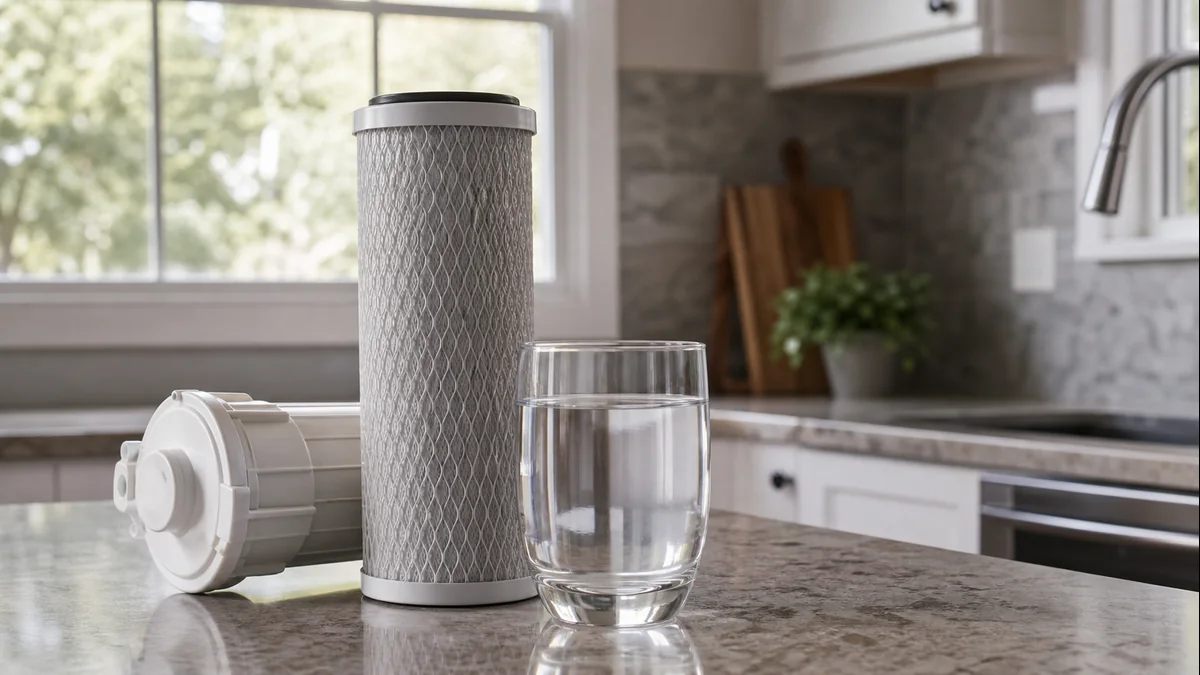
Activated carbon. It's the standard method for removing disinfection byproducts at the point of use — the compounds adsorb onto the carbon media as water passes through, the same mechanism that pulls out chlorine and chloramine taste.
| Compound | Raleigh 2025 CCR (top of range) | EPA MCL | Removed by carbon? |
|---|---|---|---|
| TTHM | 42.8 ppb | 80 ppb | Yes |
| HAA5 | 33.6 ppb | 60 ppb | Yes |
| Chlorine/chloramine taste | — | MRDL 4.0 mg/L | Yes |
A water softener does none of this — it's ion exchange built for calcium and magnesium, with no mechanism for organic compounds. An all-in-one whole-home system built for Raleigh pairs a carbon stage with softening resin, so one install handles the hardness case and the disinfection-byproduct case together.
Get the reading from your own Raleigh address, not just the system average
Raleigh Water's own report shows real TTHM and HAA5 above the system average in parts of the distribution network, and where you sit in that network depends on your address. Take the 60-second water quiz to see which all-in-one system fits your Raleigh home, or book a free water analysis for your own numbers. For the region-wide picture across Apex, Cary, and Durham, see what TTHM and HAA5 mean across the Triangle, or check is Raleigh tap water safe, or should I filter it anyway.
FAQ
I just moved to Raleigh and saw "TTHM" and "HAA5" on my Water Quality Report — should I be worried? Not panicked, but it's worth understanding. Raleigh's 2025 CCR shows TTHM reaching 42.8 ppb and HAA5 reaching 33.6 ppb in parts of the system — both real, detectable, and both under EPA's 80 and 60 ppb limits. Every Raleigh household has some level of both; a carbon stage is how you remove them rather than just track them.
My neighbor's water smells stronger of chlorine than mine right now — does that mean their TTHM/HAA5 levels are higher? Not necessarily. A stronger chlorine smell right now more likely points to Raleigh's annual free-chlorine conversion, which raises the chlorine residual system-wide for a few weeks and can vary block to block. TTHM and HAA5 levels are reported as a running average across the whole system, not a real-time reading tied to smell.
Is Raleigh's tap water actually dangerous because of these compounds? No — Raleigh Water reports no MCL violations for TTHM, HAA5, or anything else, so the water meets every legal standard that applies to it. Compliant isn't the same as zero, though, which is exactly why EPA regulates these compounds and why carbon filtration exists for households that want to go beyond the legal floor.
Does Raleigh's water softness or hardness have anything to do with these chemical levels? No, they're unrelated. Raleigh's hardness runs about 1.6 gpg — slightly hard on the WQA/Hach scale — which comes from dissolved calcium and magnesium. TTHM and HAA5 come from disinfectant reacting with organic matter in the source water. A softener handles the first; only carbon filtration handles the second.
Does boiling my Raleigh tap water get rid of TTHM or HAA5? No. Boiling is a fix for biological contaminants, not for disinfection byproducts, and it isn't a reliable way to reduce TTHM or HAA5 at home. Point-of-use activated carbon is the standard, tested method.
Will a whole-home softener installed at my Raleigh house also handle the TTHM and HAA5 in the CCR? No — a softener alone only addresses hardness through ion exchange; it has no effect on TTHM or HAA5. An all-in-one system pairs that softening resin with an activated carbon stage in a single install, so both the hardness and the disinfection-byproduct numbers in Raleigh's CCR get addressed at once.
Sources
- City of Raleigh Water — 2025 Consumer Confidence Report
- EPA — National Primary Drinking Water Regulations
Related reading: What Are TTHM and HAA5 Disinfection Byproducts in Triangle, NC Tap Water? | Why Does Raleigh Water Taste Different in Spring? | Raleigh Water Hardness | Is Raleigh Tap Water Safe, or Should I Filter It Anyway?
Answer nine practical questions, then request a written quote or well-water analysis.
Start My Water Analysis