
Trihalomethanes and Haloacetic Acids in Rolesville, NC Water — Where They Come From
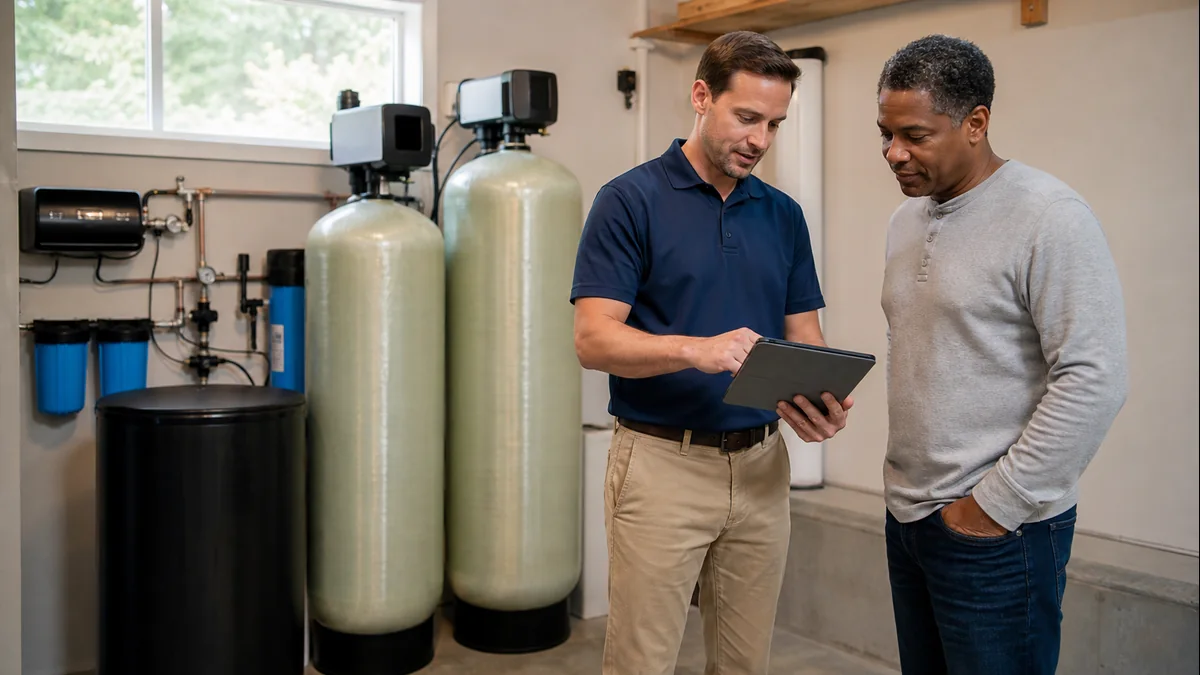
Direct answer: Rolesville is on Raleigh Water, whose 2025 report shows TTHM averaging 34.2 ppb (up to 42.8) and HAA5 averaging 22.0 ppb (up to 33.6) — both compliant with EPA's 80 and 60 ppb limits. Both form when disinfectant reacts with organic matter in the source water. A fridge or pitcher filter treats one glass at a time; a whole-home carbon stage treats every tap in the house.
Where do TTHM and HAA5 in Rolesville's water actually come from?
Rolesville doesn't run its own water plant — the town is on Raleigh Water, the same utility that also serves Raleigh, Garner, Knightdale, Wake Forest, Wendell, and Zebulon. Every figure in this article is Raleigh Water's own, applying system-wide to a Rolesville tap the same way it applies to a tap inside Raleigh proper.
Trihalomethanes and haloacetic acids form at the treatment plant, not in your pipes. Raleigh Water disinfects surface water with chloramine to kill bacteria and pathogens — a step that has to happen for the water to be safe to drink. That disinfectant then reacts with dissolved organic matter already present in the raw source water, things like decayed leaves and algae that any lake-fed system carries. That chemical reaction is what produces TTHM and HAA5. Neither compound is added on purpose, and neither is a sign the plant did something wrong.
Why doesn't Raleigh Water just remove the organic matter first?
It does, to a degree — treatment includes steps aimed at reducing organics before disinfection — but it can't eliminate all of it from lake-sourced water, and disinfection still has to happen regardless. The formation reaction also isn't confined to the plant. It keeps going, slowly, as water sits in pipes and storage tanks on its way to a Rolesville faucet, which is part of why utilities report TTHM and HAA5 as running averages across multiple points in the system rather than a single reading at the plant gate.
What does Raleigh Water's 2025 report actually show?
Raleigh Water's 2025 Consumer Confidence Report puts TTHM at an average of 34.2 parts per billion, reaching 42.8 ppb at some monitoring points. HAA5 averages 22.0 ppb, reaching 33.6 ppb. Both stay under EPA's Maximum Contaminant Levels of 80 ppb and 60 ppb, and Raleigh Water reports no violations for either.
| Compound | Raleigh Water 2025 average | Top of reported range | EPA MCL |
|---|---|---|---|
| TTHM | 34.2 ppb | 42.8 ppb | 80 ppb |
| HAA5 | 22.0 ppb | 33.6 ppb | 60 ppb |
EPA's National Primary Drinking Water Regulations table lists the potential health effects from long-term exposure above the MCL: for TTHMs, "Liver, kidney or central nervous system problems; increased risk of cancer." For HAA5, "Increased risk of cancer." Those effects describe exposure above the legal ceiling, over years — not Rolesville's current, compliant water. But "compliant" is a line EPA drew at its own risk tolerance, not a claim of zero exposure, and these are the exact compounds behind that line.
Does a fridge or pitcher filter in a Rolesville kitchen handle this?
Only for the water that passes through it. A Brita-style pitcher or a refrigerator's built-in filter uses a small carbon cartridge, and small carbon cartridges can reduce chlorine taste and some organic compounds in the water that flows through them — but that's one tap, filled a pitcher at a time, or one dispenser. Every other faucet, the shower, the washing machine, the water heater, and any ice maker not routed through that same fridge line, still receives Raleigh Water's water exactly as it left the treatment plant, TTHM and HAA5 included.
That's the practical limit of a point-of-use device: it was built to make drinking water taste better at a single spot, not to change what enters the house.
What does a whole-home carbon stage do that a point-of-use filter doesn't?
It treats water at the point it enters the house, before it splits off to any fixture. Activated carbon is the standard method for removing TTHM and HAA5 — the compounds adsorb onto the carbon media as water passes through it, the same mechanism a fridge filter uses on a smaller scale. The difference is placement and volume: a whole-home stage sits on the main line, so the reduction applies to every tap, the shower, the washer, and the water heater at once, instead of only the water that happens to pass through one cartridge.
| Fridge or pitcher filter | Whole-home carbon stage | |
|---|---|---|
| Coverage | One tap or dispenser | Every fixture in the house |
| Where it sits | At the point of use | At the main water line |
| Shower and bath water | Untreated | Treated |
| Water heater intake | Untreated | Treated |
| Cartridge size | Small, frequent swaps | Sized for whole-house flow |
An all-in-one whole-home system pairs that carbon stage with softening resin, so the same install that handles TTHM, HAA5, and chlorine taste also addresses the hardness minerals building up in fixtures and appliances — one system, both jobs, at every tap in a Rolesville home.
Does Rolesville's hardness have anything to do with TTHM and HAA5?
No — they're separate mechanisms sharing the same tap. Hardness comes from dissolved calcium and magnesium. Raleigh Water's 2025 report puts system-wide hardness at an average of 25.2 ppm, ranging from 21.9 to 35.3 ppm — roughly 1.3 to 2.1 grains per gallon, which is slightly hard on the WQA/Hach scale, not plain "hard."
TTHM and HAA5, by contrast, come from disinfectant reacting with organic matter and have nothing to do with mineral content. A softener's ion-exchange resin does nothing for either compound. That is exactly why the carbon side of a whole-home system exists as a separate stage.
See what's actually coming out of your Rolesville tap
Raleigh Water's system-wide report is the honest starting point, but a reading taken at your own address is what tells you what a whole-home carbon stage would remove at your fixtures specifically. Take the 60-second water quiz to see what fits your Rolesville home, or book a free water analysis and get that number directly — the fix is a free water analysis away, not a guess from a citywide average.
FAQ
I just moved to Rolesville and my new fridge has a water filter built in — do I still need anything else? For drinking water from that one dispenser, the fridge filter is doing some work. But it doesn't touch your shower, your washing machine, your water heater intake, or any other faucet in the house, all of which still receive Raleigh Water's TTHM and HAA5 unfiltered. A whole-home carbon stage is what covers the rest of the house.
My Rolesville water report shows TTHM under the limit — so why would I need to filter it at all? Because "under the limit" and "not present" aren't the same thing. Raleigh Water's 2025 report shows TTHM reaching 42.8 ppb and HAA5 reaching 33.6 ppb at some points in the system — both real, measurable, and both under EPA's ceiling. Carbon filtration removes them rather than counting on staying under that number.
Is Rolesville's water treated any differently than Raleigh's, since they're separate towns? No. Rolesville has no water plant of its own — it's part of Raleigh Water's system, the same source, treatment, and distribution network that serves Raleigh, Wake Forest, Garner, Knightdale, Wendell, and Zebulon. The 2025 CCR figures apply the same way across all of it.
Does boiling water get rid of TTHM before I drink it? Boiling isn't the tool for this job — it's a response to microbial contamination, not to water chemistry. Activated carbon is the established method for reducing TTHM and HAA5, which is precisely what the carbon stage of a whole-home system is built to do. Heat and filtration solve different problems.
What's the actual difference between HAA5 and HAA9? I've seen both terms. HAA5 is the five-compound group EPA regulates, with a 60 ppb legal limit — it's what Raleigh Water reports in its Consumer Confidence Report. HAA9 is a broader nine-compound sum some independent databases track, with no EPA limit attached to it at all. Never treat an HAA9 number as "compliant," since there's no legal ceiling for it to comply with.
Will installing a whole-home softener alone fix my TTHM and HAA5 numbers in Rolesville? No — a softener is ion-exchange resin built for calcium and magnesium, with no effect on TTHM or HAA5. An all-in-one system pairs that softening resin with a separate activated carbon stage, so one install covers both the hardness minerals and the disinfection byproducts in Raleigh Water's report.
Sources
- City of Raleigh Water — 2025 Consumer Confidence Report
- EPA — National Primary Drinking Water Regulations
Related reading: Water Treatment Company Near Me in Rolesville, NC | What Are TTHM and HAA5 Disinfection Byproducts in Triangle, NC Tap Water? | Does Activated Carbon Remove PFAS from Water? | Does Rolesville, NC Tap Water Have Pesticides or Atrazine in It?
Answer nine practical questions, then request a written quote or well-water analysis.
Start My Water Analysis