
Water Softener Installer Company in Apex, NC — What You'll Actually Receive
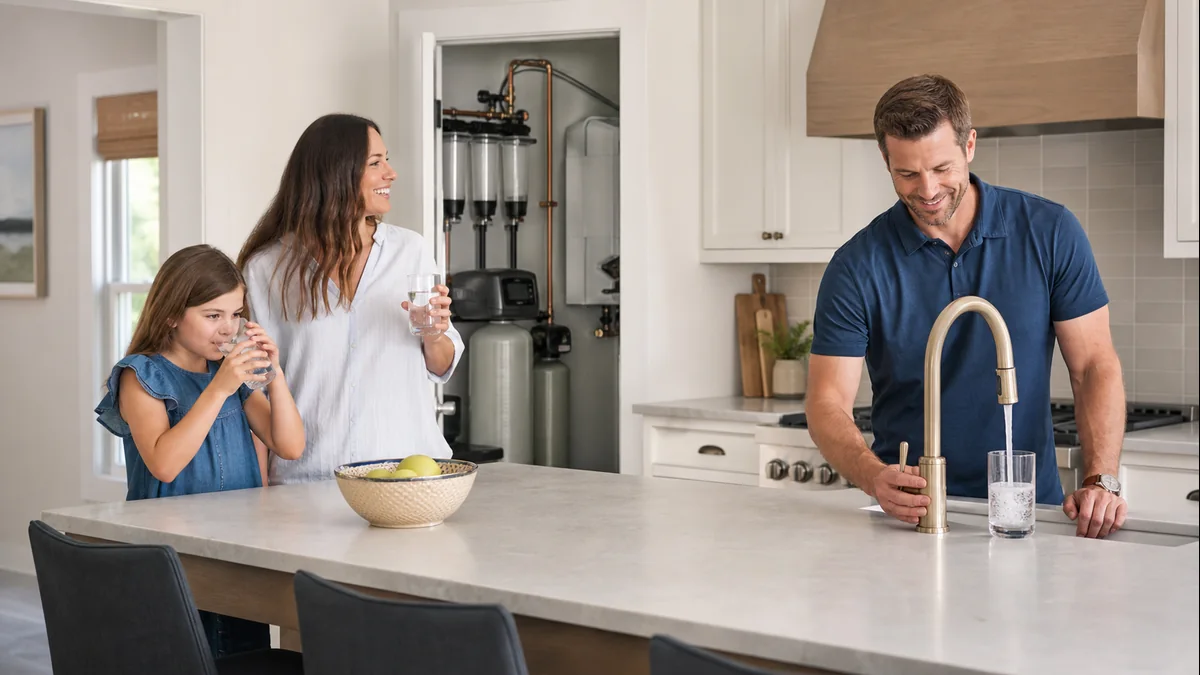
Direct answer: Triangle Waterworks installs water softeners in Apex, and the process starts with a free in-home water analysis at your address. Apex's own 2024 report puts hardness at 33.3 ppm, about 1.9 grains per gallon — "moderately soft" by the town's label, slightly hard on the Water Quality Association scale. Your system gets sized to that measured result, then professionally installed as an all-in-one softening-and-carbon unit.
What Does an Installer Company Do First, Before Anything Gets Installed?
The process starts at your address, not on a spreadsheet. Triangle Waterworks runs a free in-home water analysis that measures what's actually coming out of your Apex tap — hardness in grains per gallon, plus anything else the test picks up — before any system gets recommended or sized.
That order matters because sizing only means something once a real measurement exists behind it. The analysis comes first, the equipment recommendation follows from what it finds, and installation happens only once both of those are settled.
What Happens During the Free In-Home Water Analysis?
A technician tests your water at your own tap and walks your plumbing to see where a system fits — utility room, garage, or crawl space, depending on your home's layout. The reading from that test is what determines system sizing, not a townwide average or a catalog default.
Apex's own water travels through a shared system: B. Everett Jordan Lake supplies the Cary/Apex Water Treatment Facility, a plant Apex co-owns with Cary and that also serves Morrisville. What leaves that plant is a system average — what reaches your specific address can differ depending on where you sit in the distribution network, which is exactly why the in-home reading is the number your system gets built around.
What Does Apex's Own Water Quality Report Say About Hardness?
Apex's 2024 Annual Drinking Water Quality Report lists average total hardness at 33.3 ppm, which works out to roughly 1.9 grains per gallon. Apex's own report describes that figure as "moderately soft."
On the Water Quality Association scale — the same scale the Hach Total Hardness Test Kit, Model 5-B uses — 1.9 gpg falls inside the slightly hard band. Both labels describe the same measured water; they simply come from different classification scales, and neither one contradicts the other. How grain measurements translate into system sizing covers how that reading turns into a recommendation.
Softening Alone vs. an All-in-One System: What Gets Installed in Apex
| Softening Resin Alone | All-in-One System | |
|---|---|---|
| Handles hardness (calcium/magnesium) | Yes, through ion exchange | Yes, through ion exchange |
| Handles chlorine/chloramine taste | No | Yes, through a carbon stage |
| Handles disinfection byproducts | No | Yes, through the same carbon stage |
| Installed footprint | One unit | One unit, two stages |
| Sizing basis | Free in-home water analysis | Free in-home water analysis |
Triangle Waterworks installs the all-in-one configuration for Apex homes because hardness is only one part of what a water analysis at this address typically shows.
Why Does Apex's Disinfection Byproduct Data Matter Here?
Apex's 2024 report also measured total trihalomethanes (TTHM) at 41 ppb, with individual readings ranging up to 53 ppb — under the EPA limit of 80 ppb, so fully compliant. These byproducts form when the chloramine used to disinfect Jordan Lake water reacts with organic material as it moves through treatment and the distribution system.
EPA's National Primary Drinking Water Regulations table lists the potential long-term health effect of TTHM exposure above the legal limit as "Liver, kidney or central nervous system problems; increased risk of cancer." For HAA5, the listed effect is "Increased risk of cancer."
Apex's numbers sit under both limits, and that compliance is real — but it's a ceiling set by EPA's own risk tolerance, not a guarantee of zero risk. TTHM and HAA5 are the exact compounds EPA had in mind when it set that ceiling, which is why the carbon stage in your system removes them directly rather than relying on staying under a number. A closer look at Apex's TTHM and HAA5 data covers the full report.
Softening resin does nothing about any of this — it's built strictly for calcium and magnesium. The carbon stage in the all-in-one system is what handles chlorine taste, chloramine, and disinfection byproducts, in the same install as the softening side.
What Does Installation Day Actually Look Like?
Installation follows the sizing visit, usually as its own scheduled appointment. The system gets placed at the point where water enters your home, tied into your main line, and the control valve gets programmed to your household's actual water use rather than a factory default.
Before the crew leaves, you'll get a walkthrough of how the system runs day to day and what upkeep looks like going forward — set for your specific home based on what the water analysis found.
Details on the Apex installation process from start to finish covers the fuller step-by-step. Once you know what your system will cost to install, our Apex cost breakdown is the next step to check.
FAQ
I'm buying a house in Apex and want to know if it needs a system before I move in — how do I find out? Book the free in-home water analysis as soon as you have access to the property. It measures your actual tap reading rather than relying on the town's plant average, so you get a specific answer for that address instead of a general guess for the area.
I already had a softener installed somewhere else — can Triangle Waterworks still test my water and tell me if it's sized right? Yes. The free in-home water analysis measures your current tap water directly, which gives you a real number to compare against whatever your existing system was built for, regardless of who installed it.
How long does the whole process take, from first call to a working system? It depends on your home's layout and scheduling, but the general order is consistent: the water analysis happens first, the system gets sized from that reading, and installation follows as a separate scheduled visit. Ask for a specific timeline once your analysis is booked.
What's the difference between the softener you keep mentioning and the all-in-one system? A softener alone uses ion-exchange resin to remove calcium and magnesium — that's the hardness half. The all-in-one system adds a carbon filtration stage in the same install, which addresses chlorine taste, chloramine, and disinfection byproducts that softening resin was never built to touch.
Does the free water analysis come with any obligation to buy? No. It's free, and its purpose is to give you an accurate reading for your address so any decision that follows is based on your actual water, not a townwide average.
Why does Triangle Waterworks size the system after the water analysis? Because sizing is only accurate once the reading exists. Apex's own report shows a 33.3 ppm plant average, but individual addresses can differ, so the analysis at your tap is what the recommendation is actually built from.
Ready for Your Free In-Home Water Analysis?
The reading from your own tap is what determines everything that follows — sizing, installation, and how the system gets programmed for your household. Take the 60-second water quiz to get started, or book your free in-home water analysis with Triangle Waterworks directly.
Sources
- Town of Apex — 2024 Annual Drinking Water Quality Report
- EPA — National Primary Drinking Water Regulations
Related reading: Water Softeners in Apex, NC | Water Softener Installation in Apex, NC | Trihalomethanes and Haloacetic Acids in Apex, NC Tap Water | Water Softener Sizing by Grains | What Does a Water Softener Cost in Apex, NC?
Answer nine practical questions, then request a written quote or well-water analysis.
Start My Water Analysis