
What Does a Water Softener Maintenance Plan Look Like in Apex, NC?
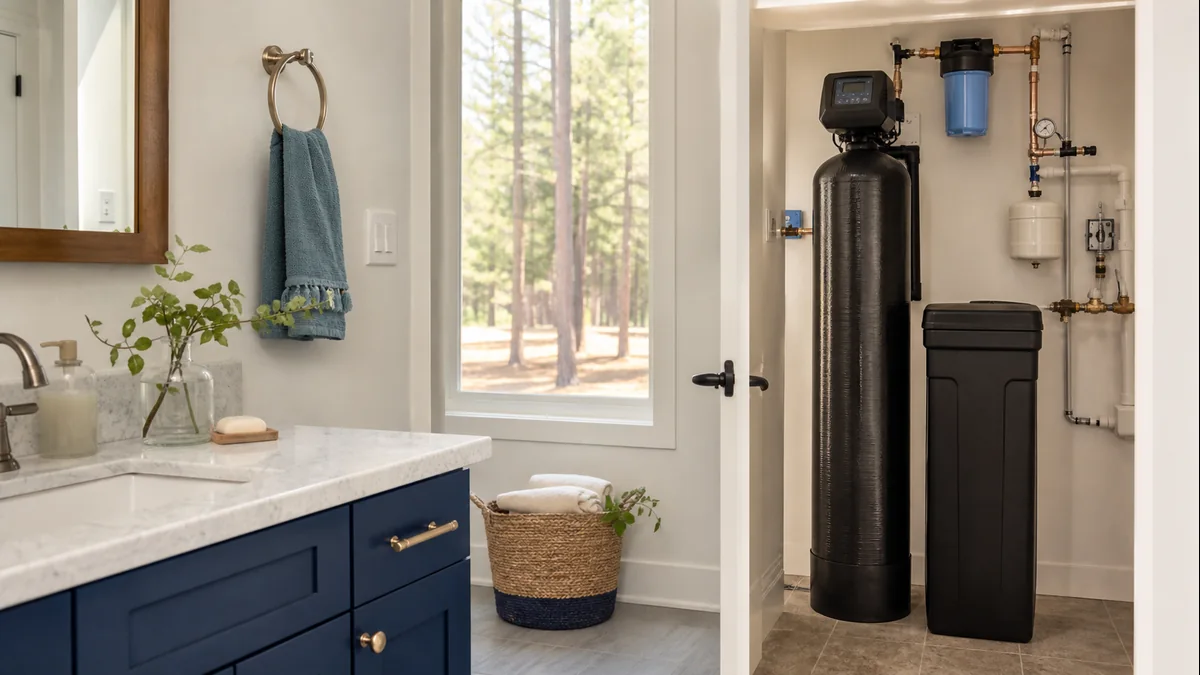
Direct answer: A maintenance plan for an Apex all-in-one system splits into two tracks: quick homeowner checks on the salt and brine tank, and technician work on the carbon stage and control valve. There's no universal calendar — your installer sets the actual schedule to your system, your household, and Apex's own measured water at install. The all-in-one design handles softening and chlorine/chloramine filtration together, so both tracks matter.
What does a maintenance plan for an Apex all-in-one system actually cover?
An all-in-one system runs two jobs at once, and each has its own upkeep. The softening side uses resin to exchange calcium and magnesium out of the water, and it needs salt and an occasional look at the brine tank. The carbon side adsorbs chlorine, chloramine, and disinfection byproducts, and it needs a technician to confirm it's still performing against your original water reading.
Neither task requires you to understand what's happening inside the valve. The homeowner side is a visual check. The technician side is a measurement — testing the water again and comparing it to what the system was set up to handle when it went in.
Who checks the salt and brine tank, and what are they actually looking for?
That part is yours. Salt should sit above the waterline, loose and granular, so water can move through it freely. Two things get in the way of that:
- A salt bridge — a hard crust forming above the water, leaving an empty pocket underneath. The tank can look full from the top while almost no brine is actually forming.
- Salt mush — salt breaking down into wet sludge at the bottom instead of dissolving cleanly, usually from humidity or the wrong salt type.
Either one is easy to break up and doesn't usually point to a bigger problem on its own. If spotting or weak lathering keeps showing up after you've cleared it and refilled with fresh salt, that's worth mentioning to your installer rather than working around it indefinitely.
What does Apex's own hardness number mean for how hard my system has to work?
The Town of Apex's 2024 Annual Drinking Water Quality Report lists average total hardness at 33.3 ppm, which the Town describes as "moderately soft." On the Water Quality Association scale the Hach Total Hardness Test Kit, Model 5-B uses, that same reading — about 1.9 grains per gallon — falls inside the slightly hard band, not soft. Both labels are accurate; they come from different scales measuring the same water.
Our own testing across Apex addresses runs 1.6 to 3.7 gpg depending on ZIP code, since a plant average and what actually reaches a given tap aren't the same thing.
At the low end that's slightly hard; at the top, around 3.7 gpg (roughly 63 mg/L), it crosses into moderately hard. Either way, a real, measurable hardness case — just not an extreme one, which is exactly why the softening side of your system doesn't have to work overtime here. See how Apex fits into the Triangle's broader hardness picture if you want the full local rundown before setting up a maintenance routine.
How does the carbon stage's job differ from the softening side?
The carbon stage isn't handling hardness at all — it's pulling chlorine, chloramine, and disinfection byproducts out of the water as it passes through. Apex's own 2024 CCR puts total trihalomethanes (TTHM) at 41 ppb, ranging up to 53 (legal limit 80), and haloacetic acids (HAA5) at 19 ppb, ranging up to 19 (legal limit 60) — both compliant, both real compounds a softener alone was never built to touch.
EPA's National Primary Drinking Water Regulations table lists TTHM's potential long-term health effect above the legal limit as "Liver, kidney or central nervous system problems; increased risk of cancer," and HAA5's as "Increased risk of cancer." Staying under those limits is a genuine compliance ceiling, not proof the compounds are absent — a carbon stage removes them directly rather than counting on staying under a number. See the full Triangle-wide disinfection byproduct picture for how TTHM and HAA5 form and why carbon filtration is the fix.
What happens during Apex's annual disinfectant switch, and does it affect my system?
Once a year, on the state's recommendation, the Cary/Apex Water Treatment Facility switches from chloramine to chlorine-only disinfection for a stretch and flushes the distribution system. Many homeowners notice a stronger, pool-like smell during that window. The Town posts the current dates on its own site rather than a fixed calendar, since timing shifts year to year — check there rather than assuming a set date.
If your carbon stage is keeping up, that smell tends to show up faintly or not at all even with a different disinfectant running. A noticeable break-through during that window is worth flagging at your next scheduled visit, since it's a useful real-world check on whether the carbon stage is still doing its job.
Homeowner tasks vs. technician tasks
| Task | Who handles it | What it involves |
|---|---|---|
| Check salt level, look for bridging or mush | Homeowner | A visual look — no tools, no schedule beyond what feels natural for your household |
| Refill salt | Homeowner | As needed, whenever the level runs low |
| Carbon stage performance check | Technician | Testing water against your original analysis, on the schedule set for your system at install |
| Control valve / regeneration settings | Technician | Confirmed against your actual household water use |
| Full system inspection | Technician | Set for your home at install, based on your water and your system |
Why does one all-in-one system beat maintaining a softener and a separate filter?
Running softening resin and carbon filtration in one unit means one set of homeowner checks and one technician relationship instead of two of each. Compare how a standalone softener stacks up against an all-in-one system if you're weighing which setup makes more sense for your home before you commit to either maintenance routine.
Consolidating also means the carbon stage and the softening resin get sized together against the same water reading, rather than two separate systems each guessing at what the other is handling.
Apex vs. a neighboring town — is the maintenance routine different?
The shape of the routine is the same across the service area — homeowner checks on salt, technician checks on the carbon stage and valve — but the specifics your installer sets depend on your measured water. See how a Cary maintenance plan compares if you're deciding between homes in different towns or just curious how the two profiles line up.
Keep the plan simple and let your installer set the specifics
An Apex maintenance plan doesn't ask much of you directly: watch the salt, glance at the brine tank, and let a technician handle the carbon stage and full inspection on the schedule set for your home. Learn more about installation in Apex if you're still deciding on a system, or take the 60-second water quiz to see what an all-in-one setup looks like for your address and get that schedule set for your actual water.
FAQ
I just had an all-in-one system installed in Apex — what should I actually be doing day to day? Almost nothing beyond a glance at the brine tank when you're already near it, checking that salt still sits above the waterline and looks loose rather than crusted. Your installer set the technician-side schedule for your specific system at install, so that part isn't something you need to track yourself.
How do I tell a salt bridge from a normal amount of salt sitting in the tank? A salt bridge is a hard crust sitting above the water level with an empty pocket underneath it — the tank looks full from the top while very little is actually dissolving into brine. Normal salt sits loose and granular and settles as it's used; if you're not sure which you're looking at, break it up gently and mention it at your next technician visit.
Apex calls its water "moderately soft" — does that mean my system barely has anything to do? Not quite. That figure, 33.3 ppm, works out to about 1.9 grains per gallon, which lands in the "slightly hard" band on the Water Quality Association scale the Hach test kit uses. Minerals at that level still accumulate on fixtures and inside a water heater over time, and our own address-level testing runs as high as 3.7 gpg depending on where you are in Apex.
My water smells noticeably different for a while each year — is that something I should call about? That's most likely Apex's annual switch from chloramine to chlorine-only disinfection, a real event the Town runs and posts dates for on its own site. A working carbon stage usually keeps that smell from breaking through strongly; if it does come through noticeably, mention it at your next scheduled visit.
What exactly does the carbon stage do, and is that something I maintain myself? It adsorbs chlorine, chloramine, and disinfection byproducts like TTHM and HAA5 as water passes through — a job the softening resin never touches. Confirming it's still performing means testing the water against your original analysis, which is technician work done on the schedule set for your system.
Is there a risk in skipping a scheduled professional visit if nothing seems obviously wrong? The visit is the one check that actually measures performance against your original water analysis rather than relying on how things look or taste. Skipping it means drift — softening or carbon performance easing off over time — can go unnoticed longer than it needs to, so it's worth keeping once your installer has it scheduled.
Sources
- Town of Apex — 2024 Annual Drinking Water Quality Report
- EPA — National Primary Drinking Water Regulations
Answer nine practical questions, then request a written quote or well-water analysis.
Start My Water Analysis