
Does Soft Water Protect Appliances in Apex, NC?
Direct answer: Apex's 2024 water quality report puts hardness at 33.3 ppm — about 1.9 grains per gallon, which the Town calls moderately soft and the Water Quality Association scale classifies as slightly hard. That mineral load still accumulates on heating elements and inside your water heater over years. Apex's water also carries trihalomethanes ranging up to 53 ppb. An all-in-one softening-and-carbon system addresses both.
What Does Apex's Own Water Report Say About Hardness?
Apex's 2024 Annual Drinking Water Quality Report lists average total hardness at 33.3 ppm, which converts to about 1.9 grains per gallon. The Town describes that as "moderately soft."
On the Water Quality Association scale the Hach Total Hardness Test Kit, Model 5-B uses, 1.9 gpg falls inside the slightly hard band (1.0–3.5 gpg), not the soft range. Both labels are accurate — they're measuring the same water on different scales, and naming the scale is what lets you check the math yourself. See the full picture of softening options for Apex homes for how that range plays out at the tap.
Apex draws its water from B. Everett Jordan Lake, treated at the Cary/Apex Water Treatment Facility, which Cary operates on Apex's behalf. That's the same regional source and treatment train serving Cary and Morrisville, so the hardness and TTHM figures in Apex's own report reflect a shared system rather than something unique to one street or subdivision.
How Does Scale Actually Accumulate Inside Appliances?
Calcium and magnesium don't disappear once water leaves the tap — they stay dissolved until heat or evaporation forces them out of solution. Inside a water heater, that happens continuously: minerals settle out of the water as it's heated and build up on the heating element and along the tank walls.
The same process happens on a smaller scale inside a dishwasher and washing machine, anywhere hot water sits or evaporates repeatedly. It's a gradual, cumulative buildup — even at Apex's moderately soft/slightly hard hardness range, it adds up over years of daily use rather than showing up all at once.
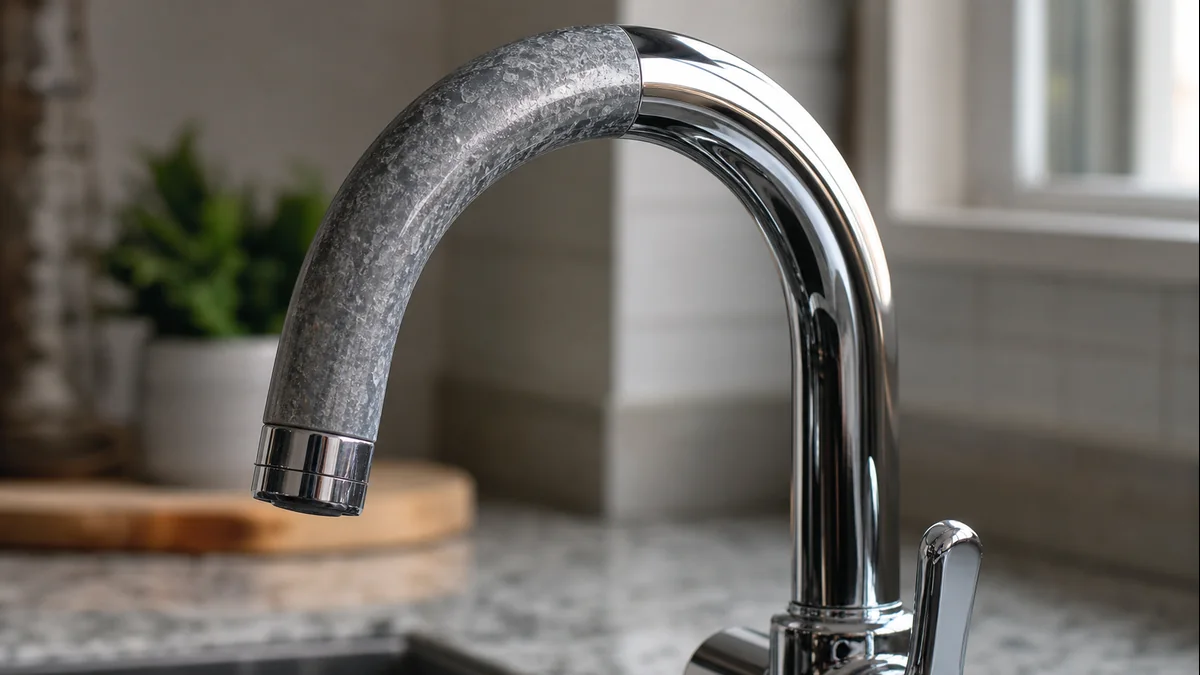
Left unaddressed, that buildup often shows up first as a white or chalky crust on visible surfaces — around a faucet aerator, inside a kettle, or on a showerhead. That visible crust is a sign of the same mineral accumulation happening less visibly inside the water heater tank and appliance components you can't see.
Why Does Apex's Water Need More Than Just Softening?
Softening addresses hardness, but Apex's water carries something a softener alone does nothing about. The Town's 2024 report measured trihalomethanes (TTHM) averaging 41 ppb and ranging up to 53 ppb — under the EPA's 80 ppb limit, but a real, measurable level of a byproduct formed during disinfection.
EPA's National Primary Drinking Water Regulations table lists TTHM's potential long-term health effect above the legal limit as "Liver, kidney or central nervous system problems; increased risk of cancer."
Apex's water is legally compliant — but "legally compliant" is a ceiling set by EPA's own risk tolerance, not a guarantee of zero risk. Those are the exact compounds and effects EPA had in mind when it set that ceiling, and a carbon stage removes them directly rather than relying on staying under a legal number. Read the full disinfection byproducts explainer for the Triangle or the Apex-specific breakdown of TTHM and HAA5 for more on where these compounds come from.
What Else Shows Up in Apex's Own Water Report?
Apex's 2024 report also tracks disinfectant levels, since the Town normally disinfects with chloramine and periodically switches to free chlorine to flush the distribution system, a routine step municipal systems use to maintain water quality. Both disinfectants do their job, and both are part of why TTHM forms in the first place — it's a byproduct of the same disinfection process that keeps the water safe to drink.
The same report lists PFOS, PFOA, PFHxS, PFNA, and PFBS as all non-detect for Apex. That's a genuinely good result for those specific compounds, and it doesn't change the case for TTHM, which is a separate, measured level in the same report. A carbon stage certified for the job addresses both: it's the same equipment doing the work whether the compound in question is present at a low level or not detected at all.
Softening Alone vs. an All-in-One System: What's the Difference for Your Home?
| What It Handles | Softening-Only System | All-in-One System (Softening + Carbon) |
|---|---|---|
| Scale on the water heater's element and tank | Yes | Yes |
| Scale on dishwasher and washer components | Yes | Yes |
| Chlorine or chloramine taste and smell | No | Yes |
| Trihalomethanes (TTHM) and other disinfection byproducts | No | Yes |
| One system, one install for both jobs | No — a second stage would be separate equipment | Yes |
What Does an All-in-One System Actually Change Day to Day in Apex?
A whole-home system is matched to your address through a free water analysis, then installed to treat every tap in the house rather than a single faucet. It's sized to what your water actually measures, not to a citywide average.
Once it's running, the day-to-day change shows up in a few places at once:
- The water heater's element and tank stop accumulating new mineral scale
- The dishwasher and washer keep running without mineral deposits building on internal components
- Chlorine or chloramine taste and smell are pulled out at the carbon stage
- TTHM and other disinfection byproducts are addressed rather than left in the water
See what installation actually involves for an Apex home once you're ready to move forward.
FAQ
I just had a new water heater installed in Apex — does the hardness here actually matter enough to worry about? It's worth accounting for. Apex's own hardness figure is slightly hard on the Water Quality Association scale, and mineral scale accumulates gradually inside a water heater regardless of the unit's age. Treating the water before it reaches the tank is what prevents that buildup from starting.
Apex calls its water moderately soft — so why would I need anything more than a basic filter? Hardness and disinfection byproducts are two separate issues. Even at a moderately soft/slightly hard hardness level, Apex's own 2024 report measured TTHM up to 53 ppb, which a basic sediment filter or a softener alone won't remove — that's specifically what the carbon stage in an all-in-one system is built to handle.
Is Apex's TTHM level actually a violation of any kind? No. Apex's TTHM result is compliant with the EPA's 80 ppb limit. Compliance means the water meets the legal ceiling, which is set at the edge of EPA's own acceptable risk tolerance — it isn't the same as zero TTHM in the water.
My dishwasher has spots and film on glasses even though Apex's hardness sounds low — is that normal? It can happen at any hardness level above soft, including Apex's slightly hard range on the WQA scale. A free water analysis at your address confirms exactly what your dishwasher is dealing with rather than relying on the town's average.
Does a softener by itself take care of everything in Apex's water? No — a softener only exchanges calcium and magnesium for hardness. It does nothing about chlorine, chloramine taste, or disinfection byproducts like TTHM, which is why the carbon stage in an all-in-one system covers what softening alone leaves out.
How is a system actually sized for my home instead of just Apex's published average? Through a free in-home water analysis that measures what's coming out of your own tap. That reading — not the Town's citywide report — is what the system gets matched to.
Protect Your Home's Appliances With a Free Water Analysis
Mineral scale and disinfection byproducts are both worth addressing now, before years of buildup add up inside your water heater, dishwasher, and washer. Take the 60-second water quiz to see how an all-in-one softening-and-carbon system fits your Apex home, or book a free in-home water analysis with Triangle Waterworks.
Sources
- Town of Apex — 2024 Annual Drinking Water Quality Report
- EPA — National Primary Drinking Water Regulations
Answer nine practical questions, then request a written quote or well-water analysis.
Start My Water Analysis