
Is a Water Softener Worth It in Durham, NC?
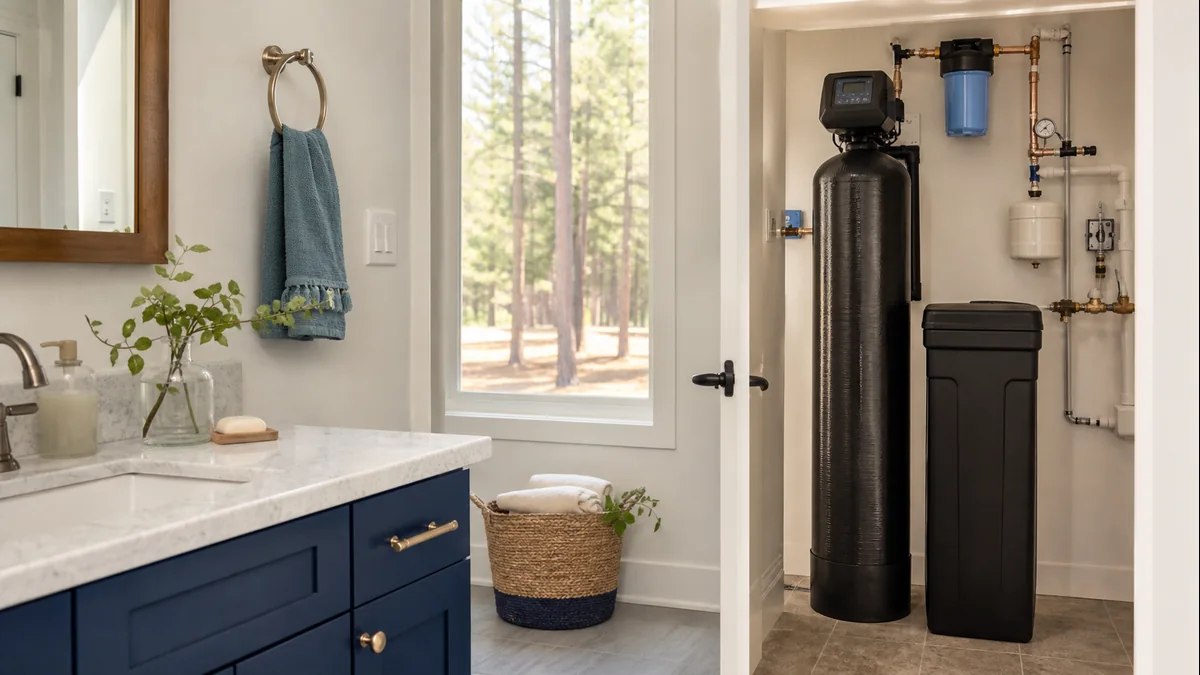
Direct answer: Yes — in Durham, the strongest case is for the all-in-one system rather than a softener alone. Durham's own 2025 water quality report shows disinfection byproducts up to 56 ppb TTHM and 49 ppb HAA5, plus PFAS, none of which a softener touches. Durham publishes no hardness figure, so a free in-home test settles that side while a carbon stage handles the rest today.
Is a Water Softener Worth It in Durham, NC?
A standalone softener answers exactly one question: how much calcium and magnesium is in the water. It's ion-exchange resin, and it does that one job well. But Durham's own water quality data points to a second problem a softener never addresses — disinfection byproducts and PFAS that pass straight through an ion-exchange system untouched.
That's why the honest answer for a Durham home is the all-in-one system: softening resin paired with a carbon filtration stage in a single install. It covers the mineral side and the contaminant side at once, sized to your home after a free in-home water analysis. See how a softener alone compares to the all-in-one system if you're weighing the two.
What Does Durham's Own 2025 Water Quality Report Show?
Durham draws from Lake Michie and the Little River Reservoir, treated at the Williams and Brown plants. Its 2025 Annual Drinking Water Quality Report lists total trihalomethanes (TTHM) at a highest locational running annual average of 56 ppb, against an EPA limit of 80. Haloacetic acids (HAA5) come in at a highest LRAA of 49 ppb, against a limit of 60.
Both figures are legally compliant — Durham is not in violation of anything. The report also shows PFOA up to 5.7 ppt and PFOS up to 7.2 ppt, chlorine running an average of 0.63 ppm, and chloramines at 1.5 ppm. Atrazine and simazine were sampled quarterly in 2025 and came back non-detect both times. Durham also purchased water from the Town of Cary during the reporting year.
Our guide to reading Durham's water quality report walks through every line of that document if you want the full picture, not just the softener-relevant parts.
Why Do Disinfection Byproduct Levels Matter, Even When They're Compliant?
TTHM and HAA5 form when chlorine-based disinfectants react with organic matter in surface water sources like Lake Michie and the Little River Reservoir. EPA regulates both because of specific, documented health effects at long-term exposure above the legal limit. For TTHMs, EPA's own listed effect is "Liver, kidney or central nervous system problems; increased risk of cancer." For HAA5, it's "Increased risk of cancer."
Durham's 56 ppb and 49 ppb sit under those limits, which is exactly what "compliant" means. But compliant is a ceiling EPA set based on its own risk tolerance — not a promise of zero exposure. These are the exact compounds and exact effects EPA had in mind when it drew that line at 80 and 60 ppb. The Triangle-wide guide to disinfection byproducts covers how TTHM and HAA5 form and why carbon is the fix, not just the flag.
A carbon filtration stage removes these compounds at the tap rather than relying on staying under a legal number. That's the case for addressing it now instead of treating "compliant" as "solved."
Does Durham Have Hard Water?
Durham does not publish a hardness figure of its own — its 2025 report, like its prior reports, contains none. That's a real gap, not a sign the water is soft; it just means there's no town number to cite either way for a Durham address.
The only way to know a specific home's number is a free in-home water test. Since Durham purchased water from Cary during the reporting year, a household's hardness can vary depending on where in the distribution system that water traveled — another reason a town-wide average, even where one exists, doesn't answer the question for your tap.
What Happens to Plumbing and Appliances Over Years of Mineral Exposure?
Calcium and magnesium don't disappear after a single wash cycle or a single fill of the water heater — they're present in every gallon that runs through the house, and what they leave behind accumulates. Deposits build gradually on fixtures, inside pipes, and on heating elements, the same way scale builds in a kettle over repeated use.
That buildup is cumulative rather than sudden, which is part of why it's easy to underestimate: a few months of mineral exposure looks like nothing, but years of it is a different picture. Softening resin removes calcium and magnesium through ion exchange before that buildup has a chance to start.
Is a Softener Alone Enough for Durham Water?
A softener alone solves the mineral side completely — that's genuinely all it's designed to do. What it doesn't do is touch chlorine or chloramine taste, PFAS, or the TTHM and HAA5 levels documented in Durham's own report.
Softeners are ion exchange for calcium and magnesium only. Removing PFAS or disinfection byproducts requires carbon rated for that purpose, or reverse osmosis. Boiling doesn't remove PFAS and can actually concentrate it, so it's not a substitute either. A softener installed by itself in Durham leaves the second half of the water-quality picture untouched.
Softener Alone vs. All-in-One System: How Do They Compare in Durham?
| Softener Alone | All-in-One System | |
|---|---|---|
| Calcium/magnesium (hardness) | Removed | Removed |
| Chlorine/chloramine taste and smell | Not addressed | Removed by carbon stage |
| TTHM / HAA5 | Not addressed | Reduced by carbon stage |
| PFAS | Not addressed | Addressed by PFAS-rated carbon |
| Installation | Single unit | Single install, both stages |
| Sizing | Free in-home analysis | Free in-home analysis |
What About Durham's PFAS Levels and the Chlorine/Chloramine Taste?
Durham's report shows PFOA up to 5.7 ppt and PFOS up to 7.2 ppt. Removing PFAS from water at the tap needs carbon certified for that purpose (NSF/ANSI 53 or P473) or reverse osmosis certified to NSF/ANSI 58 — not a softener, and not boiling, which can concentrate PFAS rather than removing it.
The report's chlorine and chloramine numbers — 0.63 ppm and 1.5 ppm respectively — are also what a taste or odor complaint at the tap usually traces back to. A carbon stage addresses both the PFAS and the taste and smell in the same pass, which is the case for the carbon half of the all-in-one system regardless of what a home's hardness reading turns out to be. Durham's PFAS picture in full covers where these compounds come from and what removes them.
What Does the Free In-Home Water Analysis Cover?
The analysis is where the mineral question gets answered for your specific address rather than left as a town-wide unknown. It measures your home's actual hardness, and from there the all-in-one system gets sized to what that test finds — not a guess and not a borrowed number from a neighboring town's report.
The upkeep that follows is straightforward: someone keeps the salt supply stocked on the softening side, and the schedule for that gets set at install based on the home's actual usage, not a generic interval. Nothing about ownership is complicated once the system is sized correctly.
Is It Worth Installing Before I Know My Exact Hardness Number?
Yes — the carbon case doesn't wait on a hardness reading. Durham's TTHM, HAA5, and PFAS figures are already documented in the town's own report regardless of what a specific home's mineral content turns out to be. The free analysis fills in the hardness half of the picture at the same visit, so there's no reason to delay the carbon side while waiting to learn a number.
FAQ
I just moved to Durham and don't know if my water is hard — where do I even start? Start with a free in-home water analysis. Durham doesn't publish a hardness figure the way some neighboring towns do, so a test at your own address is the only way to get a real number instead of guessing. Our guide for new Durham residents covers what else to check when you move in.
Does Durham's water quality report show any hardness number I can use? No — Durham's 2025 report, like its previous reports, doesn't include a hardness figure. That's a genuine gap in what the town publishes, not a hidden "soft" or "hard" answer. A free in-home test is the only way to get a number for your address.
My tap water tastes like chlorine some weeks and not others — is that connected to what's in Durham's report? Likely yes. Durham's report lists chlorine at a 0.63 ppm running average and chloramines at 1.5 ppm, and taste or smell that comes and goes is a common way that shows up at the tap. A carbon stage addresses that directly.
Does a softener remove the PFAS or disinfection byproducts Durham's report lists? No. Softeners are ion exchange for calcium and magnesium only — they don't remove PFAS, TTHM, or HAA5. Removing those requires carbon rated for the purpose, or reverse osmosis, which is why the all-in-one system pairs both stages in one install.
What's the actual difference between a softener alone and the all-in-one system for a Durham home? A softener alone handles minerals and stops there. The all-in-one system adds a carbon stage that also addresses chlorine/chloramine taste, PFAS, and the disinfection byproducts documented in Durham's own report — one install instead of two separate problems.
I'm just weighing whether this is worth doing now — what's the actual next step? A free in-home water analysis. It measures your home's hardness and confirms how the all-in-one system should be sized, so you're working from your own numbers instead of a town average or a guess.
Get a Free Water Analysis for Your Durham Home
Durham's own report already lays out the contaminant case; the only piece missing for your address is the hardness number, and that's free to get. Take the 60-second water quiz to see how the all-in-one system fits your Durham home, or book a free in-home water analysis with Triangle Waterworks.
Sources
Related reading: How to Read Your Water Quality Report in Durham, NC | PFAS and Forever Chemicals in Durham, NC | Water Softener vs. All-in-One System | Just Moved to Durham, NC — What to Know About Your Water | Disinfection Byproducts Explained for the Triangle
Answer nine practical questions, then request a written quote or well-water analysis.
Start My Water Analysis