
Does Apex NC Tap Water Have Pesticides?
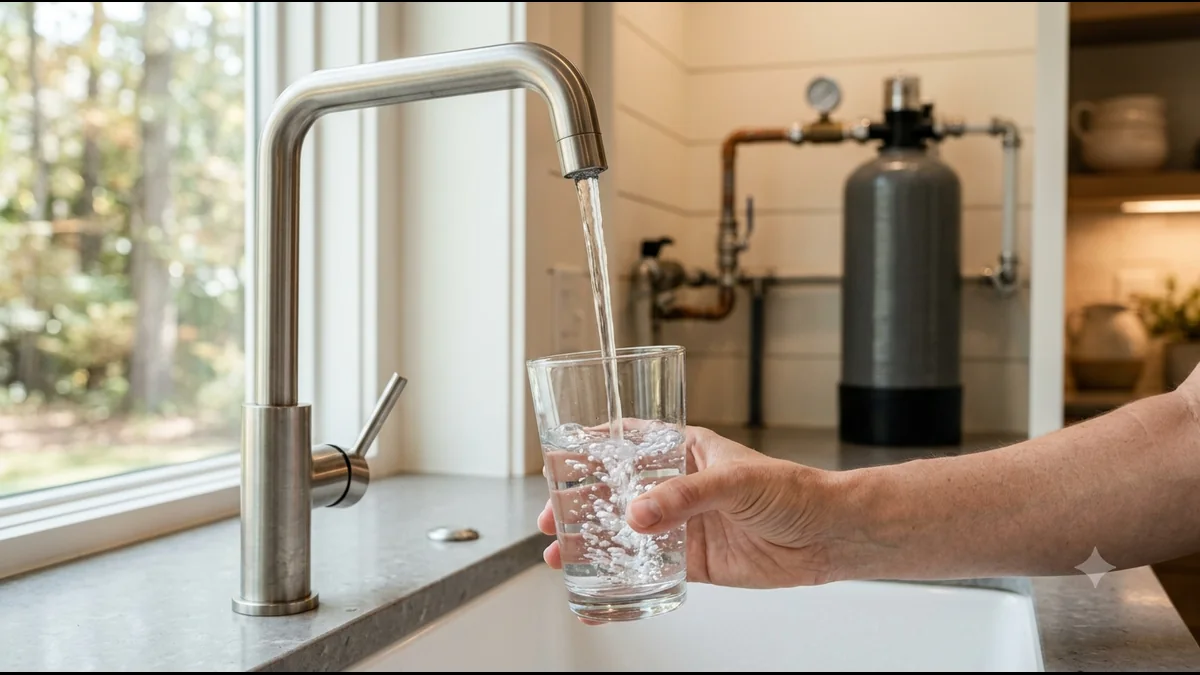
Direct answer: No — Apex's 2024 Annual Drinking Water Quality Report lists no detected atrazine, simazine, or other pesticide/herbicide anywhere in its contaminant tables. The Cary/Apex Water Treatment Facility already doses raw Jordan Lake water with activated carbon before it's even filtered. The same report shows real disinfection byproducts and trace PFAS that survive that process — a whole-home carbon stage at your tap picks up where the plant leaves off.
Does Apex NC tap water have pesticides in it?
No, based on Apex's own current testing. Apex's 2024 Annual Drinking Water Quality Report states its tables list only substances actually detected during the year's testing, and no atrazine, simazine, or other pesticide or herbicide appears anywhere in that report.
Apex routinely monitors for over 150 contaminants under federal and state law, and the synthetic organic contaminant category — which includes atrazine and simazine — came back clean for 2024. That's the same result Cary reported for its own separate 2025 testing on the shared source, for what it's worth, though each town publishes its own independent numbers.
How does the Cary/Apex Water Treatment Facility already fight contaminants before water reaches your tap?
The plant treats raw Jordan Lake water with powdered activated carbon at the very first step. Apex's own report describes it directly: "Powdered activated carbon is added to our source water, Jordan Lake, and is pumped to our Cary/Apex Water Treatment Facility where additional powdered activated carbon may be added."
From there, water goes through ozonation to oxidize organics and treat taste and odor, coagulation with alum and polymer, clarification, a second optional ozonation step, chlorine disinfection, filtration through sand and carbon, fluoride and pH adjustment, and finally chlorine and ammonia combined in the clearwell to form chloramines for distribution.
Activated carbon isn't a home-filtration concept the plant is unaware of — it's already the plant's own first and one of its last lines of defense, which is exactly the principle a home carbon stage extends.
What does Apex's own 2024 water quality report show for pesticides and herbicides?
Clean on pesticides specifically, alongside real numbers for the contaminants that make it through treatment and into the distribution system.
| Substance | Apex's 2024 result | Federal limit | Where it stands relative to the plant |
|---|---|---|---|
| Atrazine / simazine | Not detected (no line in report) | 3 ppb / 4 ppb | Handled by the plant's carbon dose |
| TTHM | 41 ppb, ranging to 53 | 80 ppb | Forms after disinfection, measured in distribution |
| HAA5 | 19 ppb (range 8–19) | 60 ppb | Same — a disinfection byproduct, not a plant failure |
| PFBA / PFHxA (PFAS) | 3.8 ppt / 3.65 ppt | Not individually regulated | Plant carbon reduces PFAS; some still measurable |
| PFOS, PFOA, PFHxS, PFNA, PFBS | Not detected | 4 ppt each | Below detection in 2024 |
The pattern is consistent with Cary's report on the same source: pesticides tested clean, while chlorine byproducts and a couple of PFAS compounds are present at low, compliant levels.
If the treatment plant already uses carbon, why would I need a carbon stage at home too?
Because TTHM and HAA5 are a byproduct of the disinfection step, not a contaminant the plant failed to filter out — they form when chlorine or chloramine reacts with organic matter, and that reaction continues after water leaves the plant and travels through the distribution system. Apex's report identifies both as "byproduct of drinking water disinfection" and samples them at multiple points across the system, not just at the plant gate.
EPA's National Primary Drinking Water Regulations table lists the potential health effect from long-term exposure above the MCL as "liver, kidney or central nervous system problems; increased risk of cancer" for TTHM, and "increased risk of cancer" for HAA5. Apex's 41-to-53 ppb TTHM range is legally compliant — and it's also exactly the compound EPA had in mind when it set that 80 ppb ceiling using its own risk tolerance, not a promise of zero exposure.
A carbon stage at your own tap removes what forms between the plant and your faucet — water the plant's own upstream carbon dose never had the chance to treat.
What else shows up in Apex's report that a plant-level carbon dose doesn't erase?
Hardness. Apex's report classifies its water as "moderately soft" at an average of 33.3 ppm (1.9 grains per gallon) — the plant doesn't treat for hardness at all, since powdered activated carbon targets organics and taste/odor compounds, not dissolved calcium and magnesium.
Triangle Waterworks measures 1.6 to 3.7 grains per gallon across the wider service area in its own testing, slightly hard to moderately hard on the WQA/Hach scale, and Apex sits toward the higher end of that measured range.
That's a genuine, verifiable case for a softening stage alongside carbon — not a contradiction of Apex's "moderately soft" classification, just a different measurement point (your tap, not the plant average) and a different scale (the WQA/Hach scale the industry's own test kits use).
Where can I see Apex's full water quality report myself?
Apex's Annual Drinking Water Quality Report is posted at apexnc.org under the Water Quality section, and it notes that the fuller Cary Consumer Confidence Report — covering additional detail on the shared facility — is available at carync.gov/waterreport. Both are published annually and cover the prior calendar year's testing.
A town-wide report is an average across the whole distribution system. If you want to know what's actually reaching your specific address, especially for hardness, a free water analysis tests your own tap rather than the system-wide number.
Ready to see what's actually reaching your Apex tap?
Apex's pesticide results are clean, and the plant's own carbon dose is doing real work upstream — the disinfection byproducts and hardness that form and accumulate after that point are worth addressing now, not living with. Take our 60-second water quiz to see which all-in-one system fits your home, or book a free water analysis for your own address.
FAQ
I just moved to Apex and someone told me the water comes straight from a lake with farm runoff — should I worry about pesticides specifically? Apex's 2024 report shows no detected atrazine, simazine, or other pesticide, so that specific worry doesn't hold up against the town's own current testing. Jordan Lake is monitored closely because of its agricultural watershed, which is why this category gets tested every year rather than assumed safe.
Why does Apex's report show TTHM at 41 to 53 ppb if the plant treats the water with carbon at the start? Because TTHM forms from the reaction between disinfectant and organic matter, and that reaction continues in the pipes after treatment, not just at the plant. The plant's upstream carbon dose reduces organics before disinfection, but it can't remove a byproduct that hasn't formed yet — a home carbon stage catches what forms downstream.
Is Apex's water considered hard, and is that connected to the pesticide testing at all? The two are unrelated — hardness is calcium and magnesium, not agricultural chemicals. Apex's report classifies its water as "moderately soft" at 1.9 grains per gallon, and Triangle Waterworks measures up to 3.7 grains per gallon across the service area on the WQA/Hach scale, which is a real reason to consider softening regardless of the clean pesticide result.
Does the plant's carbon treatment mean PFAS is completely gone from Apex's water? Not completely — Apex's 2024 report shows PFBA at 3.8 ppt and PFHxA at 3.65 ppt, both below any individual regulatory limit but still measurable, while PFOS, PFOA, and several others came back non-detect. The plant's carbon dose reduces PFAS significantly; it doesn't guarantee zero, which is the same logic that applies to a home carbon stage.
How often does Apex actually test for atrazine and other pesticides? Synthetic organic contaminants are part of Apex's required annual monitoring, though EPA permits some substances to be tested less than once a year when concentrations aren't expected to vary much year to year. Apex's report discloses this directly, so a clean result reflects testing done within that required schedule.
I have well water outside Apex's service area — does this report tell me anything about my water? No — Apex's report only covers water tested at the shared Cary/Apex facility and its distribution system, and North Carolina doesn't regulate private well water after construction. A free water analysis is the only way to know what's actually in a specific well.
Sources
- Town of Apex — Annual Drinking Water Quality Report
- EPA — National Primary Drinking Water Regulations
Related reading: Do Triangle NC Tap Water Systems Have Pesticides or Herbicides? | Does Cary NC Tap Water Have Pesticides or Atrazine? | Water Softener in Apex, NC | PFAS & Forever Chemicals in Apex, NC | Best Whole-Home System for Cary, Apex, and Morrisville
Answer nine practical questions, then request a written quote or well-water analysis.
Start My Water Analysis